Summary
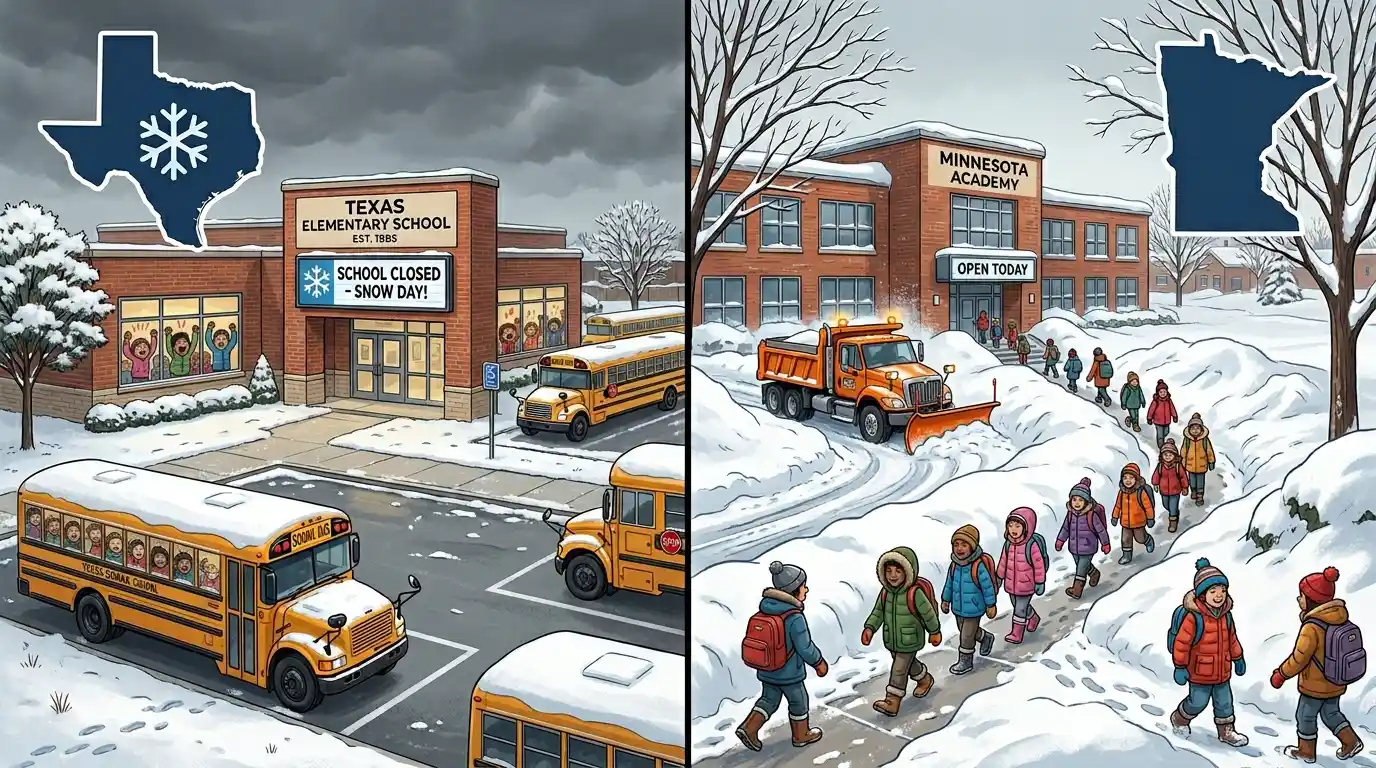
This article Why Texas Schools Close With Less Snow explores the fascinating and often misunderstood reason why Texas schools close with just a light dusting of snow while schools in Minnesota or Michigan power through blizzards with a foot of snow. It digs into infrastructure limitations, driver inexperience, road treatment capacity, climate adaptation, and decision-making processes that make winter weather a genuine public safety emergency in the South — even when it barely registers on a snow gauge. Whether you’re a curious parent, a student, or a policy observer, this deep dive will change how you think about snow days.
Table of Contents
- Introduction: The Snow Day Paradox
- Texas vs. Northern States: The Numbers Don’t Lie
- Infrastructure Is Everything: Why Roads Are the Real Problem
- Salt, Sand, and Snow Plows: The Equipment Gap
- Driver Behavior and Winter Inexperience
- School Bus Safety and Fleet Preparedness
- Climate Adaptation: It’s Not Just About Snow Volume
- The Role of Ice vs. Snow in Southern Closures
- How School Districts Make the Call
- What Tools Help Predict School Closures?
- Texas Freeze Events: A Wake-Up Call
- What Northern States Do Differently
- Can Texas Schools Improve Their Winter Response?
- Conclusion
Why Texas Schools Shut Down With Less Snow Than Northern States
Every winter, social media erupts with the same debate. A photo surfaces: Texas schools closed. Two inches of snow on the ground. Meanwhile, a school in Buffalo, New York, is open during a full-blown blizzard. The comment sections rage. “Texans are soft.” “Northerners are crazy.” But the reality is far more nuanced — and far more interesting — than either camp admits.
Understanding why Texas and other Southern states cancel school with minimal snowfall requires looking beyond the snow itself. It requires examining road systems, public infrastructure, population preparedness, driver behavior, equipment availability, and even the physics of ice formation. When you lay it all out, the answer becomes crystal clear: it’s not about toughness. It’s about science, safety, and smart risk management.
Texas vs. Northern States: The Numbers Don’t Lie
Let’s start with raw data. Minneapolis, Minnesota, averages about 54 inches of snow per year. Buffalo, New York, can receive over 90 inches annually. Chicago, Illinois, regularly sees 36+ inches per season. These cities have entire ecosystems built around winter weather management.
Dallas, Texas? It averages less than 2 inches of snow per year. Houston? Even less. San Antonio has gone entire decades without measurable snowfall.
This disparity in snowfall frequency is the foundational reason behind every school closure decision. Cities that deal with snow regularly have invested billions of dollars in preparation. Cities that face it once or twice a decade — or once a generation — simply haven’t, and arguably shouldn’t have to.
Infrastructure Is Everything: Why Roads Are the Real Problem
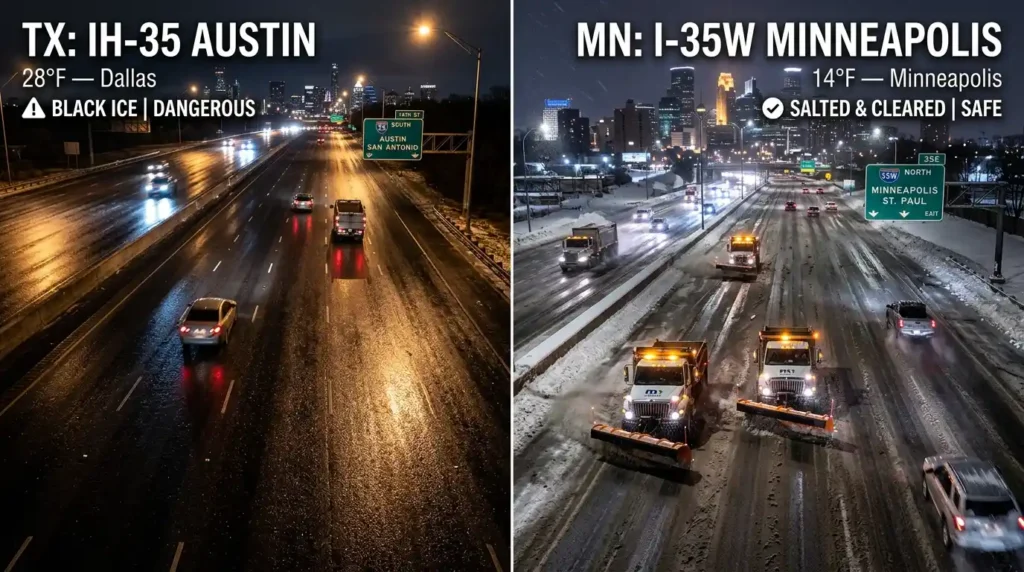
The backbone of any school closure decision is road safety — and road safety in winter weather is almost entirely dependent on infrastructure investment. Northern states have spent decades developing layered, redundant winter road management systems. Texas has not, for a very logical reason: it doesn’t need to most of the time.
Texas roads are engineered for heat management. They’re designed with materials and grades suited for 100°F summers, not sub-freezing winters. When temperatures drop and moisture falls, these road surfaces respond differently from northern pavement. Thermal expansion and contraction patterns differ. Drainage systems behave differently. The result is a road network that becomes significantly more dangerous with even a small amount of frozen precipitation than its northern counterparts.
Additionally, Texas has fewer divided highways with emergency pullouts in suburban and rural areas where ice accumulates fastest. Overpasses and bridges — abundant in Texas metro areas — freeze rapidly and create accident hotspots that Northern infrastructure is specifically designed to address.
Salt, Sand, and Snow Plows: The Equipment Gap
Here’s where the math becomes undeniable. The city of Chicago maintains a fleet of 285+ snow plows. New York City operates over 1,700 pieces of snow-fighting equipment. These cities pre-treat roads with liquid brine days before a storm even arrives.
Dallas? In a good year, the city might have 30 to 50 trucks capable of spreading salt or sand, and many of those are shared with other municipal functions. Houston has a similarly limited supply. The Texas Department of Transportation (TxDOT) has expanded its de-icing capabilities in recent years, but the coverage-per-square-mile ratio remains dramatically lower than that of states in the Frost Belt.
The brine pre-treatment process — standard in Minnesota, Wisconsin, and Ohio — prevents ice bonding to pavement. Without it, even a small rain-to-freeze event creates a skating rink across hundreds of miles of roadway. Texas cities rarely have the budget, the storage capacity, or the institutional knowledge to deploy brine treatment at scale.
When school administrators look at a 1-inch snowfall forecast in Dallas versus a 12-inch forecast in Detroit, they’re not comparing the same risks. Detroit’s 12 inches will be plowed, brined, and sanded before school buses roll. Dallas’s 1 inch may coat every untreated road surface with a thin, nearly invisible layer of ice, which is exponentially more dangerous.
Driver Behavior and Winter Inexperience
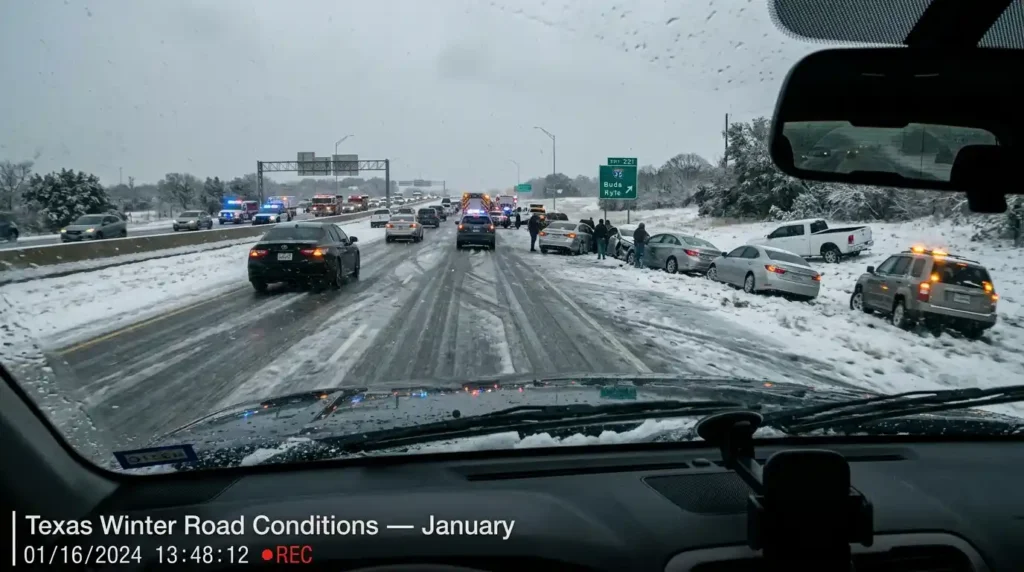
Infrastructure aside, one of the most significant — and least discussed — variables is driver skill in winter conditions. A driver in Minneapolis who has navigated icy roads every winter for 30 years has developed muscle memory for braking distances, steering corrections, and safe following distances on slick roads.
A Texas driver who encounters ice once every five years has none of that. Studies in traffic safety and human behavior consistently show that inexperienced winter drivers are involved in significantly more accidents per inch of snowfall than their northern counterparts. The Texas Department of Public Safety reports a dramatic spike in traffic accidents during even minor winter weather events.
This matters for school closures because school buses share roads with all these drivers. Even if the bus driver is skilled and the bus is safe, one out-of-control sedan can cause a fatal accident. School district risk assessors must account for the entire road ecosystem — not just their own vehicles.
School Bus Safety and Fleet Preparedness
Northern school districts equip their buses with snow chains, anti-lock braking upgrades, and winter-rated tires as standard procedure. Bus driver winter training is mandatory and annual in many Frost Belt states. Maintenance crews regularly inspect undercarriages for cold-weather mechanical failures.
Texas school buses typically run on all-season tires appropriate for the climate, which are not designed for snow or ice. Retrofitting hundreds or thousands of buses with winter tires and chains for a two-day weather event every few years is economically impractical. The result is a fleet that, while perfectly safe under normal Texas conditions, is not winter-capable.
Climate Adaptation: It’s Not Just About Snow Volume
Climate adaptation is the concept that communities develop systems, behaviors, and infrastructure suited to their typical climate conditions. This is entirely rational and economically efficient. You wouldn’t fault Phoenix for not having flood channels the size of Amsterdam’s, nor would you fault Amsterdam for not having Phoenix-style evaporative cooling systems.
Southern states like Texas, Georgia, Tennessee, and the Carolinas are climatically adapted to warm, occasionally wet winters — not frozen ones. Their entire public systems — from power grids (as the 2021 Texas freeze catastrophically demonstrated) to road treatment programs to school building heating systems — are calibrated for their normal climate range.
When temperatures drop outside that calibrated range, the whole system strains. Schools close not because of weakness, but because the entire surrounding support infrastructure is operating outside its design parameters.
The Role of Ice vs. Snow in Southern Closures
This is perhaps the most misunderstood aspect of the entire debate. Texas doesn’t close for snow. Texas closes for ice.
Northern snow is often the fluffy, crystalline variety that accumulates on top of pre-treated pavement and gets plowed effectively. Southern winter precipitation frequently arrives as freezing rain, sleet, or a rain-to-freeze transition — weather patterns that produce black ice, the most dangerous form of winter road hazard.
Black ice is transparent. It’s nearly invisible. It forms instantly when rain hits pavement that has cooled below 32°F. It offers essentially zero traction. Even experienced winter drivers struggle with black ice. For untreated Texas roads with unprepared drivers, it is a genuine public safety emergency.
The National Weather Service specifically identifies freezing rain events in the South as disproportionately dangerous relative to snowfall totals precisely because they create ice without the visible warning signs that heavy snowfall provides.
How School Districts Make the Call
School superintendents and district administrators don’t make snow day decisions lightly. They typically work through a structured assessment process that considers:
- Current road conditions from police and public works reports
- Weather forecast models from the National Weather Service and private meteorological services
- Temperature trend data (is it warming or refreezing?)
- Time of bus runs — is the worst weather at 6 AM or 2 PM?
- Community geography — rural routes freeze differently than urban ones
- Building heating capacity — can schools maintain safe indoor temperatures?
In Northern states, this process often concludes with “we can handle it.” In Texas, the same process frequently concludes with “the risk is unacceptable.” Both conclusions reflect rational analysis of genuinely different conditions.
Want to stay ahead of school closure decisions before they’re announced? The Snow Day Calculator Free tool uses real-time weather data and regional variables to estimate the probability of a snow day in your area — a genuinely useful resource for parents and students planning around uncertain winter weather.
What Tools Help Predict School Closures?

Predicting whether a school will close involves far more than simply watching the weather forecast. It requires modeling local road conditions, historical closure patterns by district, temperature drop timing, and precipitation type — variables that differ dramatically between Texas and Northern states.
Modern predictive tools now integrate meteorological data with regional infrastructure knowledge to generate closure probabilities. The ongoing debate about whether human judgment or algorithmic prediction is more accurate is explored in depth in this excellent piece: Human Forecaster vs Algorithm — Who Predicts Snow Days Better? — a must-read for anyone fascinated by the science behind snow day decisions.
The National Oceanic and Atmospheric Administration (NOAA) also provides region-specific winter weather impact assessments, and its Winter Weather Safety resources are regularly referenced by school district emergency planners across the country.
Texas Freeze Events: A Wake-Up Call
The February 2021 Texas winter storm — Winter Storm Uri — wasn’t just a weather event. It was a systemic failure that exposed exactly how unprepared Southern infrastructure is for extreme cold. Power grids failed. Water pipes burst. Roads became impassable for days. Over 200 people died.
The event, which brought temperatures as low as -2°F to parts of Texas, forced a national conversation about climate adaptation, infrastructure investment, and the risks of building systems optimized only for average conditions. For school administrators, Uri was a visceral reminder that “it never gets that bad here” is not a risk management strategy.
Since 2021, many Texas school districts have revisited their winter closure protocols, erring further on the side of caution when winter weather forecasts are issued.
What Northern States Do Differently
The success of Northern states in keeping schools open during heavy snowfall comes down to systemic, sustained investment:
Pre-Season Preparation
States like Wisconsin, Ohio, and Minnesota begin winter road preparation in October. Brine solution is pre-positioned. Plow driver contracts are finalized. Equipment is inspected and winterized. School bus fleets receive seasonal maintenance.
Real-Time Road Monitoring
Northern states operate sophisticated road weather information systems (RWIS) with embedded sensors that track pavement temperature, moisture, and treatment effectiveness in real time. Decision-makers have granular, block-by-block data.
Community-Wide Winter Culture
Northern communities have winter as a cultural practice. Residents own proper winter tires. They know how to dress children for cold bus stops. They understand the risks and mitigate them personally. This collective behavior reduces risk at every level of the school transportation chain.
Can Texas Schools Improve Their Winter Response?
The honest answer is: somewhat, and gradually. Significant improvements would require sustained investment in road treatment equipment, driver training programs, school bus winterization, and building HVAC upgrades. Some Texas cities have made meaningful strides since 2021.
However, there will always be an economic and practical ceiling. Building Minnesota-level winter infrastructure for a state that experiences significant winter weather once every few years is fiscally indefensible. The smarter path is targeted investment in the highest-risk scenarios — particularly ice event response, bridge and overpass treatment, and bus fleet safety upgrades — while continuing to use school closures as a rational safety tool when conditions exceed current capacity.
Conclusion
The question of why Texas schools close with less snow than Northern states has a straightforward answer wrapped in layers of complexity: infrastructure, experience, equipment, and ice physics. It’s not about regional toughness or cultural weakness. It’s about rational risk management within the constraints of each region’s climate-adapted systems.
Northern states keep schools open in heavy snow because they’ve spent decades and billions of dollars building the capacity to do so safely. Texas closes schools in light snow because it hasn’t needed to build that capacity — and because what falls in Texas is often ice, not snow, on roads designed for summer heat.
The next time you see a Texas school closure announcement during a “light dusting,” remember: the risk isn’t in the inches of snow. It’s in everything surrounding it — the untreated roads, the unprepared drivers, the unequipped buses, and the invisible black ice that makes a Texas winter morning genuinely dangerous. That’s not an excuse. That’s engineering, climatology, and public safety working exactly as they should.