Summary
What Machine Learning Has to Do With Snow Day Predictions is simple: machine learning helps turn messy winter weather data into clearer probability-based forecasts. Instead of guessing whether a school district, college, or workplace may close, machine learning models can analyze snowfall totals, road conditions, temperature trends, timing of the storm, historical closure patterns, and local decision-making behavior. The result is a smarter, data-driven way to estimate the chance of a snow day before the final call is made.
Table of Contents
- What Machine Learning Has to Do With Snow Day Predictions: The Big Picture
- Why Traditional Snow Day Forecasting Is So Difficult
- What Machine Learning Has to Do With Snow Day Predictions for Schools
- The Data Behind Snow Day Prediction Models
- How Machine Learning Algorithms Estimate Snow Day Probability
- Why Local Factors Matter More Than People Think
- Machine Learning vs. Human Decision-Making
- How a Snow Day Calculator Uses Prediction Logic
- Benefits and Limitations of AI-Based Snow Day Forecasts
- Conclusion
- FAQs
What Machine Learning Has to Do With Snow Day Predictions: The Big Picture
Snow day predictions may look simple from the outside. People check the forecast, look at the snowfall total, and wonder whether school will be canceled. But behind every snow day decision is a complex mix of meteorology, transportation safety, timing, public policy, local geography, and human judgment.
This is where machine learning becomes useful.
Machine learning is a branch of artificial intelligence that allows computer systems to learn patterns from historical data. Instead of following only fixed rules, a machine learning model can study thousands of past weather events and identify which conditions often led to school closures, delayed openings, remote learning days, or normal schedules.
For example, a traditional forecast may say a town is expected to receive six inches of snow. A machine learning-based snow day prediction model may go further and ask deeper questions:
- Did six inches of snow previously close schools in this district?
- What time will the snow start and stop?
- Will roads freeze before morning buses run?
- Is there ice, sleet, or freezing rain mixed in?
- How rural or urban is the school district?
- Does the district usually close early or wait until the last minute?
- Are surrounding districts also likely to close?
This data-driven approach is why modern tools like a Snow Day Calculator can feel more useful than a basic weather app. They are not replacing official school announcements, but they help families, students, and teachers estimate the likelihood of a closure using probability-based thinking.
Why Traditional Snow Day Forecasting Is So Difficult
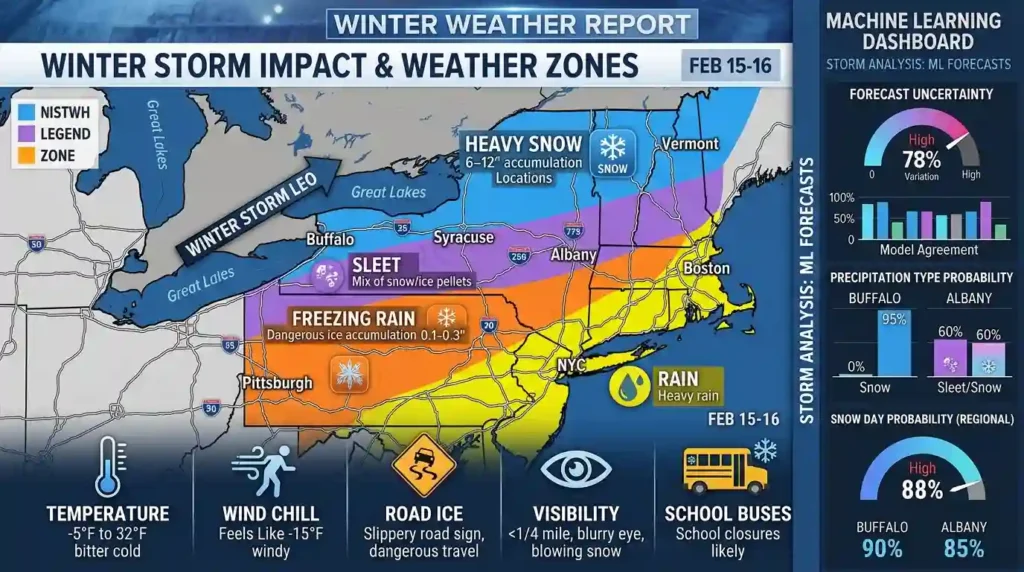
Snowstorms are unpredictable because small changes in temperature, moisture, elevation, wind direction, and storm track can create very different outcomes. A shift of only a few miles can mean the difference between rain, sleet, freezing rain, or heavy snow.
Traditional snow day forecasting usually depends on weather reports, radar, local news, and school district judgment. These are valuable, but they do not always give a clear answer for families trying to plan the next morning.
Weather forecasts also include uncertainty. A forecast of “3 to 7 inches” is not a single outcome. It is a range of possibilities. The National Weather Service and NOAA’s Weather Prediction Center often communicate winter weather using probabilistic forecasting, which helps show possible snowfall ranges and uncertainty. A useful authoritative resource is the NOAA Weather Prediction Center probabilistic precipitation portal.
The challenge is that school closures are not based only on snowfall. A district may close for three inches of snow if roads are icy and buses cannot operate safely. Another district may stay open after eight inches if snow removal is fast and the storm ends overnight.
This is exactly the kind of problem machine learning is designed to analyze. It can connect multiple variables at once and identify patterns that humans may miss.
What Machine Learning Has to Do With Snow Day Predictions for Schools
Machine learning helps schools and families understand risk, not just raw weather numbers. In the context of snow day predictions, risk means the probability that winter weather will disrupt safe travel, school operations, or campus access.
A school district may consider:
- Student transportation routes
- Bus driver availability
- Road treatment schedules
- Sidewalk safety
- Wind chill during student pickup
- Power outage risk
- Ice accumulation
- Rural road conditions
- Parking lot safety
- Timing of snow removal
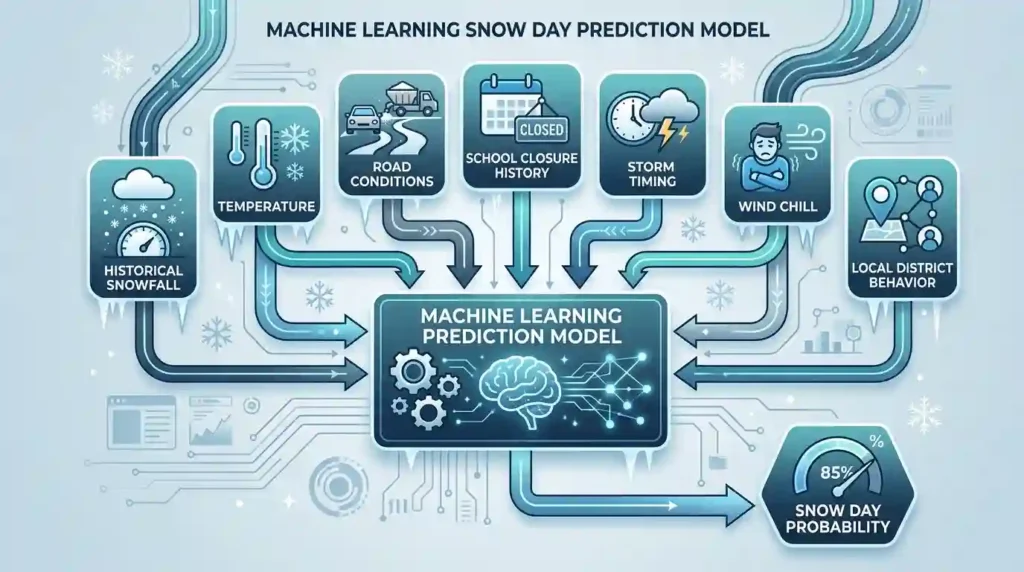
Machine learning models can use these factors as features. A feature is a data point used by an algorithm to make a prediction. For snow day forecasting, features may include snowfall accumulation, temperature, precipitation type, storm timing, historical closures, and even local school district behavior.
For example, if a district has historically closed when snow begins before 5 a.m. and accumulates more than four inches by bus pickup time, a model can learn that pattern. If the same district usually stays open when snow ends before midnight and roads are plowed by morning, the model can learn that too.
This is why machine learning is valuable: it does not simply ask, “How much snow will fall?” It asks, “Based on similar conditions in the past, what usually happened?”
The Data Behind Snow Day Prediction Models
A machine learning snow day prediction system depends on high-quality data. The better the data, the more useful the prediction can be.
Important data sources may include:
Historical Weather Data
Historical weather data includes past snowfall totals, temperature, wind speed, humidity, pressure, and precipitation type. This helps the model understand what actually happened during previous winter storms.
School Closure Records
Past school closure data is extremely important. A snow day prediction model needs to know when schools closed, opened late, dismissed early, or stayed open during similar weather events.
Road and Transportation Conditions
Road safety is one of the biggest factors in snow day decisions. A machine learning model may consider road temperature, freezing rain, snowplow timing, traffic reports, rural road exposure, and public transportation conditions.
Geographic and Local Data
Elevation, distance from major roads, urban density, and regional snow preparedness all matter. A district in a mountain area may handle snow differently from a coastal town that rarely gets winter storms.
Time-Based Features
Timing can be just as important as snowfall amount. Snow that falls overnight can disrupt morning buses. Snow that starts after dismissal may not affect school at all. Machine learning can evaluate storm timing, peak intensity, and morning commute risk.
How Machine Learning Algorithms Estimate Snow Day Probability
Machine learning algorithms do not “know” whether school will close in the same way a superintendent does. Instead, they calculate probability based on patterns.
A model may be trained using past examples. Each example includes weather conditions and the final outcome: school open, delayed, closed, or remote. Over time, the algorithm learns which combinations of conditions are most likely to lead to a snow day.
Several types of machine learning methods can be used for snow day prediction.
Logistic Regression
Logistic regression is often used for probability-based classification. It can estimate the chance of a snow day based on variables like snowfall total, temperature, and storm timing.
Decision Trees
A decision tree works like a series of yes-or-no questions. For example:
- Is snow expected before 6 a.m.?
- Is accumulation above four inches?
- Is temperature below freezing?
- Did nearby districts close?
The tree follows these decisions until it reaches a likely outcome.
Random Forest Models
A random forest combines many decision trees to make a more reliable prediction. This helps reduce errors from relying on a single decision path.
Gradient Boosting
Gradient boosting models can improve prediction accuracy by learning from previous mistakes. They are often strong performers in structured data problems, including weather-related classification tasks.
Neural Networks
Neural networks can identify complex patterns in large datasets. They may be useful when combining radar imagery, satellite data, numerical weather models, and local closure history.
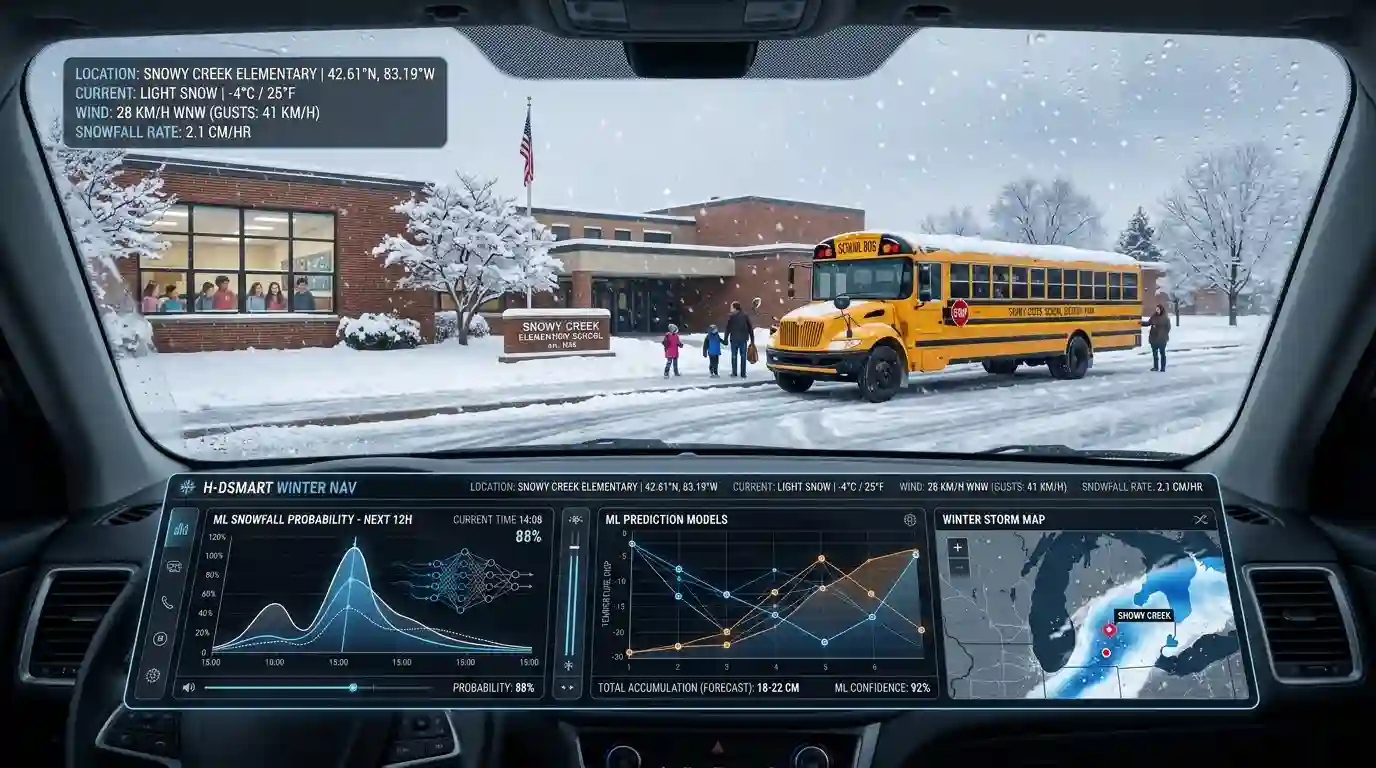
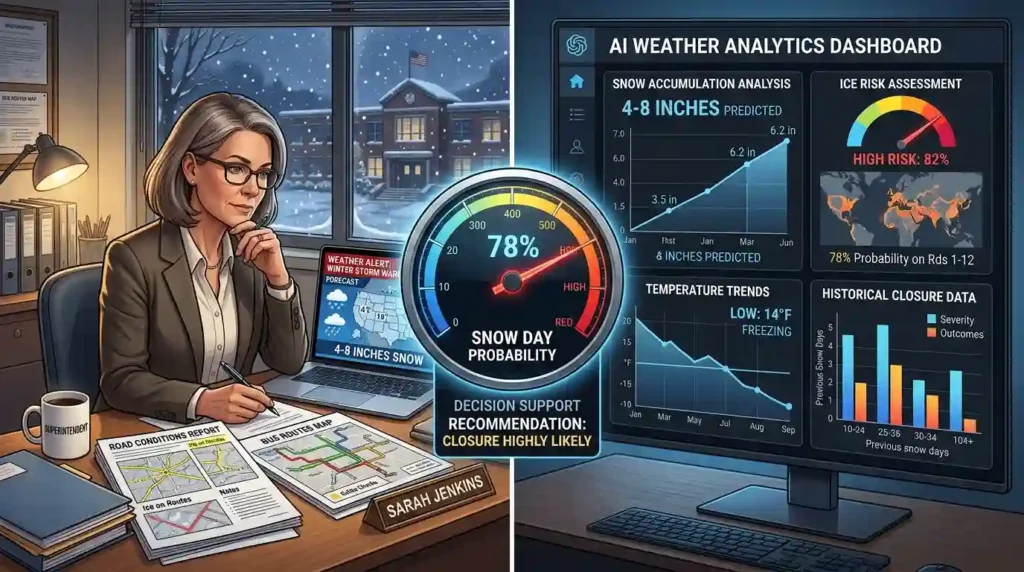
The final output is usually a probability score. For example, a model may predict a 78% chance of a snow day. That does not guarantee closure, but it gives users a more informed estimate than guessing from snowfall totals alone.
Why Local Factors Matter More Than People Think
One of the biggest mistakes people make with snow day predictions is assuming every district responds the same way. In reality, local context matters a lot.
A northern district with strong snow removal equipment may stay open during a storm that would close schools in a warmer region. A rural district with long bus routes may close more quickly than a compact urban district. A college campus may make a different decision than a K–12 district because students live on campus, commute from different areas, or attend evening classes.
This is also why college snow days are different from school snow days. College students may deal with parking lots, campus hills, walking paths, commuter routes, residence halls, and professor-specific attendance policies. You can explore this difference in more detail in College Students Experience Snow Day Cancellations Differently.
Machine learning models become more useful when they include local history. A national forecast can tell you about the storm. A localized prediction model can help estimate what your specific district or campus is likely to do.
Machine Learning vs. Human Decision-Making
Machine learning can support snow day predictions, but it should not replace human judgment. School leaders must consider safety, communication, staffing, legal responsibilities, and community needs.
A machine learning model can process large amounts of data quickly. It can compare current weather to past storms, detect closure patterns, and generate probability estimates. However, it may not fully understand last-minute issues such as a broken heating system, a local road closure, a power outage, or a sudden change in district policy.
Human decision-makers bring context. They talk to transportation teams, emergency managers, road crews, meteorologists, and neighboring districts. They also consider how a closure affects families, meal programs, childcare, and staff availability.
The best snow day prediction approach combines both:
- Machine learning for pattern recognition
- Weather forecasting for storm tracking
- Human judgment for safety decisions
- Local communication for final announcements
This combination makes snow day prediction more accurate, practical, and responsible.
How a Snow Day Calculator Uses Prediction Logic
A snow day calculator is designed to simplify complex information into an easy-to-understand probability. While every calculator may work differently, the general idea is to combine weather data, local conditions, and prediction logic to estimate the chance of a school closure.
A smart snow day calculator may evaluate:
- ZIP code or location
- Forecasted snowfall
- Ice accumulation
- Temperature before school hours
- Wind chill
- Timing of precipitation
- Day of the week
- Previous school closure behavior
- Regional snow preparedness
The calculator then turns those inputs into a prediction score. For students and parents, this is helpful because it gives a quick estimate without requiring them to interpret multiple weather maps and forecast models.
However, users should remember that a snow day calculator is a prediction tool, not an official announcement. The final decision always comes from the school district, college, university, or workplace.
Benefits and Limitations of AI-Based Snow Day Forecasts
Machine learning brings several benefits to snow day prediction, but it also has limitations.
Benefits
Machine learning can analyze huge amounts of historical and real-time data. It can detect patterns across weather conditions, school decisions, and transportation risks. It can also update predictions as new forecast data arrives.
Another major benefit is personalization. Instead of giving the same forecast to everyone in a region, a machine learning model can adjust predictions based on local district behavior and neighborhood-level weather conditions.
It can also help reduce uncertainty. Families often want to know whether they should prepare for childcare, remote learning, delayed work schedules, or transportation changes. A probability-based estimate helps them plan earlier.
Limitations
Machine learning models are only as good as their data. If historical closure records are incomplete or local weather data is inaccurate, predictions may be less reliable.
Forecast uncertainty is another limitation. If the storm track changes suddenly, the model’s prediction may change too. Winter storms can shift quickly, especially when temperatures are near freezing.
There is also the issue of human policy. A school district may change its closure standards after a new superintendent, transportation policy, remote learning rule, or safety guideline. A model trained on older decisions may not immediately understand that change.
This is why machine learning should be seen as a decision-support tool. It improves snow day predictions, but it does not guarantee them.
The Future of Snow Day Predictions
The future of snow day prediction will likely become more personalized, more local, and more data-driven. As weather models improve and artificial intelligence becomes more advanced, prediction tools may be able to combine live radar, road sensors, school closure history, and real-time transportation data.
Future systems may also provide separate predictions for:
- Elementary schools
- High schools
- Colleges
- Commuter campuses
- Rural districts
- Urban districts
- Workplaces
- Public transportation routes
Instead of one broad snow forecast, users may receive a more specific risk score based on their exact location and schedule. For example, a parent may see a high chance of a two-hour delay, while a nearby college student may see a moderate chance of campus closure.
Machine learning may also improve communication. Instead of vague forecasts, users may get explanations such as:
“Snowfall is expected before morning bus routes, temperatures will remain below freezing, and similar past storms closed local schools 82% of the time.”
This type of explanation makes predictions more transparent and easier to trust.
Conclusion
Machine learning has a major role in modern snow day predictions because it can analyze patterns that are too complex for simple guessing. Snow day decisions depend on more than snowfall totals. They involve temperature, ice, timing, road safety, school district history, local geography, transportation routes, and human judgment.
By using predictive analytics, artificial intelligence, historical weather data, and local closure patterns, machine learning can estimate the probability of a snow day with greater context. It does not replace official school announcements, but it helps students, parents, teachers, and college communities make better plans.
In the end, snow day prediction is not about asking, “Will it snow?” The better question is, “Will the weather create enough risk to change the school schedule?” Machine learning helps answer that question more intelligently.
FAQs
What does machine learning have to do with snow day predictions?
Machine learning helps snow day predictions by analyzing historical weather data, school closure records, road conditions, storm timing, and local decision patterns. It uses these patterns to estimate the probability of a school cancellation or delay.
Can machine learning predict snow days accurately?
Machine learning can improve snow day prediction accuracy, especially when it uses strong local data. However, it cannot guarantee a closure because final decisions depend on school officials, safety concerns, and last-minute weather changes.
What data is used in snow day prediction models?
Common data includes snowfall totals, temperature, wind chill, ice accumulation, storm timing, road conditions, historical school closures, ZIP code location, and local district behavior.
Is a snow day calculator the same as an official school announcement?
No. A snow day calculator provides a probability estimate. The official decision must come from the school district, college, university, or workplace.
Why do nearby schools make different snow day decisions?
Nearby schools may have different bus routes, road conditions, elevation, snow removal resources, district policies, and safety concerns. Machine learning can account for these local differences when enough data is available.
Does artificial intelligence replace meteorologists?
No. Artificial intelligence and machine learning support forecasting, but meteorologists and school officials still play an important role. Human expertise is needed to interpret risks and make final safety decisions.
Why is timing important in snow day predictions?
A storm that hits during the morning commute is more likely to affect school than snow that falls after dismissal. Machine learning models consider when snow starts, when it peaks, and whether roads can be cleared before school begins.
Can machine learning predict college snow days?
Yes, but college snow day predictions require different factors. Colleges may consider commuter students, campus sidewalks, parking lots, residence halls, evening classes, and campus-wide operations.