
Summary
If you have ever checked a snow day predictor the night before a winter storm, you have probably wondered how accurate is a snow day calculator and whether that exciting probability score actually means school will close. The short answer: a snow day calculator can be helpful, especially within a 24-hour forecast window, but it is not a 100% guarantee. Its accuracy depends on weather forecast reliability, local school district policy, road conditions, storm timing, temperature trends, and how quickly real-time weather data changes.
A good snow day calculator works best as a planning tool for students, parents, teachers, and families. It can estimate the snow day chance, but the final school decision still belongs to school officials.
Table Of Content
- What Is a Snow Day Calculator?
- How Accurate Is a Snow Day Calculator in Real Life?
- Why Snow Day Calculator Accuracy Changes
- How Accurate Is a Snow Day Calculator the Night Before?
- Weather Factors That Affect Snow Day Predictions
- School District Policies and Closure Thresholds
- Why Snow Day Calculators Can Be Wrong
- How to Use a Snow Day Predictor the Smart Way
- Conclusion
- FAQs
What Is a Snow Day Calculator?
A snow day calculator is an online tool that estimates the chance of school being canceled, delayed, or moved due to winter weather. People also call it a snow day predictor, snow day probability calculator, snow day finder, snow day forecast tool, or school closure forecast.
Most tools ask for a ZIP code, city name, or local forecast location. Some may also ask what type of school you attend, whether you are in a rural area, suburban area, or big city, and how strict your district usually is about closures. A tool like a snow day calculator can help families plan ahead by turning weather data into a simple prediction percentage or probability score.
The basic idea is simple: the calculator reviews weather forecast signals and compares them with historical patterns. If the weather forecast shows heavy snow overnight, dangerous roads, wind chill, ice, or a winter storm warning, the snow day probability may rise. If the storm track shifts away, snowfall totals drop, or temperatures stay above freezing, the chance may fall.
A snow day calculator does not officially cancel school. It predicts the likelihood based on available information. That distinction matters. The calculator can say there is an 80% snow day chance, but the official closure announcement comes from the school district, local school board, private school leadership, or school administrators.
How Accurate Is a Snow Day Calculator in Real Life?
In real life, snow day calculator accuracy can range from surprisingly useful to completely off, depending on timing and local conditions. A realistic answer is that snow day calculators are often more reliable for short-term forecasts than long-range forecasts. A 24-hour forecast or 24-48 hour forecast usually provides stronger prediction confidence than a week-ahead forecast.
Many users ask, “are snow day calculators accurate?” The honest answer is: sometimes, but not always. They can be accurate when the storm is already well-defined, the snowfall forecast is consistent, and the district has a clear history of closing under similar conditions. They become less reliable when the forecast uncertainty is high, temperatures are near freezing, or the storm track could shift by only a few miles.
A 1-2°F temperature change can make a huge difference. At 31°F, roads may become icy and snow accumulation can build quickly. At 33°F, the same precipitation forecast may produce slush, rain, or melting snow. That small change can turn a strong snow day prediction into a normal school morning.
For many locations, a snow day predictor may feel most useful when it gives a broad probability range. For example:
| Prediction Percentage | What It Usually Means |
| 0-30% | School is likely open unless conditions worsen |
| 30-60% | Possible delay or cancellation, but uncertain |
| 60-80% | Meaningful snow day chance, especially with alerts |
| 80-90% | High chance if roads and timing support it |
| 90%+ | Strong signal, but still not a 100% guarantee |
Some calculators may claim 93% accuracy or even 98% accuracy, but users should read those claims carefully. Accuracy rate depends on how the tool measures success. Does it count delays? Does it compare against official school closure data? Does it update using real-time results? Does it work equally well in New York, Massachusetts, Maine, Ohio, Michigan, Illinois, Ontario, and Quebec?
A high number can sound impressive, but the underlying method matters.
Why Snow Day Calculator Accuracy Changes
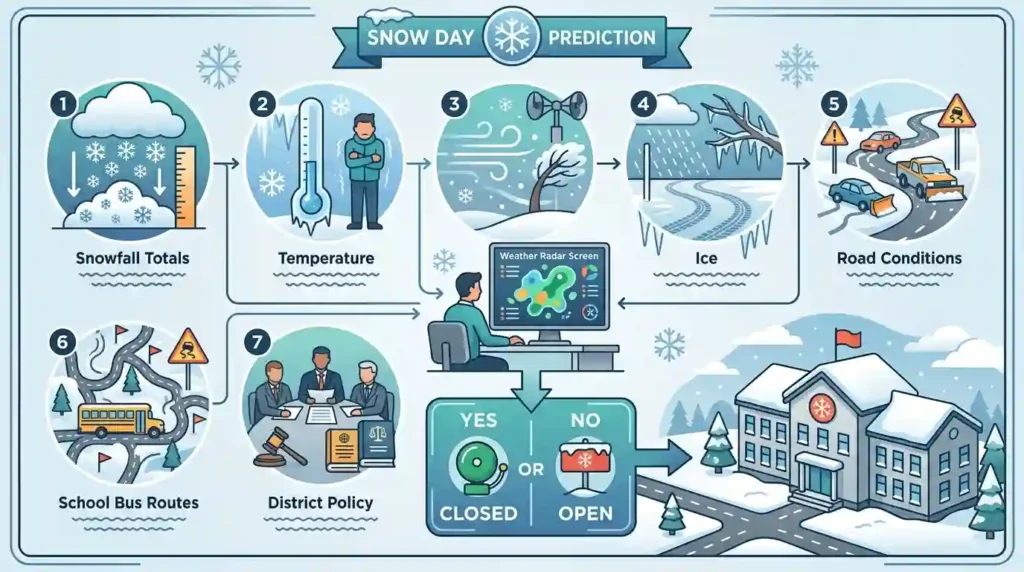
Snow day prediction is difficult because school cancellation is not only a weather question. It is a weather, road safety, timing, and policy question.
A snow day probability calculator may use real-time weather data from sources such as NOAA, the National Weather Service, Environment Canada, OpenWeatherMap, Open-Meteo, weather.com, or other Weather API providers. It may review snowfall totals, snowfall timing, wind speed, wind chill, precipitation forecast, temperature trends, radar, advisories, watches, and warnings.
But the final school decision includes human judgment. School officials may ask:
- Is the heaviest snow arriving before buses leave?
- Will school bus routes be safe?
- Are bridges, hills, back roads, and rural roads passable?
- Can plows clear roads before morning commute?
- Is there freezing rain or a 0.1-inch ice glaze?
- Will temperatures drop and create freeze cycles?
- Are sidewalks and parking lots safe?
- Are nearby districts closing?
- Do working parents need early notice?
This is why people often ask, “does snow day calculator work?” It works as a forecast-based estimate, but it cannot fully reproduce the judgment of every superintendent, transportation director, or local school board.
The tool may predict snow accurately and still miss the school decision. For example, 5-8 inches of snow in a snow-prone area of Maine may not automatically close school if plowing speed is high and roads are treated early. Meanwhile, 2-4 inches plus freezing rain in a hilly area with back roads may create dangerous roads and force closure.
How Accurate Is a Snow Day Calculator the Night Before?
The evening before a storm is usually one of the best times to check a snow day calculator. By then, the short-term forecast is more stable, radar may show the storm forming, and meteorologists have a better understanding of storm intensity and storm timing.
A snow day calculator checked five days in advance may be fun, but it is mostly a long-range forecast guess. A 3-4 day forecast can show a possible winter storm pattern, but the storm track may still change. A week-ahead forecast may suggest the next snow day, but it should not be treated as a firm school closure forecast.
The night before, especially after updated weather models, NWS alerts, and local forecasts come in, prediction confidence improves. If the tomorrow forecast shows heavy snow beginning at midnight, 10+ inches by morning, wind gusts, and a winter storm warning, the calculator may offer a more realistic prediction.
Morning forecast updates can also change everything. A storm expected to arrive overnight might slow down. Snowfall chance may decrease. Heavy snow may shift north or south. What looked like an 85% snow day probability at 8 p.m. might become 40% by 5 a.m. if the storm track moves away.
So, are snow day calculators more accurate the night before? Usually yes. But the most accurate result often comes from checking both the evening before and early morning, then confirming with district channels.
Weather Factors That Affect Snow Day Predictions
Snowfall Totals
Snow accumulation is one of the most obvious factors. More inches of snow usually mean a higher snow day chance. But total snow is not everything.
Two inches of snow during the morning commute can be more disruptive than six inches that falls after school starts. Likewise, light snow over twelve hours may be manageable, while moderate snow or heavy snow during bus pickup can be dangerous.
A snow day calculator may weigh snowfall totals differently depending on region. In snow-prone areas such as Michigan, West Michigan, Holland, Maine, Ontario, or Quebec, schools may stay open during snow that would close schools elsewhere. In areas with fewer plows or less winter infrastructure, smaller totals can cause more disruption.
Snowfall Timing
Storm timing is one of the biggest reasons prediction confidence changes. If snow falls overnight and plows have time to clear roads, schools may open. If snow starts at 6 a.m., school bus routes may become unsafe right when students are traveling.
An overnight blizzard, daytime blizzard, or heavy snow during commute hours can dramatically increase the chance of school cancellation. The same storm arriving at noon may lead to early dismissal instead of a full snow day.
Temperature Trends
Temperature is a quiet but powerful factor. A 1-2°F temperature change can decide whether precipitation becomes snow, sleet, freezing rain, or plain rain.
When temperatures hover near freezing, forecast uncertainty rises. That is when users ask, “has the snow day calculator ever been wrong?” Yes, and near-freezing storms are a common reason. A tool may expect snow accumulation, but warmer pavement or a slight warm layer in the atmosphere can reduce totals.
Ice and Freezing Rain
Freezing rain can be more dangerous than snow. A thin 0.1-inch ice glaze can make roads, bridges, sidewalks, and school parking lots hazardous. Ice affects buses, drivers, and pedestrians. It can also bring power outages if trees and lines collect enough ice.
A calculator that focuses too heavily on inches of snow may underestimate freezing rain. Better tools consider ice, sleet, freeze cycles, and road safety.
Wind and Wind Chill
Wind affects visibility, drifting snow, and wind chill. A blizzard is not only about snowfall totals. Strong wind can cause blowing snow and whiteout conditions, making roads impassable. The National Weather Service notes that winter storms may bring snow, sleet, and freezing rain, and that blizzards can create whiteout conditions and dangerous roads National Weather Service.
Wind chill may also affect school decisions, especially in the Midwest, Northeast, and Canada. Schools may delay or close if extreme cold creates safety concerns for children waiting at bus stops.
Road Conditions
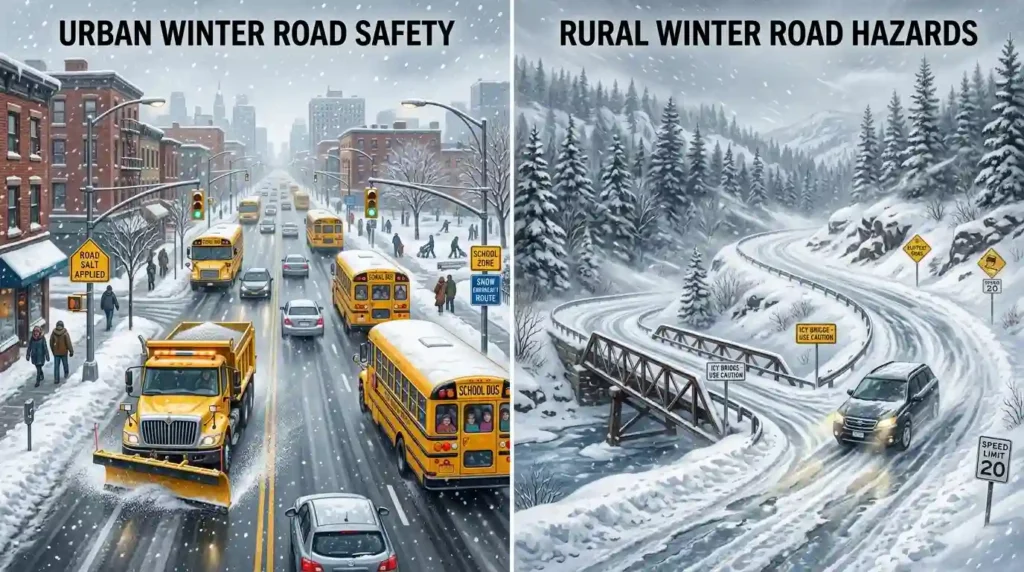
Road conditions are where weather data meets reality. Packed snow, icy roads, hills, bridges, back roads, drainage problems, and plowing speed can all affect school closure decisions.
Rural areas may close sooner because buses travel long routes over untreated roads. Urban areas may have more plows, but traffic congestion can create travel safety problems. Suburban areas may depend on how quickly local roads, school lots, and sidewalks are cleared.
School District Policies and Closure Thresholds
The biggest limitation of any snow day calculator is that every school district is different.
One district may close at 4 inches of snow if roads are hilly and buses travel long rural routes. Another may stay open with 6 inches because plowing is fast and winter storms are common. Private school decisions may differ from public school decisions. Big cities may consider public transportation, while small towns may focus on school bus safety.
A strong snow day predictor should consider local trends and district history. Historical school closure data is valuable because it shows how a district has responded to similar storms in the past. If a district often closes when snowfall forecast reaches 5-8 inches plus freezing rain, that pattern improves prediction accuracy.
This is where AI analysis, smart algorithms, probability models, and historical analysis can help. An AI-powered predictor may compare current atmospheric conditions with historical weather data and school closure history. Some older tools used patented formulas, regressive statistics, or region-based closure thresholds. Newer tools may use transparent algorithms and real-time weather data to generate a prediction percentage.
Still, even the smartest algorithm cannot know every local factor. A superintendent may close because several bus drivers are unavailable, a power outage affects buildings, or nearby roads remain untreated. Another district may stay open because the storm underperformed or road crews cleared faster than expected.
That is why “is the snow day calculator legit?” is not the same as “is the snow day calculator guaranteed?” A legit calculator can still be wrong because its result is a probability, not an official closure announcement.
Why Snow Day Calculators Can Be Wrong
Forecast Uncertainty
Weather models are powerful, but winter weather is complicated. Storm patterns can shift. Lake-effect snow can intensify in one town and miss another. Valleys, elevation, lakes, and terrain can create sharp local differences.
Lake-effect snow is a classic example. One ZIP code may receive 10+ inches while another nearby town gets only light snow. A snow day calculator using city-level data may overestimate or underestimate the actual local impact.
Overestimation of Snow Impact
Sometimes snow day calculators overestimate closure chances because they treat snowfall totals as the main factor. But school cancellation depends on roads, timing, and district policy.
If a storm drops 6 inches overnight but ends early, roads may be cleared by morning. If temperatures rise, snow may compact or melt. If plows work quickly, a school district may decide travel is safe.
Missing Local Road Data
Many calculators use weather forecast data, but not all have access to real-time road conditions. Road safety depends on road type, hills, bridges, drainage, treatment, traffic, and local plowing speed. Without this data, a prediction can miss the final school decision.
District Decision-Making Is Human
School officials often make decisions after consulting transportation teams, emergency management, local weather alerts, and neighboring districts. Sometimes they decide conservatively for winter safety. Other times they keep school open because the worst of the storm will arrive later.
The calculator may be mathematically reasonable and still differ from the final school decision.
Forecast Timing Changes
A storm expected to peak at 5 a.m. may arrive at 10 a.m. instead. That can change the outcome from full cancellation to early dismissal, delay, or normal schedule. This is why the answer to “does the snow day calculator work?” depends heavily on when you check it.
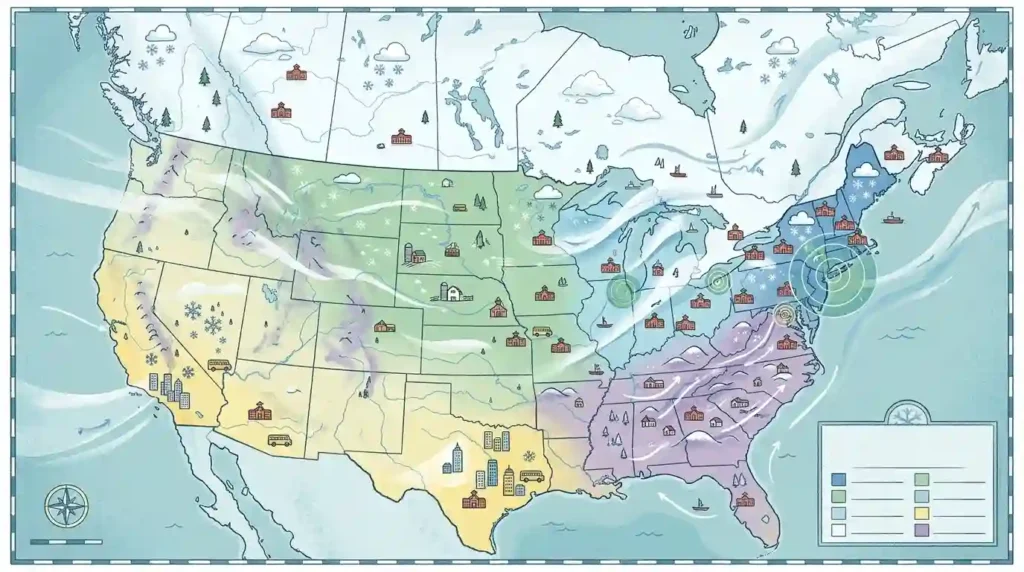
Are Snow Day Calculators Accurate for Every Region?
No tool performs equally well everywhere. Regional patterns matter.
In the Northeast, places like New York, Massachusetts, and Maine often have strong winter infrastructure, but they can also face intense nor’easters, coastal storms, and mixed precipitation. In the Midwest, states like Ohio, Michigan, and Illinois may deal with lake-effect snow, wind chill, and blowing snow. In Canada, Ontario and Quebec often have colder temperatures, different school closure norms, and Environment Canada alerts.
Rural areas and hilly areas may see more closures because travel safety is harder to maintain. Urban areas may stay open more often if roads are plowed quickly, but big cities can face challenges with traffic, sidewalks, and public transit. Small towns may make faster decisions, while large districts may need more coordination.
A snow day predictor is most accurate when it understands local forecast patterns, historical closure behavior, and regional thresholds. If it treats every ZIP code the same, reliability drops.
How to Use a Snow Day Predictor the Smart Way
A snow day calculator works best when you treat it as one signal among several.
First, check the local forecast. Look at snowfall totals, snowfall timing, ice, wind speed, wind chill, and temperature trends. Then check NWS alerts, advisory, warning, or watch information. For Canada, check Environment Canada alerts. Also compare with trusted sources like local meteorologists, The Weather Channel, weather.com, or a government weather data source.
Second, check the prediction closer to the event. A 24-hour forecast is more reliable than a 3-4 day forecast. The evening before is useful, and the morning forecast can confirm whether the storm is behaving as expected.
Third, think like a school administrator. Ask whether roads will be safe for buses, whether freezing rain is likely, whether snow will peak during commute time, and whether your district typically closes under similar conditions.
Fourth, confirm with official school channels. Use the calculator for morning planning, childcare, groceries, school commute decisions, and travel plans, but rely on district channels for the final school decision.
If you enjoy learning the background of these tools, the article Who Created the Snow Day Calculator? is a natural next read because it explains the origin and evolution of the idea.
What Accuracy Range Should You Expect?
There is no universal accuracy rate that applies to every snow day calculator. However, a practical way to think about reliability is by forecast window:
| Forecast Window | Typical Reliability |
| Week-ahead forecast | Low; useful only for early awareness |
| 3-4 day forecast | Moderate; storm patterns may still shift |
| 24-48 hour forecast | Better; snowfall forecast becomes clearer |
| Evening before | Often strong if models agree |
| Morning forecast | Usually strongest for real-time results |
In stable winter storms, a good predictor may feel like it reaches 75-85% accuracy or even 80-90% accuracy. In messy storms with sleet, freezing rain, lake-effect snow, or near-freezing temperatures, accuracy may feel closer to 60-70%.
Claims of 90%+ accuracy should be treated with context. What region was tested? Was it only for major storms? Did the calculator include delays? Was the data based on historical school closure data? Did it compare predictions with official closure announcements?
A realistic prediction is more valuable than a flashy 98% accuracy claim. A transparent probability model that explains uncertainty is better than a tool that pretends winter weather has no prediction limits.
Is the Snow Day Calculator Accurate Enough to Plan Around?
Yes, but plan with flexibility.
For families, a snow day forecast can help with childcare, work schedules, groceries, and travel plans. For students, it can give a sense of whether tomorrow might be a snow day. For teachers, it can help prepare remote assignments or adjust lesson timing. For drivers, it can be a reminder to check winter safety plans and road alerts.
But it should never replace official school channels. The calculator is useful for community preparedness, not final confirmation.
Think of the probability score this way:
A 20% result means “probably school.”
A 50% result means “watch closely.”
A 75% result means “prepare for a possible closure.”
A 90%+ result means “very likely, but still confirm.”
That mindset keeps the tool helpful without giving it more authority than it has.
Conclusion
A snow day calculator can be accurate, especially when used close to the storm and paired with reliable weather data. It is most useful within a 24-hour or 24-48 hour forecast window, when snowfall timing, storm intensity, temperature, wind, ice, and road conditions are clearer.
Still, it is not 100% reliable. Snow day prediction depends on forecast uncertainty, local terrain, school bus routes, district policy, plowing speed, road safety, and the judgment of school officials. The best approach is to use a snow day predictor as a planning tool, then confirm the final school decision through official school channels.
So, is snow day calculator accurate? It can be. Is the snow day calculator legit? A well-built one can be. But no snow day probability calculator can promise a 100% guarantee, because winter weather and school closures are both full of local details.
FAQs
How accurate is the Snow Day Calculator?
A Snow Day Calculator can be fairly accurate for short-term forecasts, especially the evening before or morning of a storm. However, it is not 100% reliable because school closures depend on weather, roads, timing, and district policy.
Is the Snow Day Calculator reliable?
It is reliable as a planning tool, not as an official closure source. Use it to estimate snow day probability, then confirm with your school district’s official channels.
How accurate is a snow day predictor?
A snow day predictor is usually more accurate within 24-48 hours of a storm. Long-range forecasts are less reliable because storm track, temperature, and snowfall totals can change.
How does a snow day calculator make predictions?
It typically uses weather forecast data, snowfall totals, temperature, wind, ice risk, storm timing, location, and sometimes historical school closure data to create a probability score.
What factors affect snow day calculator accuracy?
Major factors include snowfall forecast, snow accumulation, freezing rain, wind chill, road conditions, school bus routes, terrain, district history, and closure thresholds.
Why does snow day calculator accuracy vary by region?
Different regions handle snow differently. A city in Michigan or Maine may stay open with several inches of snow, while a less snow-prepared area may close with much less.
Does the Snow Day Calculator guarantee school closures?
No. It provides a prediction percentage, not a 100% guarantee. Only the school district can make the official closure announcement.
How reliable are snow forecasts for predicting school closures?
Snow forecasts are useful, but school closures also depend on road safety and district policy. A good forecast improves prediction confidence but does not guarantee a closure.
How does forecast timing affect snow day calculator accuracy?
Timing matters a lot. Snow during the morning commute is more likely to close school than snow that falls after buses have already arrived.
What time should I check a snow day calculator for the most accurate result?
Check the evening before the storm and again early in the morning. These times usually provide better real-time results than checking several days ahead.
How do icy roads affect snow day predictions?
Icy roads can raise the snow day chance even when snowfall totals are low. Bridges, hills, back roads, and untreated roads are especially important.
Does freezing rain affect snow day calculator accuracy?
Yes. Freezing rain can make predictions harder because even a thin ice glaze can create dangerous travel conditions and cause closures.
Why can a snow day calculator be wrong?
It can be wrong because forecasts change, temperatures shift, snow totals vary by location, road conditions differ, and school officials may make a decision the tool cannot predict.
Do school district policies affect snow day calculator results?
Yes. District policy is one of the biggest factors. Some districts close quickly for safety, while others stay open unless conditions are severe.
Are snow day calculators more accurate the night before a storm?
Usually, yes. The night before a storm, short-term forecast data is stronger, radar is clearer, and prediction confidence is higher than it is several days in advance.
