Summary
Every winter morning, millions of parents and students face the same anxious ritual — frantically checking for school closure news before the alarm even fully sounds. Two main sources dominate this mad dash: the traditional school district hotline and the modern snow day calculator. But which one actually delivers the information faster, more accurately, and more reliably? This article, Snow Day Calculator vs School District Hotline, dives deep into both options, comparing their update speeds, accuracy, technology, and user experience so you can make the smartest choice next time a blizzard threatens your school schedule.
Table of Contents
- Introduction — The Race Against the Storm
- What Is a School District Hotline?
- What Is a Snow Day Calculator?
- How Fast Do School Districts Actually Update Their Hotlines?
- How Fast Do Snow Day Calculators Update?
- Accuracy Comparison — Prediction vs. Official Announcement
- Why Hotlines Fail During Peak Winter Events
- The Technology Behind Snow Day Calculators
- Real-World Scenarios — Which Source Wins?
- Tips for Getting Snow Day News Fast
- Conclusion
1. Introduction — The Race Against the Storm
It is 5:30 AM. Sleet is hammering your windows. Your child is already awake, peering hopefully through frost-covered glass. You grab your phone and face the oldest winter parenting question of the modern era: do you call the school district hotline, or do you trust that snow day prediction tool you bookmarked last November?
This is not a trivial choice. A wrong read means a scrambled morning — rushing lunches, waking babysitters, or sending a kid to stand at a bus stop in a whiteout. The difference between a school district hotline and a snow day calculator is not just a matter of preference. It is a matter of speed, technology, data sources, and update frequency — all factors that directly affect how quickly you get accurate school closure information.
In this deep-dive comparison, we examine both tools through the lens of real-world performance, meteorological data reliability, and user experience to definitively answer: which updates faster when winter strikes?
2. What Is a School District Hotline?
A school district hotline is the traditional, official phone-based or web-based announcement system operated directly by local school boards and district administrators. When severe weather threatens, a designated school official — often the superintendent — monitors conditions and makes a closure decision. That decision is then pushed to:
- A recorded phone message on the district’s dedicated closure hotline
- The official school district website
- Email or SMS notification systems (where available)
- Local TV and radio broadcast partners
- Social media pages managed by the district
How School Districts Make Closure Decisions
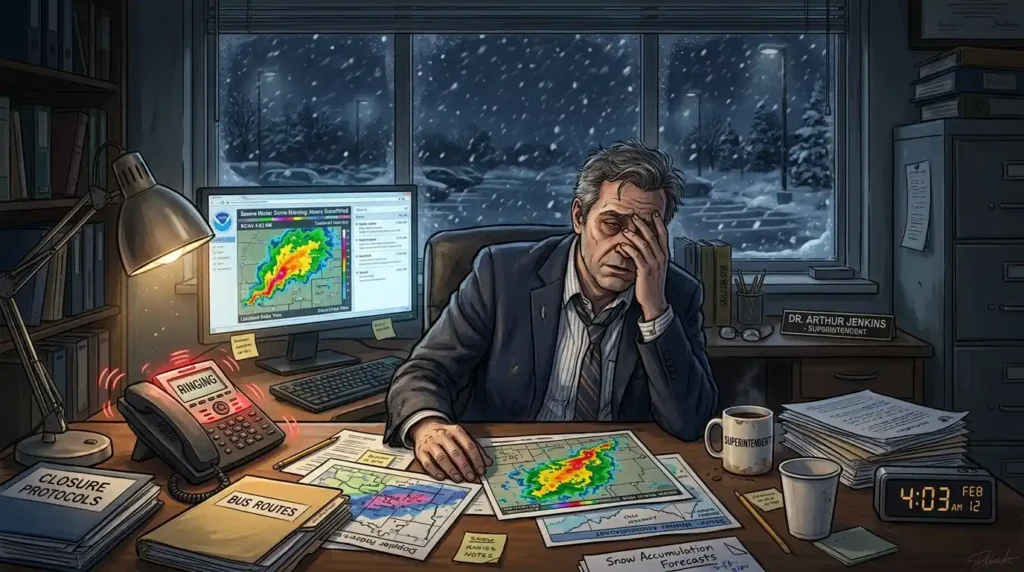
Superintendents and district officials typically begin monitoring weather conditions the evening before a potential snow event. Key inputs they consult include:
- National Weather Service (NWS) forecasts for the specific region
- Direct communication with local road maintenance crews and transportation directors
- Early morning road condition reports from bus drivers or contracted transportation partners
- Temperature projections for early morning departure windows (typically 6–8 AM)
The final call is rarely made before 4:30–6:00 AM, because officials want the most current conditions before committing. This cautious approach, while understandable from an administrative standpoint, creates a frustrating delay for families who need to plan hours in advance.
3. What Is a Snow Day Calculator?
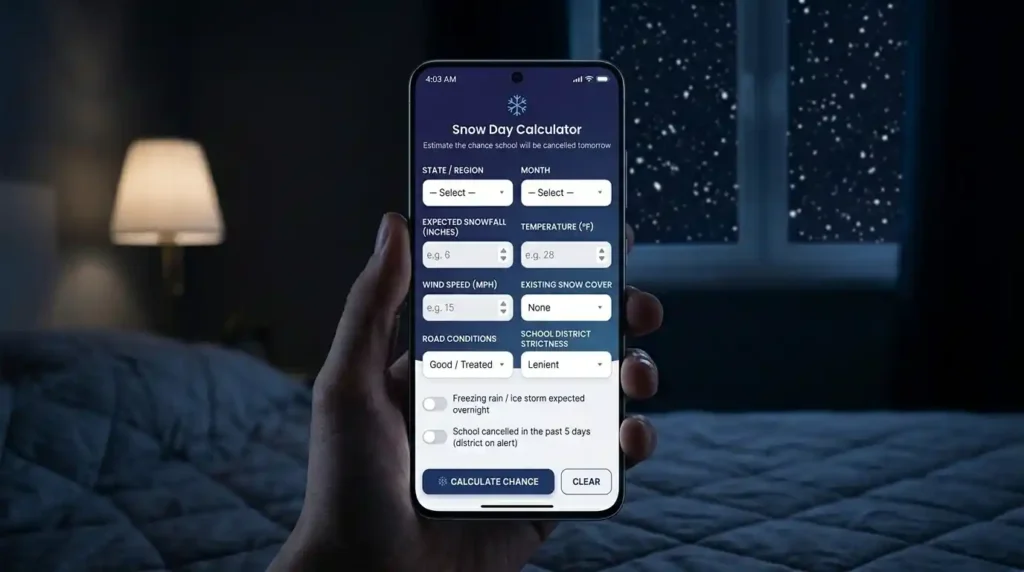
A snow day calculator is an algorithm-driven digital tool that uses real-time meteorological data, historical school closure patterns, and regional weather modeling to predict the probability of a school snow day — often hours or even days before a school district makes its official announcement.
Modern snow day predictors pull data from multiple authoritative sources simultaneously:
- NOAA weather feeds and National Weather Service APIs
- Doppler radar and satellite imagery layers
- Regional snowfall accumulation forecasts
- Historical closure data for specific zip codes and school districts
- Wind chill indexes, ice storm warnings, and road treatment schedules
The result is a probability score — often displayed as a percentage — that tells parents and students how likely a snow day is before anyone has even woken up. Tools like Try Free Snow Day Predictor deliver these real-time probability updates around the clock, meaning the data refreshes continuously as new weather models run — not just when a human official decides to update a recorded message.
4. How Fast Do School Districts Actually Update Their Hotlines?
The honest answer is: not very fast, and often inconsistently.
School district hotlines are bottlenecked by human decision-making chains. Here is a typical timeline during a major winter weather event:
| Time | Activity |
| Evening prior | Superintendent monitors NWS forecasts |
| 3:00 – 4:00 AM | Transportation director checks road crews |
| 4:30 – 5:30 AM | Decision is made |
| 5:30 – 6:00 AM | Hotline recording is updated |
| 6:00 – 6:30 AM | Robocall or mass SMS sent to enrolled families |
| 6:30 AM+ | TV stations broadcast closure lists |
That means the earliest most families receive hotline confirmation is between 5:30 and 6:30 AM — a window that is already dangerously close to school departure time for many households. And that is on a good day.
When Hotlines Fail Completely
During major regional blizzards, ice storms, or multi-district closure events, school hotlines frequently:
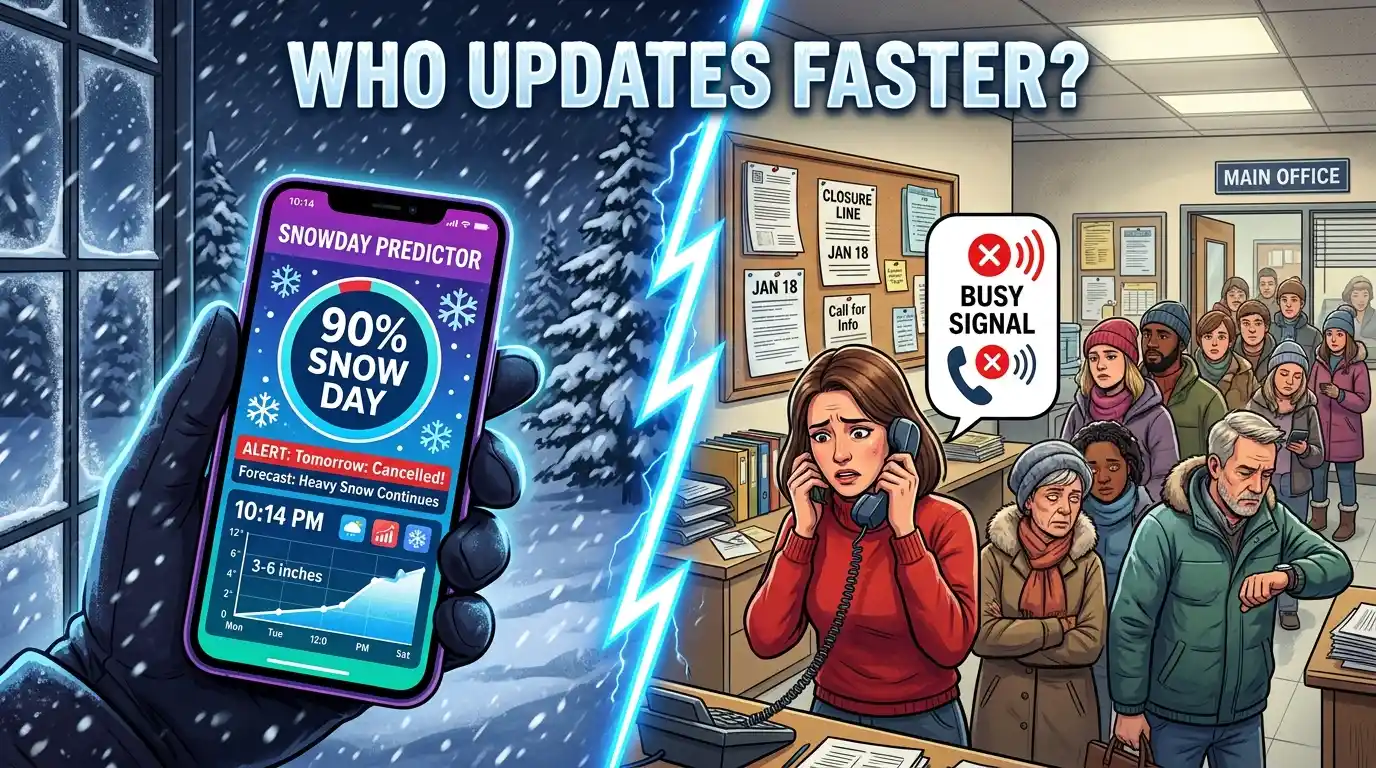
- Experience busy signals due to call volume overload
- Crash or go unresponsive on district websites
- Lag on social media because pages are only monitored during business hours
- Issue contradictory information across platforms (website says closed, hotline says open)
This is not hypothetical. Research from the Consortium for School Networking (CoSN) has documented repeated communication breakdowns during high-volume weather events, where parents could not reach school information systems for 30 minutes or longer during peak calling windows.
5. How Fast Do Snow Day Calculators Update?
This is where the comparison becomes stark. A quality snow day calculator does not wait for human approval. It updates continuously and automatically as new weather data becomes available.
Most weather-algorithm-based prediction tools operate on 15-minute to 60-minute refresh cycles, tied directly to NWS model updates and Doppler radar sweeps. This means:
- At 10 PM the night before, you can already see a high-confidence snow day probability
- At 2 AM, the prediction refines as overnight temperature readings and storm tracking data sharpen
- At 4 AM, the tool may already be showing a 95% snow day likelihood before the superintendent has even looked at their phone
For families with early commutes, overnight shift workers, or parents who need to arrange childcare, this advance notice window is invaluable. It is the single most important functional advantage a snow day calculator holds over the traditional hotline system.
6. Accuracy Comparison — Prediction vs. Official Announcement
Speed means nothing without accuracy. So how do snow day calculators stack up against the official word from school districts?
Snow Day Calculator Accuracy
Snow day predictors derive accuracy from the same foundational data that meteorologists use. Tools using ensemble weather modeling — which aggregates multiple forecast models simultaneously — have demonstrated strong performance, particularly for events involving:
- Heavy snowfall accumulation (6+ inches)
- Sub-zero wind chill events
- Ice storm and freezing rain conditions
Where calculators can miss: hyperlocal conditions like a specific rural road or district-specific policies around delayed openings versus full closures. An algorithm does not know that your district closes for two inches but stays open with a two-hour delay for six.
Official Hotline Accuracy
School district hotlines, by definition, provide 100% accurate closure status once updated — because they represent the final official decision. The problem is not accuracy; it is timeliness. A hotline that updates at 6:15 AM is perfectly accurate and nearly useless for a family that needed to arrange alternative childcare at midnight.
The ideal strategy combines both: use a snow day calculator for early probability awareness, and confirm with the official hotline or district website for verified confirmation.
7. Why Hotlines Fail During Peak Winter Events
Understanding why hotlines fail requires appreciating what they actually are: legacy communication infrastructure built in an era when broadcasting a single recorded message to a much smaller calling audience was sufficient.
Today’s school communities are larger, more geographically dispersed, and more digitally connected than ever. When a Category 1 winter storm threatens a metro area, dozens of districts may all update their hotlines within the same 30-minute window, generating massive simultaneous call volumes to public phone systems.
Additionally, many districts still rely on third-party automated calling vendors for mass notifications. When those vendors experience server loads from multiple clients simultaneously, delays cascade across entire counties.
Frozen or failing infrastructure is itself a weather risk. Black Ice Causes Surprise Snow Days more often than heavy snowfall events — precisely because ice conditions develop rapidly and give district administrators almost no lead time to update their systems before the first buses would need to roll.
8. The Technology Behind Snow Day Calculators
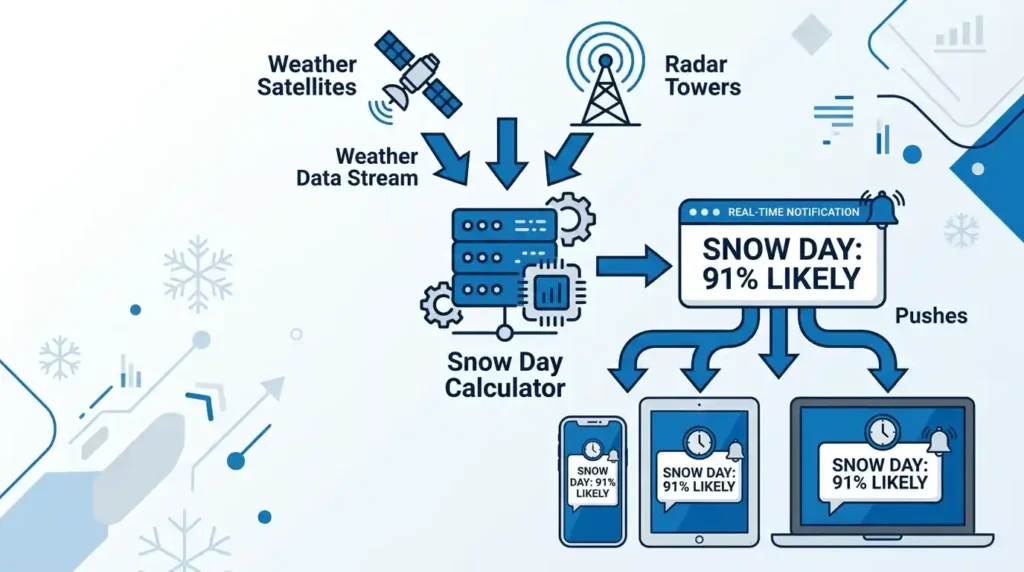
Modern snow day prediction tools are built on meteorological APIs, machine learning pattern recognition, and geospatial data mapping. Here is a simplified breakdown of the core technology stack:
Weather Data Ingestion
- NOAA’s National Digital Forecast Database (NDFD) provides grid-point forecasts at 2.5km resolution
- NWS Winter Storm Watch and Warning feeds feed directly into alert weighting algorithms
- Commercial weather APIs from providers like The Weather Company (IBM) and Tomorrow.io offer hyper-local forecast granularity
Historical Closure Pattern Analysis
Sophisticated calculators incorporate years of actual school closure records for specific zip codes and districts, identifying the exact thresholds at which a given superintendent historically calls a snow day. This creates a district-specific behavioral model that dramatically improves predictive accuracy.
Real-Time Update Architecture
Unlike a hotline recording that requires a human to re-record a message, snow day calculators run on automated pipeline architectures that pull, process, and publish updated probability scores without any human intervention — 24 hours a day, 7 days a week.
According to NOAA’s Winter Weather Preparedness resources (https://www.weather.gov/safety/winter), updated weather model output is available every 6 to 12 hours for most regions, giving automated tools multiple fresh data inputs across any overnight storm event.
9. Real-World Scenarios — Which Source Wins?
Scenario A: Major Blizzard Forecast 48 Hours Out
Winner: Snow Day Calculator. The calculator begins showing elevated closure probability a full two days before the event. The hotline will not update until the morning.
Scenario B: Surprise Overnight Ice Storm
Winner: Snow Day Calculator (narrowly) Ice events are notoriously fast-moving. While a calculator updates hourly from NWS alerts, hotlines may not activate until very early morning — sometimes after icy roads have already formed.
Scenario C: Light Dusting Near the Closure Threshold
Winner: Official Hotline When snowfall is borderline and the decision depends on district-specific policy, the hotline’s official confirmation beats any probability estimate.
Scenario D: Multi-District Regional Snowstorm
Winner: Snow Day Calculator When hotlines across an entire region are overwhelmed, a calculator’s continuously updated web interface remains accessible and stable.
10. Tips for Getting Snow Day News Fastest
- Bookmark a reliable snow day calculator and check it the evening before any storm forecast
- Sign up for your district’s email and SMS alert list — these reach you faster than a hotline recording
- Follow your school district’s official social media accounts for real-time updates
- Check local TV station school closure lists which often post digitally before they broadcast
- Set weather alerts on your phone from the National Weather Service for your specific county
- Use both tools together — use the calculator for probability awareness and the hotline for final confirmation
Conclusion
The verdict is clear: snow day calculators update significantly faster than school district hotlines in almost every realistic winter weather scenario. They operate on automated data pipelines tied to live meteorological feeds, provide continuous overnight updates, and deliver probability insights hours or days before any human administrator reaches for their phone.
School district hotlines remain the authoritative final word — but that word comes late, often under technical stress, and through infrastructure that simply was not designed for today’s scale of connected families. For early awareness, smart planning, and peace of mind, a snow day calculator wins the speed race by a substantial margin.
Use them together. Check the calculator the night before. Confirm with the hotline by 6 AM. That combination gives you both speed and certainty — exactly what every winter morning demands.