Summary
When a winter storm rolls in, parents, students, and school administrators all ask the same question: Will tomorrow be a snow day? Two of the most trusted names in weather forecasting — AccuWeather and Weather.com (The Weather Channel) — both promise accurate predictions, but they use different data models, technologies, and presentation styles. This article dives deep into a head-to-head comparison of both platforms specifically for snow day forecasting, examining hourly precision, snowfall accumulation estimates, winter storm alerts, user experience, and more. By the end, you’ll know exactly which platform deserves your trust when snowflakes are on the way.
Table of Contents
- Introduction: Why Snow Day Forecasting Accuracy Matters
- Overview of AccuWeather
- Overview of Weather.com (The Weather Channel)
- Forecasting Technology: How Each Platform Predicts Snow
- Snowfall Accumulation Accuracy – Head to Head
- Hourly vs. Daily Forecasts for Winter Storms
- Winter Storm Alerts and Warnings
- Mobile App Experience for Snow Forecasting
- Hyperlocal Forecasting: Which Goes More Granular?
- AccuWeather vs Weather.com: Side-by-Side Comparison Table
- When to Use Both Platforms Together
- How a Snow Day Calculator Complements Weather Forecasts
- Conclusion
Introduction: Why Snow Day Forecasting Accuracy Matters
Every winter, millions of families wake up at 5 AM to check one thing: is school cancelled today? A wrong forecast doesn’t just cause confusion — it sends kids to school in dangerous conditions or keeps them home unnecessarily. For school districts, bus drivers, road crews, and parents alike, snow day forecasting is not a casual interest. It’s a practical, high-stakes decision tool.
AccuWeather and Weather.com are the two dominant consumer weather platforms in the United States, and both have invested heavily in winter weather prediction. But they are built differently, draw on different meteorological models, and present information in distinct ways. Understanding these differences is essential when you’re trying to figure out if tomorrow’s snowstorm will actually close your child’s school.
Overview of AccuWeather
AccuWeather was founded in 1962 by Dr. Joel N. Myers in State College, Pennsylvania. It is widely regarded as one of the most precise commercial weather services in the world, particularly renowned for its MinuteCast® technology — minute-by-minute precipitation forecasting — and its Extended Forecasts that project weather conditions up to 90 days in advance.
What Makes AccuWeather Stand Out for Winter Weather?
- Superior Long-Range Snow Forecasts: AccuWeather meteorologists often issue winter storm outlooks 7–10 days in advance, giving families and school administrators early warning.
- RealFeel® Temperature: A proprietary index that accounts for wind chill, humidity, and sun angle — critical for understanding actual winter conditions beyond raw temperature.
- Hyperlocal Precision: AccuWeather claims street-level accuracy in many metropolitan areas, which matters enormously when two zip codes five miles apart see drastically different snowfall totals.
- Human Meteorologist Oversight: Unlike platforms relying solely on algorithmic outputs, AccuWeather employs a large team of professional meteorologists who review and refine automated forecasts.
Overview of Weather.com (The Weather Channel)
The Weather Channel was launched in 1982 and acquired by IBM in 2016. Its digital platform, Weather.com, is powered in part by IBM’s The Weather Company infrastructure, integrating artificial intelligence and machine learning into its core forecasting engine.
What Makes Weather.com Strong for Snow Predictions?
- AI-Driven Forecasting (Deep Thunder): IBM’s Deep Thunder technology uses machine learning trained on decades of historical weather data to improve short-range precipitation predictions.
- Interactive Radar Maps: Weather.com’s radar visualization tools are exceptionally user-friendly, allowing users to animate precipitation movement in real-time.
- Winter Storm Naming: The Weather Channel began naming winter storms in 2012, which — while controversial among meteorologists — helps the public track storm systems more easily.
- Video Content: Weather.com embeds expert meteorologist video briefings directly into winter storm coverage, giving users context beyond raw numbers.
Forecasting Technology – How Each Platform Predicts Snow
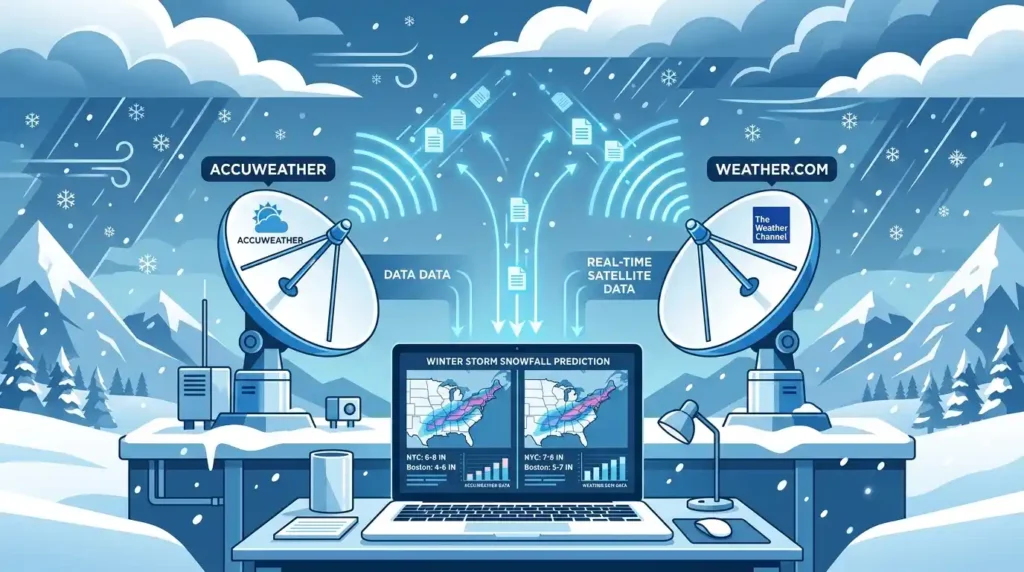
Both platforms ingest data from the National Weather Service (NWS), NOAA, the Global Forecast System (GFS), and the European Centre for Medium-Range Weather Forecasts (ECMWF) — the gold-standard international weather model often called the “Euro model.”
The critical difference lies in what they do with that raw data:
AccuWeather layers proprietary algorithms on top of NWS and ECMWF data, combined with its own network of weather stations and human meteorologist corrections. Their AccuWeather Superior Accuracy™ claim is backed by several independent third-party accuracy studies for precipitation and temperature.
Weather.com leverages IBM’s computational infrastructure to run Deep Thunder, a high-resolution machine learning model that excels in short-range (0–72-hour) forecasts. Deep Thunder ingests over 100 terabytes of historical weather data and runs ensemble models to generate probabilistic snowfall predictions.
Which Model Is More Accurate for Snow?
Independent accuracy studies, including research published by ForecastWatch, have consistently shown that for winter precipitation specifically, the difference between major platforms narrows within 24 hours of a storm. However, AccuWeather tends to perform better at the 3–7 day range for snowfall accumulation estimates, while Weather.com edges ahead in radar-based real-time storm tracking.
Snowfall Accumulation Accuracy – Head to Head
Accumulation estimates — how many inches of snow will actually fall — are the single most important metric for snow day decision-making. A forecast of 1–2 inches rarely closes schools. A forecast of 6–8 inches almost always does.
AccuWeather’s Accumulation Forecasting
AccuWeather provides snowfall range estimates (e.g., “4 to 7 inches”) rather than single-point numbers, which is considered the meteorologically responsible approach since exact totals are inherently uncertain. Their Winter Center feature consolidates storm summaries, total accumulation maps, and hour-by-hour snowfall timing in one dedicated dashboard.
Weather.com’s Accumulation Forecasting
Weather.com also uses range estimates and supplements them with snow probability percentages — a useful metric that tells you the likelihood of measurable snowfall rather than just a predicted total. Their color-coded winter storm maps are visually intuitive, with accumulation ranges displayed geographically across affected regions.
Edge: For accumulation precision over multiple days, AccuWeather holds a slight advantage due to meteorologist-reviewed outputs. For visual storm mapping and snow probability displays, Weather.com is superior.
Hourly vs. Daily Forecasts for Winter Storms
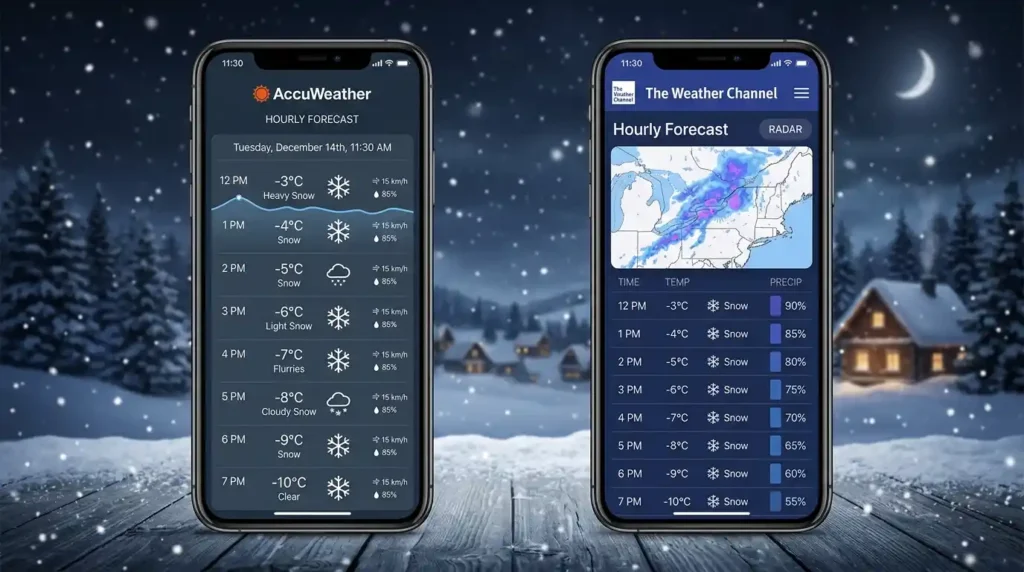
For parents trying to decide whether a 6 AM school bus is safe, hourly granularity is far more useful than a simple daily forecast.
AccuWeather offers hour-by-hour breakdowns up to 72 hours, including precipitation type (snow vs. sleet vs. freezing rain), snowfall intensity, and RealFeel® temperature. Their MinuteCast® feature drills into the next 2 hours with minute-by-minute precipitation start and stop times — invaluable for morning commute planning.
Weather.com provides hourly data as well, with a strong emphasis on precipitation probability and wind chill values. Their interactive maps allow users to scrub through time to visualize storm movement hour by hour.
Edge: AccuWeather’s MinuteCast® is unmatched for ultra-short-range precision. Weather.com’s animated radar gives better visual storm movement context.
Winter Storm Alerts and Warnings
Both platforms relay official NWS Winter Storm Watches, Warnings, and Advisories. However, they supplement official alerts differently.
AccuWeather issues its own AccuWeather Alerts™ that sometimes precede official NWS warnings when its proprietary models detect elevated risk. This proactive approach has been praised by emergency managers.
Weather.com integrates alerts into a bold, attention-grabbing notification system and publishes detailed storm briefings — written expert summaries explaining storm impacts, timeline, and affected geography.
For staying informed early, pairing these alerts with a dedicated Snow Day Calculator helps translate meteorological data into a practical school-closure prediction, saving you the guesswork.
Mobile App Experience for Snow Forecasting
AccuWeather App
The AccuWeather app is clean, fast, and information-dense. Winter weather features are prominently surfaced during storm periods. The Daily Snowfall Map and Winter Storm Center are accessible directly from the home screen during active winter weather events. Push notifications for winter alerts are reliable and timely.
Weather.com App
The Weather.com app is visually richer, with full-screen radar animations and embedded video content. However, some users find it heavier on advertisements and slightly slower to load. Its Storm Radar feature — a standalone companion app — is one of the best free radar tools available for tracking snow in real time.
Edge: AccuWeather for clean data access; Weather.com for radar visualization enthusiasts.
Hyperlocal Forecasting – Which Goes More Granular?
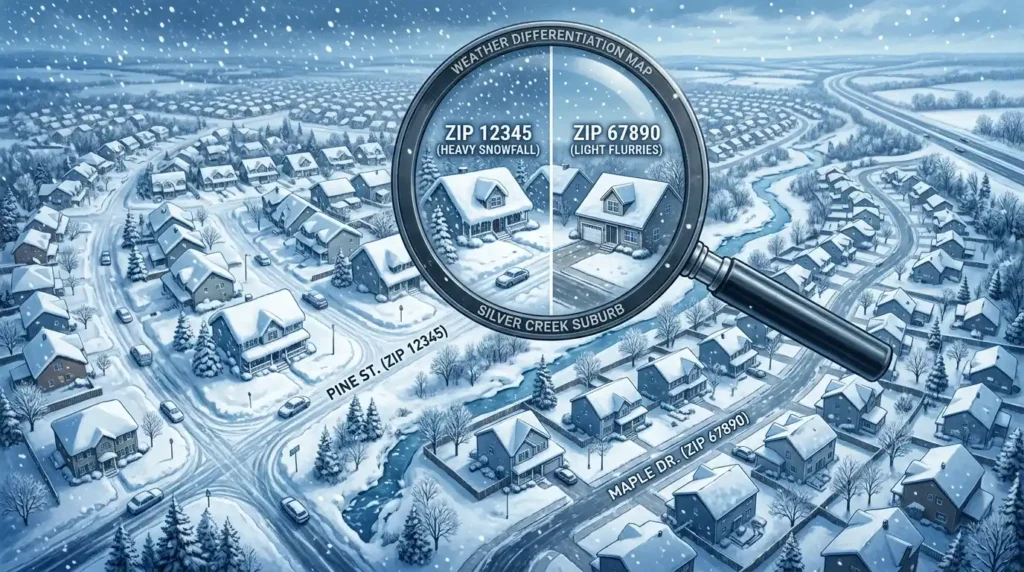
“Hyperlocal” forecasting refers to predictions specific to a precise geographic point — your neighborhood, your street — rather than a broad city-wide forecast.
AccuWeather has invested significantly in neighborhood-level forecasting, claiming accuracy down to 0.1 miles in supported markets. This is powered by a dense network of personal weather stations and partnerships with municipal data providers.
Weather.com, through IBM’s infrastructure, also provides point-based forecasts and integrates data from the Weather Underground personal weather station network (which IBM also owns), giving it access to over 250,000 citizen-operated weather stations worldwide.
Edge: Comparable, with Weather.com having a slight advantage in personal weather station data density thanks to Weather Underground integration.
AccuWeather vs Weather.com – Side-by-Side Comparison
| Feature | AccuWeather | Weather.com |
| Long-Range Snow Forecast (7–10 days) | ✅ Excellent | ⚠️ Good |
| Hourly Snowfall Detail | ✅ Excellent | ✅ Good |
| Real-Time Radar | ⚠️ Good | ✅ Excellent |
| Snowfall Accumulation Maps | ✅ Strong | ✅ Strong |
| MinuteCast® Precision | ✅ Unique Feature | ❌ Not Available |
| AI/ML Forecasting (Deep Thunder) | ❌ Not Available | ✅ Unique Feature |
| Mobile App Speed | ✅ Fast | ⚠️ Moderate |
| Winter Storm Alerts | ✅ Proactive | ✅ Strong |
| Personal Weather Station Integration | ⚠️ Good | ✅ Excellent |
| Free Access Quality | ✅ Strong | ✅ Strong |
When to Use Both Platforms Together
The most informed snow day watchers don’t choose one platform — they triangulate. Here’s a smart workflow:
- 5–7 days out: Check AccuWeather’s Extended Winter Forecast for storm potential windows.
- 2–3 days out: Compare AccuWeather and Weather.com accumulation range estimates. If they agree, confidence is higher.
- 24 hours out: Use Weather.com’s animated radar to track storm approach timing.
- Morning of: Use AccuWeather’s MinuteCast® to see exactly when snowfall begins and peaks.
This multi-source approach mirrors what professional meteorologists call ensemble forecasting — combining multiple model outputs to reduce individual model error. You can also check how other families approach this decision-making process in our Snow Day Calculator vs School District Hotline comparison.
How a Snow Day Calculator Complements Weather Forecasts
Even the best weather forecast doesn’t automatically tell you whether school will be cancelled. School closure decisions factor in road conditions, district policy, bus route accessibility, and administrator judgment — not just raw snowfall totals.
That’s where a dedicated Snow Day Calculator bridges the gap. By combining weather forecast data with historical school closure patterns and regional variables, a snow day calculator translates meteorological predictions into a practical probability score — answering the one question AccuWeather and Weather.com don’t: will school actually be cancelled?
For a deeper look at how these digital tools compare to traditional information sources, visit the National Weather Service’s Winter Weather Safety page at weather.gov/safety/winter — a comprehensive, authoritative resource for understanding winter storm classifications and safety thresholds used by school districts nationwide.
Conclusion
Both AccuWeather and Weather.com are powerful, trustworthy tools for snow day forecasting — and the honest answer is that neither is universally “better.” AccuWeather excels in long-range precision, minute-by-minute storm timing, and meteorologist-reviewed accumulation forecasts. Weather.com excels in real-time radar visualization, AI-powered short-range modeling, and personal weather station density.
For the typical parent or student nervously eyeing the forecast the night before a potential snow day, the winning strategy is to check both — use AccuWeather for confidence in accumulation totals and timing, and Weather.com for live storm tracking. Then, round out your decision-making with a Snow Day Calculator to see how that forecasted snowfall translates into actual school closure probability. When all three sources align, you can finally breathe easy — or start planning that snow day movie marathon.