Summary
Every Ohio student, parent, and school administrator knows the feeling — a winter storm is rolling in, and everyone wants to know the same thing: Will school be cancelled tomorrow? This comprehensive guide explains exactly how a Snow Day Calculator works for Ohio residents, what local weather data and school district policies factor into snow day decisions, and how you can use prediction tools to stay one step ahead of winter weather. Whether you’re in Columbus, Cleveland, Cincinnati, or a rural township in Appalachian Ohio, this article arms you with everything you need to know.
Table of Contents
- What Is a Snow Day Calculator?
- Why Ohio Is Uniquely Vulnerable to Winter Weather
- How Ohio School Districts Decide on Snow Days
- Key Factors the Snow Day Calculator Analyzes for Ohio
- How to Use the Snow Day Predictor for Ohio
- Regional Differences Across Ohio
- Tips for Parents and Students on Snow Day Prep
- Common Misconceptions About Snow Day Predictions
- Conclusion
Snow Day Calculator for Ohio – What You Need to Know
Ohio winters are no joke. From lake-effect snow pounding the northeastern counties to ice storms glazing Central Ohio highways, the Buckeye State faces a diverse and often dangerous range of winter weather events every single year. For millions of families across the state, the ritual is the same every storm season: check the weather app, refresh the school district website, and anxiously wait for that automated phone call or emergency alert.
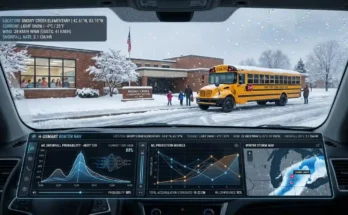
But what if there was a smarter, more data-driven way to predict whether your child’s school would cancel classes before you even went to bed? Enter the Snow Day Calculator for Ohio — a powerful, algorithmic tool that takes the guesswork out of winter weather school closures.
What Is a Snow Day Calculator?
A Snow Day Calculator is a digital prediction tool that uses real-time and forecast meteorological data, combined with historical school closure patterns, to estimate the probability that a school district will cancel classes due to winter weather conditions.
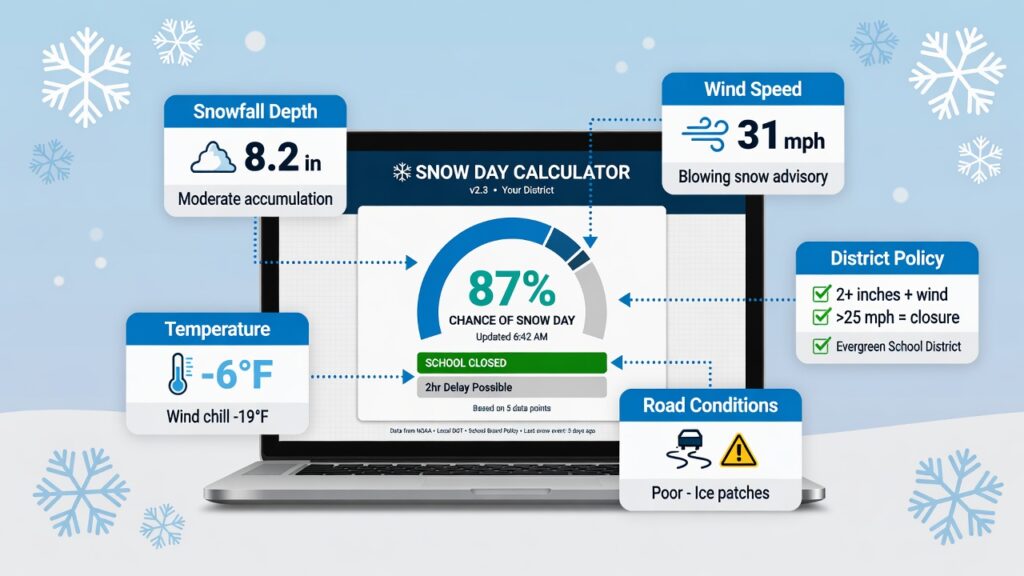
Unlike a basic weather forecast, which simply tells you how much snow is expected, a snow day calculator factors in a much richer set of variables: storm timing, temperature trends, wind chill, road conditions, regional geography, and even the specific closure thresholds of individual school districts.
These tools have become increasingly sophisticated. Modern snow day predictors use machine learning models trained on years of local school closure data, meaning their predictions grow more accurate over time as they learn the behavioral patterns of specific Ohio counties and districts.
How Accurate Are Snow Day Calculators?
Accuracy depends heavily on data quality and how far in advance the prediction is made. Most reputable tools achieve 70–85% accuracy when predicting 24 hours out, and accuracy climbs closer to 90%+ when the prediction window narrows to 12 hours or less. The more hyper-local the data, the better the prediction — which is why tools specifically calibrated for Ohio districts consistently outperform generic national weather apps.
Why Ohio Is Uniquely Vulnerable to Winter Weather
Ohio sits at a meteorological crossroads that makes it one of the most weather-volatile states in the entire Midwest. Several geographic and climatic factors combine to create a complex winter weather environment.
Lake-Effect Snow in Northeast Ohio
The northeastern corner of Ohio — including Cuyahoga, Lake, Geauga, and Ashtabula counties — is among the most snow-battered regions in the continental United States. Cold Arctic air masses sweep across Lake Erie, picking up massive amounts of moisture, and then dump that moisture as heavy snowfall the moment they hit land. Cleveland and surrounding communities can receive lake-effect snow events of 12–18 inches in a single day, completely independent of any broader storm system.
Ice Storms in Central and Southern Ohio
Central Ohio (Columbus metro) and the southern regions face a different but equally dangerous threat: freezing rain and ice storms. When warm, moist air from the Gulf of Mexico collides with Arctic cold fronts over Ohio, the result is often a thick glaze of ice coating every road, sidewalk, and power line. Just a quarter-inch of ice accumulation can make roads impassable and trigger widespread school closures across Franklin, Delaware, Licking, and Ross counties.
Wind Chill and Blowing Snow in Western Ohio
The flat agricultural plains of western Ohio — stretching through Darke, Mercer, Van Wert, and Defiance counties — offer little natural windbreak. Arctic winds can drive already-fallen snow into dangerous blizzard-like conditions with near-zero visibility, even when snowfall totals themselves are modest.
This geographic diversity is precisely why a generic national snow day calculator fails Ohio users. Accurate predictions require localized Ohio weather data feeding into the prediction model.
How Ohio School Districts Decide on Snow Days
Understanding the decision-making framework behind school closures helps you better interpret snow day calculator predictions.
The Role of the Superintendent
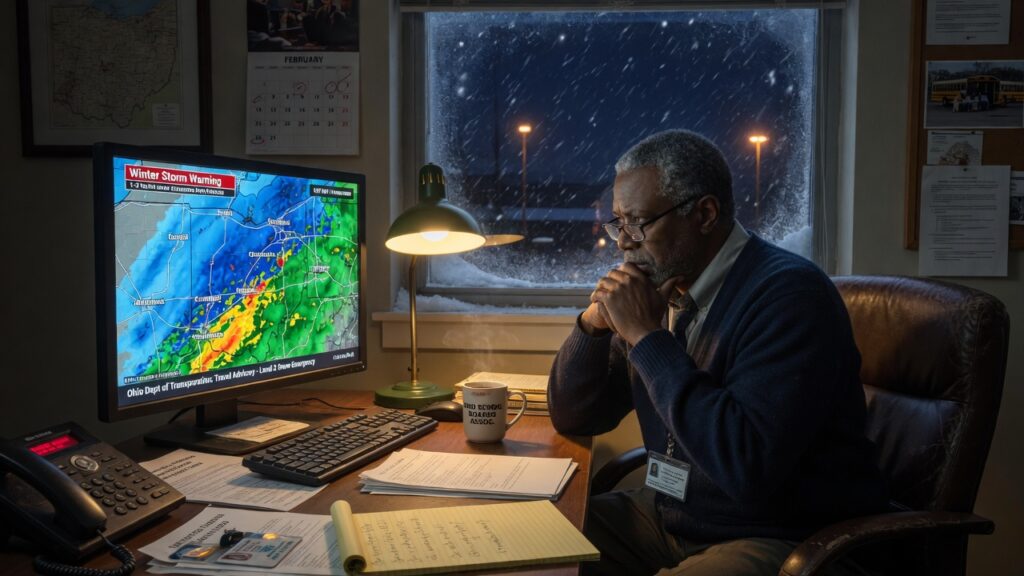
In Ohio, the authority to cancel school due to weather rests primarily with the district superintendent. This is not a decision made by the state government or the Ohio Department of Education and Workforce. Each of Ohio’s 600+ school districts operates under its own closure policy.
Superintendents typically begin monitoring weather forecasts 24–48 hours before a predicted storm. Most will make the final call between 4:00 AM and 6:00 AM on the day in question, after receiving updated road condition reports from county engineers and transportation supervisors.
What Gets Evaluated
For a deeper look at the exact criteria local administrators weigh, check out this detailed breakdown of Things Schools Check Before Calling a Snow Day — it covers everything from bus safety protocols to temperature thresholds and road treatment status.
Key factors typically include:
- Current and forecast snowfall accumulation (inches on the ground and expected)
- Wind chill advisory or warning status from the National Weather Service
- Road treatment and plowing status from the Ohio Department of Transportation (ODOT)
- Visibility conditions for school bus drivers
- Temperature at the time buses would begin running (typically 5:30–6:30 AM)
- Parking lot and sidewalk conditions at school buildings
Make-Up Day Requirements
Ohio school districts are required by state law to provide a minimum of 182.5 instructional hours (or an equivalent number of days, depending on the district’s scheduling model). Snow days consume those built-in buffer days first. Once the buffer is exhausted, districts must either add make-up days or petition the Ohio General Assembly for a waiver — something that occurred during particularly brutal winters like 2013–14 and 2018–19.
Key Factors the Snow Day Calculator Analyzes for Ohio
A well-designed Ohio snow day calculator doesn’t just check precipitation totals. Here’s a breakdown of the data layers it synthesizes:
1. National Weather Service Forecast Data
The tool pulls real-time forecast data from NWS offices in Cleveland, Pittsburgh (which covers eastern Ohio), and Indianapolis (which covers western Ohio). This includes hourly snowfall projections, wind speed and direction, and probability of precipitation.
2. ODOT Road Condition Reports
The Ohio Department of Transportation maintains a live road conditions map through its OHGO platform. Snow day calculators that integrate ODOT data can factor in whether primary and secondary roads in a given county have been pre-treated, are being actively plowed, or are closed entirely.
3. Historical Closure Data by District
By analyzing years of past snow day decisions across Ohio’s 600+ districts, the algorithm learns each district’s sensitivity thresholds. Some districts — especially rural ones with long bus routes — cancel school at 3–4 inches of snow. Urban districts with shorter routes may wait until 6–8 inches.
4. Temperature and Wind Chill Indices
Ohio law doesn’t mandate a specific wind chill closure threshold, but many districts have adopted informal benchmarks around -20°F wind chill as a trigger for closure. The calculator weighs current and projected wind chill readings accordingly.
5. Storm Timing Relative to School Hours
A snowstorm that peaks at 2:00 AM and tapers off by 5:00 AM — allowing several hours for road treatment before buses roll — is far less likely to cause a closure than one that intensifies between 5:00 AM and 8:00 AM. Storm timing is one of the most underappreciated variables in closure prediction.
How to Use the Snow Day Predictor for Ohio
Using the tool is straightforward, even for non-tech-savvy parents and students.
- Navigate to the Snow Day Predictor tool.
- Enter your Ohio location — either your city/town name or ZIP code.
- Select your school district from the dropdown, if prompted.
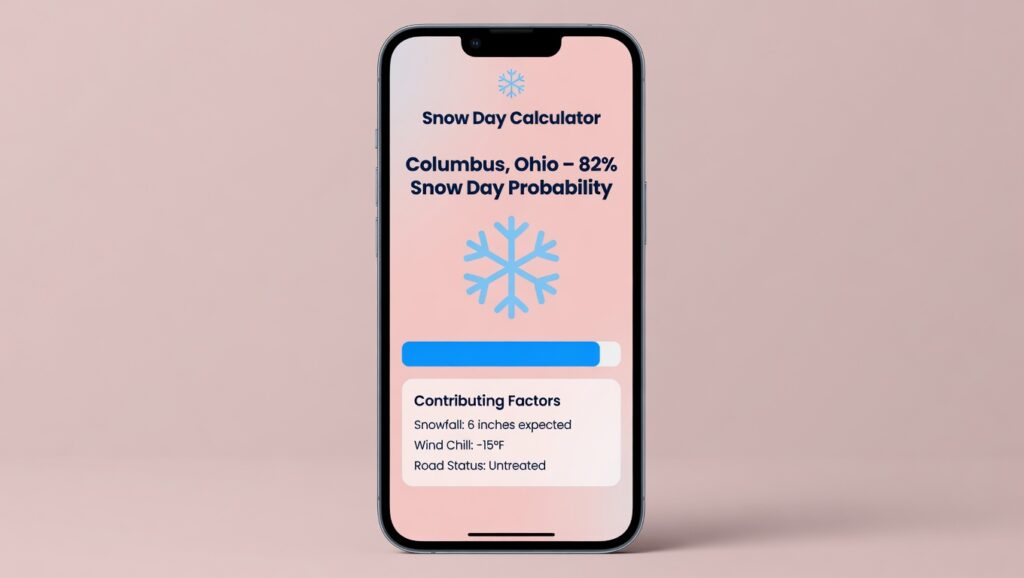
- Review the probability score — typically expressed as a percentage (e.g., “78% chance of a snow day tomorrow”).
- Check the contributing factors panel to understand why the score is what it is.
- Set a notification alert if the tool supports it, so you’re automatically informed of any probability changes as new weather data comes in overnight.
For best results, check the predictor again around 10:00 PM the night before a predicted storm, and again at 5:00 AM the morning of. The accuracy window sharpens considerably in those final hours.
Regional Differences Across Ohio
Because Ohio is meteorologically diverse, snow day probability varies dramatically by region even during the same storm.
| Region | Primary Winter Threat | Avg. Annual Snow Days |
| Northeast Ohio (Cleveland) | Lake-effect snow | 8–12 days |
| Central Ohio (Columbus) | Ice storms, mixed precipitation | 3–6 days |
| Southwest Ohio (Cincinnati) | Ice storms, occasional heavy snow | 2–5 days |
| Northwest Ohio (Toledo) | Blowing snow, lake-effect (Lake Michigan influence) | 5–8 days |
| Southeast Ohio (Athens/Appalachian) | Heavy mountain-effect snow, ice | 4–7 days |
A good Ohio snow day calculator accounts for these regional baselines when generating predictions. A 4-inch snowfall in Cleveland barely registers; the same 4 inches in Cincinnati can shut down an entire metropolitan school system.
According to the National Weather Service, Ohio averages between 20 and 100+ inches of annual snowfall depending on the county — a spread that reinforces why hyper-local prediction models matter. The NWS provides county-level winter weather advisories, watches, and warnings that serve as essential inputs for any reliable snow day prediction engine.Visit the NWS Winter Weather Resource Center for official guidance on Ohio winter storm classifications.
Tips for Parents and Students on Snow Day Prep
A high probability score from the snow day calculator doesn’t mean you should wait passively. Smart families use prediction tools to prepare, not just to speculate.
For Parents
- Arrange backup childcare early. If the probability score climbs above 60% the night before, start making calls now, not at 6:00 AM.
- Charge devices overnight. Ice storms in Ohio frequently knock out power. Ensure phones, tablets, and laptops are fully charged.
- Check the OHGO app (Ohio’s official road conditions platform) independently to assess commute safety for yourself, even if the school remains open.
- Sign up for your district’s emergency notification system — most Ohio districts use platforms like SchoolReach, ParentSquare, or Infinite Campus to push automated closure alerts.
For Students
- Don’t count on a snow day to finish homework. Even an 85% probability means there’s a 15% chance school is on. Complete your assignments the night before.
- Have winter gear accessible. On uncertain weather days, dress in layers regardless — conditions can change between morning and afternoon dismissal.
Common Misconceptions About Snow Day Predictions
“If it’s snowing heavily at midnight, school will definitely be cancelled.”
Not necessarily. Superintendents make decisions based on what conditions will be like at bus time — usually 5:30–7:00 AM — not at midnight. A storm that peaks early and allows for 4+ hours of plowing may not result in closure.
“The Snow Day Calculator is just guessing.”
Modern predictive tools use regression models and machine learning trained on thousands of historical closure data points. They are systematic, data-driven instruments — not digital coin flips.
“Urban districts cancel school less often.”
This is partially true and partially false. While urban districts with shorter bus routes can tolerate more snow, their greater population density means a single ice storm can create dangerous pedestrian conditions that rural schools don’t face. Urban districts in Ohio cancel school for different reasons, not necessarily less often.
Conclusion
Ohio’s winter weather landscape is one of the most complex and regionally diverse in the United States. From the brutal lake-effect snowbands battering Ashtabula County to the treacherous ice storms paralyzing Columbus each February, predicting school closures requires far more than a glance at the weather app.
A Snow Day Calculator for Ohio bridges the gap between raw meteorological data and the real-world decision-making frameworks that superintendents use. By integrating NWS forecast data, ODOT road conditions, historical district closure patterns, and storm timing analysis, these tools deliver actionable, probabilistic predictions that help families plan, prepare, and stay safe.
Whether you’re a parent arranging childcare, a student hoping for a day off, or a school administrator benchmarking your own decision against predictive data, the right snow day tool puts credible, hyperlocal intelligence at your fingertips.
Stay warm, stay informed, and let the data work for you this Ohio winter season.