Summary
This article Public vs Private Schools: Who Calls Snow Days First explores the fascinating differences between how public and private schools approach snow day decisions. From bureaucratic chains of command to independent administrator authority, we break down the key factors that influence when — and why — each school type pulls the trigger on a snow day. Whether you’re a parent, student, or just weather-curious, this deep dive covers decision-making frameworks, accountability structures, historical patterns, and practical tools to help you predict your next day off.
Table of Contents
- Introduction
- Understanding the Snow Day Decision Framework
- Public Schools: How the Decision Gets Made
- Private Schools: The Independent Advantage
- Key Factors That Influence Snow Day Timing
- Geographic and Regional Patterns
- How Technology and Weather Tools Are Changing the Game
- Parent Expectations and School Accountability
- Real-World Patterns: Who Calls It First?
- Tips for Predicting Your School’s Snow Day
- Conclusion
Public Schools vs Private Schools – Who Calls Snow Days Earlier?
Every winter, millions of students across North America wake up before dawn, press their faces against frosted windows, and wait — hoping for that magical announcement that school is cancelled. But have you ever noticed that some schools seem to call snow days hours before others? The difference often comes down to one critical factor: whether the school is public or private.
Understanding why one institution cancels before another isn’t just trivia. It reveals big structural differences in governance, liability, community expectations, and administrative authority. Let’s break it all down.
Understanding the Snow Day Decision Framework
Before diving into the public vs. private debate, it’s important to understand what a snow day decision actually involves. School administrators don’t simply look outside and make a call — they are evaluating a complex set of variables, including:
- Road and transportation safety for students and staff
- School building conditions, such as heating systems and roof load capacity
- Local emergency management advisories
- Precipitation forecasts from meteorological services
- Staffing availability for teachers and support personnel
- Historical precedent and community expectations
The decision-making process differs dramatically depending on whether a school operates under a public district framework or a private institutional structure. These structural differences are at the heart of why snow day timing varies so widely.
Public Schools: How the Decision Gets Made
The Chain of Command
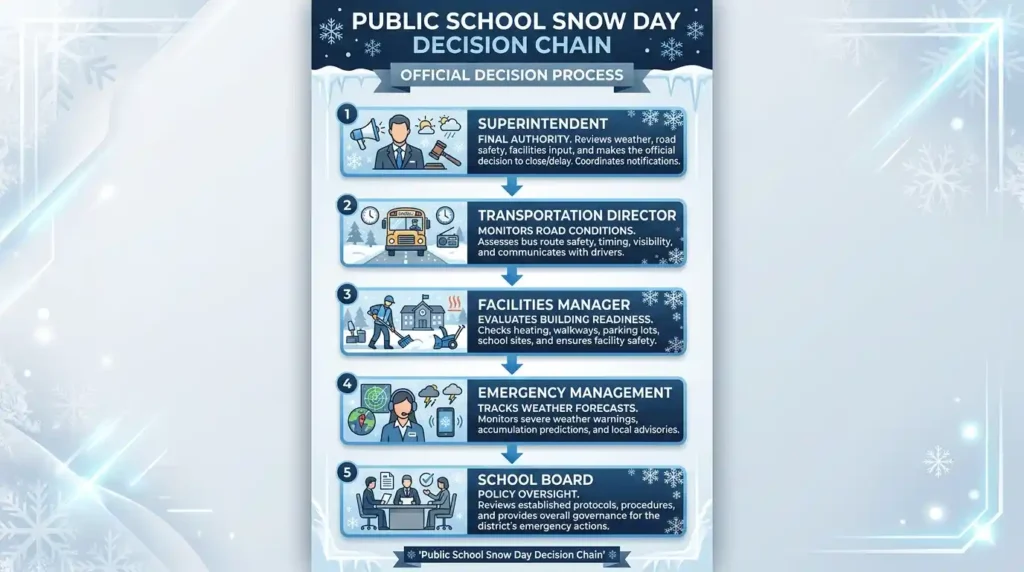
Public schools operate within a structured bureaucratic hierarchy. In the United States, a snow day decision for a public school typically flows through the following chain:
- Superintendent of Schools — the final authority
- Transportation Director — assesses road and bus route conditions
- Facilities Manager — checks building safety and heating
- Local Emergency Management Agencies — provide official weather advisories
- School Board — holds policy oversight (though not typically involved in same-day decisions)
This layered structure means the decision-making process is slower by design. The superintendent must gather input from multiple departments before making a call. Many districts also have formal written policies — sometimes approved by the school board — that define threshold conditions for closure.
The Role of State and District Policy
Public school districts are governed by state education departments and must comply with mandatory instructional day requirements. Most U.S. states require a minimum of 180 school days per year. This creates an institutional hesitancy to call snow days too liberally, as each cancelled day may need to be made up later — either by extending the school year or reducing vacation days.
This accountability pressure is a significant reason why public schools often delay their closure announcements compared to their private counterparts. Superintendents face scrutiny from both parent communities and school boards, making them more conservative in their decisions.
Communication and Announcement Timing
Public schools typically notify families through automated phone systems, email alerts, local TV and radio station announcements, and district websites. These systems require coordination, which adds time. Most public school snow day announcements are made between 5:00 AM and 6:30 AM, with some districts aiming for notification by 5:00 AM to accommodate early bus routes.
Private Schools: The Independent Advantage
Streamlined Decision-Making
Private schools — whether they are parochial schools, independent day schools, charter schools with independent governance, or boarding schools — operate with significantly more administrative autonomy. The head of school, principal, or headmaster can often make a unilateral snow day decision without consulting a school board or district office.
This independence translates directly into faster decisions. A private school head can look at a 6-inch overnight snowfall forecast, assess their school’s unique population (many of whom commute longer distances), and call a closure by 4:30 AM or earlier — before most public schools have even begun their deliberation process.
No Mandatory Day Requirements (or More Flexibility)
While many private schools still follow a 180-day calendar as a best practice, they are not legally bound by state instructional time mandates in the same way public schools are. This gives them greater flexibility to close early and make up time through alternative learning schedules, modified calendars, or remote instruction days.
Some elite private schools have adopted flexible academic calendars that build in buffer days precisely for weather events, removing the institutional hesitancy that slows down public school decisions.
Tuition-Paying Parents and Accountability Pressure
Here’s an interesting paradox: private schools face a different kind of accountability pressure. Their families are paying tuition — sometimes tens of thousands of dollars annually — and they expect a high standard of care and responsiveness. A private school that forces students to commute through a blizzard risks far more reputational damage than a public school making the same decision.
This tuition-driven accountability often pushes private school administrators to err on the side of caution, leading to earlier snow day calls.

Key Factors That Influence Snow Day Timing
Whether public or private, several shared and diverging factors shape when a school makes the call:
Transportation Infrastructure
Public schools often operate large school bus fleets covering wide geographic areas. Bus routes through rural or suburban roads are highly vulnerable to ice and snow. Transportation directors must physically inspect key routes, often beginning at 3:00 AM or 4:00 AM, to make recommendations. This legwork is actually one reason public school decisions, while slower bureaucratically, are often grounded in thorough on-the-ground assessment.
Private schools, especially those in urban areas, rely more heavily on parent drop-off and private transportation. Their decision-making doesn’t hinge as heavily on bus route conditions, allowing for faster calls based purely on weather data.
School Location and Population Density
Urban schools — both public and private — often call snow days less frequently than suburban or rural schools. Dense cities tend to be better equipped with road-clearing and salting infrastructure. Schools in rural New England, the Midwest, or mountainous regions have far lower thresholds for closure.
Administrator Experience and Institutional Memory
Experienced administrators build a strong institutional memory about how local weather patterns affect their specific school community. A veteran superintendent who has managed a district for 15 years may have deeply calibrated intuition — sometimes more reliable than any forecast model.
For a more data-driven approach to predicting school closures, tools like the Free Snow Day Calculator allow parents and students to calculate the probability of a snow day based on real-time local weather data. This kind of predictive tool is increasingly influencing how both types of schools — and their communities — anticipate closures.
Geographic and Regional Patterns
Regional culture plays a massive role. In the American South, where snowfall is infrequent and infrastructure for winter road treatment is minimal, even a light dusting can close both public and private schools simultaneously. In the Upper Midwest or New England, schools have higher thresholds for closure because heavy snow is an expected seasonal reality.
Interestingly, in regions with high snowfall, private schools in affluent suburban areas often call days off earlier because their students travel longer distances from upscale neighbourhoods with less road maintenance priority.
How Technology and Weather Tools Are Changing the Game
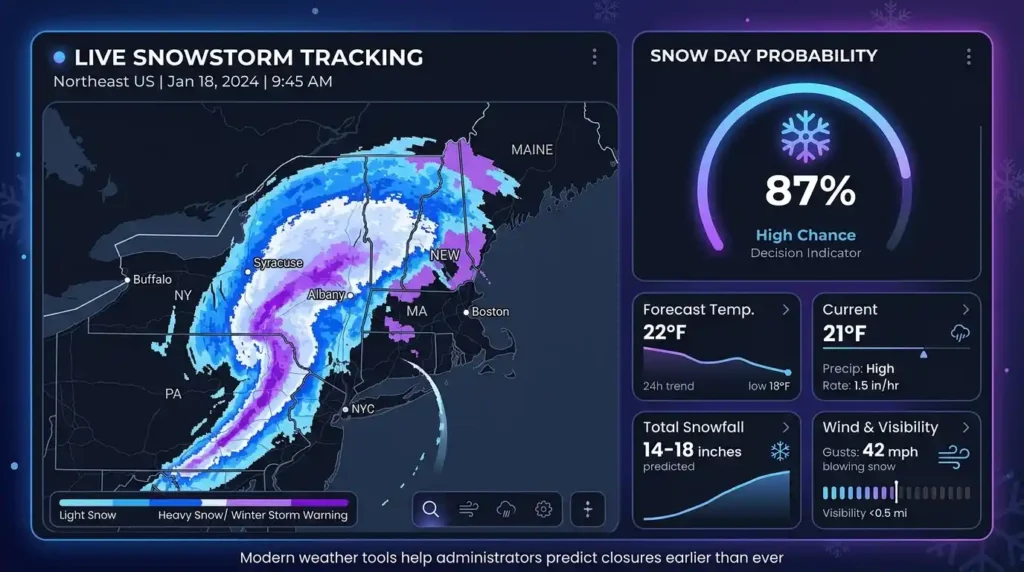
Modern meteorology has dramatically improved the accuracy and lead time of winter storm forecasting. Administrators now have access to:
- High-resolution weather models (GFS, NAM, ECMWF)
- Real-time road condition sensors from state DOTs
- Hyperlocal precipitation maps from services like Weather.com and AccuWeather
Speaking of which, the debate between weather services is real — check out our comparison of AccuWeather vs Weather.com to understand which platform gives more accurate local winter storm predictions for school closure planning.
The National Weather Service (NWS), operated by NOAA, remains the most authoritative source for official winter storm warnings, watches, and advisories, and is the primary reference point for most school district meteorological decisions. You can find their official winter storm resources at weather.gov.
Parent Expectations and School Accountability
The Social Media Effect
In the age of social media and instant communication, parent communities — especially in private school networks — are highly vocal and fast to react. A private school that waits too long to call a snow day and then has an incident (a student bus accident, a slip and fall on icy walkways) faces immediate and amplified public scrutiny.
Public school superintendents, while also accountable, operate within a more politically structured environment. They must balance community pressure against union agreements, state requirements, and district policies that can slow responsiveness.
Remote and Hybrid Learning as the New Variable
Post-pandemic schooling introduced a significant new variable: remote learning days. Many districts — both public and private — now use “virtual snow days” or “eLearning days” as alternatives to full cancellations. This has changed the calculus significantly.
Private schools, with more flexible technology infrastructure and often stronger eLearning platforms, have been faster adopters of the virtual snow day model. This means they may technically “close” in the traditional sense less often, but are still protecting student safety.
Real-World Patterns: Who Calls It First?
Based on consistent regional reporting and community patterns, the general consensus among educators and parents is:
- Independent private schools tend to call snow days 30 minutes to 2 hours earlier than comparable public school districts in the same geographic area.
- Urban public schools are often the last to cancel, given their lower transportation dependence and stronger city infrastructure.
- Rural public school districts with extensive bus networks often call closures surprisingly early — sometimes the night before — once a storm forecast reaches a certain threshold.
- Parochial schools (Catholic, Lutheran, etc.) tend to fall somewhere in between — faster than large public districts but slightly more conservative than elite independent schools.
Tips for Predicting Your School’s Snow Day
- Monitor the National Weather Service for official winter storm watches and warnings — these carry more weight than commercial forecast apps.
- Track historical patterns — your school’s past decisions during similar storm events are the strongest predictor.
- Use predictive tools like the Free Snow Day Calculator to get a data-backed probability estimate before you go to bed.
- Follow local transportation authority updates — if your city or county suspends bus service, school closures almost always follow.
- Watch school social media accounts — private schools especially often drop hints or early notifications via Instagram or Facebook before official announcements.
Conclusion
The question of who calls snow days earlier — public schools or private schools — doesn’t have a single universal answer, but the evidence strongly suggests that private schools, particularly independent institutions, act faster due to their streamlined decision-making authority, greater flexibility from state mandates, and tuition-driven accountability to families.
Public schools operate within a more complex, multi-layered governance structure that, while more deliberate and thorough, inherently slows the decision timeline. That said, rural public school districts with extensive bus networks are a notable exception — they often make the earliest calls of all, driven by the logistical demands of road safety across wide service areas.
What both school types share is a genuine commitment to student safety. Whether it takes one phone call or five department sign-offs, the goal is the same: keeping kids safe in dangerous winter conditions.
As weather forecasting technology continues to improve and virtual learning options expand, the traditional snow day announcement is evolving — but the thrill of waking up to that cancellation notice never gets old.
