Summary
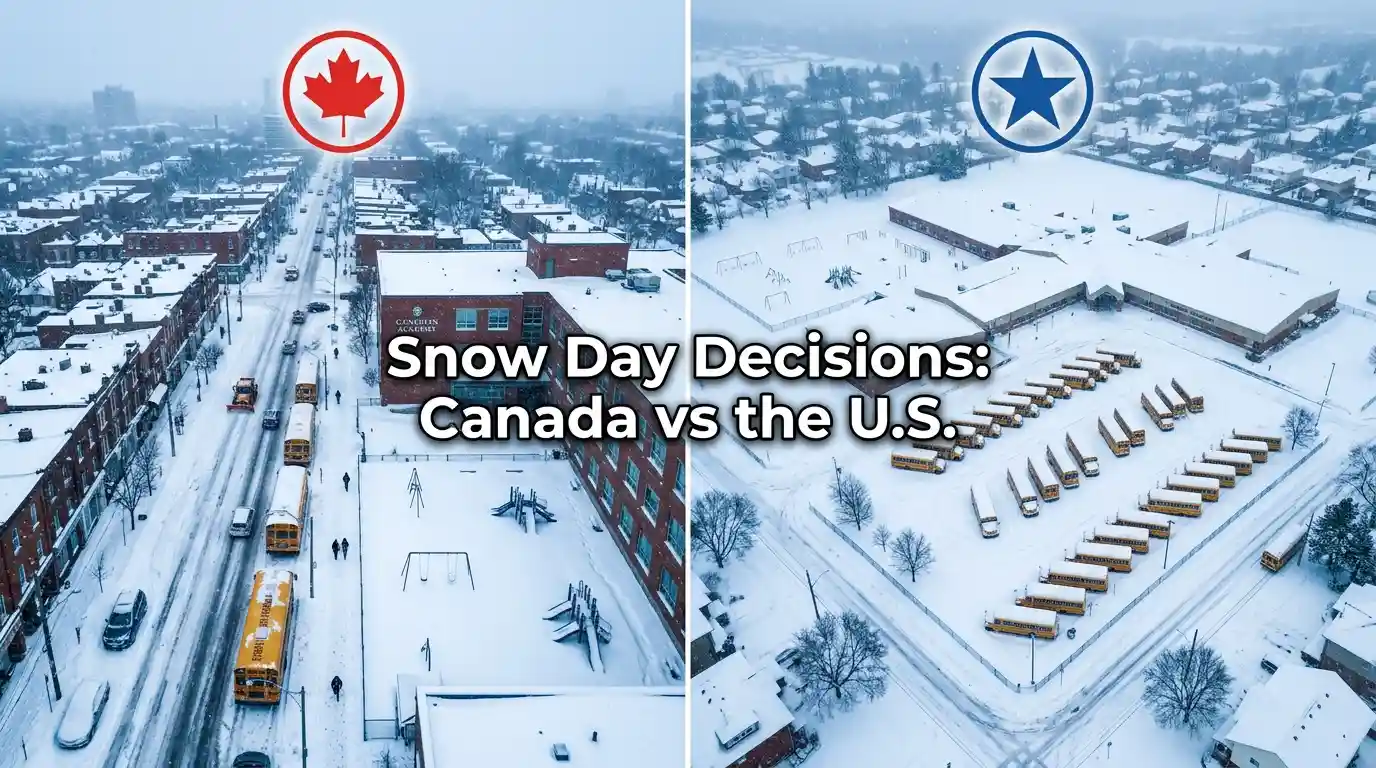
Every winter, millions of parents and students on both sides of the 49th parallel wake up with the same anxious question: Is school cancelled today? But the answer to that question is reached in surprisingly different ways depending on whether you’re in Winnipeg or Wisconsin. This article How are snow days decided in Canada vs the US breaks down exactly how snow day decisions are made in Canada versus the United States — from the decision-makers involved, to the tools, thresholds, and timelines used — and what those differences reveal about each country’s approach to education, safety, and winter preparedness.
Table of Contents
- Introduction: One Storm, Two Countries, Different Answers
- Who Actually Makes the Snow Day Call?
- Canadian Snow Day Decision-Making: Province by Province
- American Snow Day Decision-Making: District by District
- The Role of Weather Thresholds and Safety Standards
- Technology and Tools Used to Predict Snow Days
- Transportation Infrastructure: The Biggest Variable
- How School Boards Communicate Cancellations
- Virtual Snow Days: A Post-Pandemic Shift
- Cultural Attitudes Toward Winter in Canada vs the U.S.
- Conclusion
1. Introduction: One Storm, Two Countries, Different Answers
A February blizzard rolls across the Great Lakes. On one side of the border, an Ontario school board director is already on the phone with the regional transportation authority at 4:30 AM. On the other side, a Michigan superintendent is reviewing road condition reports and checking wind chill forecasts. Both are trying to answer the same critical question — but the frameworks, authorities, and cultural expectations guiding their decisions are remarkably different.
Snow day decision-making is not simply a matter of measuring snowfall. It is a complex, multi-variable process that intersects public safety policy, transportation logistics, labour agreements with teachers’ unions, parental expectations, and increasingly, digital forecasting technology. Understanding how Canada and the United States each navigate this process reveals big structural and cultural differences in how the two nations run their public school systems.
Whether you are a curious parent, a school administrator, or a policy researcher, this in-depth comparison will give you a comprehensive look at what goes on behind the scenes when the decision is made to call a snow day.
2. Who Actually Makes the Snow Day Call?
Canada: School Boards and Transportation Consortia
In Canada, the authority to cancel school almost always rests with school board directors or superintendents of education, working in close collaboration with student transportation consortia — regional bodies that manage bus fleets serving multiple school boards.
In provinces like Ontario, these transportation consortia (such as the Student Transportation of Eastern Ontario, or STEO) are often the first to recommend cancellations based on road assessments conducted by their own bus operators and dispatchers. The school board then makes the final call, but in practice, if the transportation consortium declares routes unsafe, schools rarely remain open.
United States: Superintendents at the District Level
In the United States, the decision is almost entirely centralized at the school district superintendent level. Superintendents hold significant autonomous authority — they consult with transportation directors, local law enforcement, and weather services, but the final call is theirs to make. There is no equivalent of Canada’s regional transportation consortia model in most American states. This means greater variation from district to district, even within the same county experiencing identical weather.
2. Canadian Snow Day Decision-Making: Province by Province
Ontario
Ontario has one of the most structured snow day systems in North America. School boards partner with regional student transportation consortia who deploy early-morning road patrols — actual bus drivers or road supervisors who drive predetermined routes as early as 4:00 AM to assess conditions firsthand. Decisions are typically made by 6:00–6:30 AM and communicated through board websites, automated phone calls, and local radio stations.
Quebec
Quebec’s approach is influenced heavily by its distinct linguistic school boards (now called school service centres under Bill 40) and its historically robust winter preparedness culture. Schools in cities like Montreal rarely close for snow alone — the city’s extensive underground pedestrian network and aggressive plowing schedules mean urban schools can operate in conditions that would shut down schools in warmer provinces. Rural Quebec schools, however, may close more readily due to dangerous road conditions on secondary routes.
Alberta and Saskatchewan
The Prairie provinces deal with extreme cold warnings as frequently as heavy snowfall. In Alberta, the cold weather protocol is often more decisive than snow accumulation — wind chills of -40°C or colder are a standard threshold for school closure recommendations. School boards work closely with Environment and Climate Change Canada (ECCC) for weather data and advisories.
British Columbia
BC’s Lower Mainland, including Metro Vancouver, is paradoxically one of the most disruption-prone regions in Canada despite receiving far less snow than Prairie provinces. Because the infrastructure — including roads, bus fleets, and driver training — is not built for heavy snow, even 5–10 cm of snowfall can trigger widespread school closures across the Fraser Valley and Metro Vancouver districts.
3. American Snow Day Decision-Making: District by District
The Role of the Superintendent
In the United States, the school district superintendent operates with considerable discretion. In states like Ohio, Pennsylvania, and New York, superintendents typically begin monitoring conditions the night before a potential storm, relying on the National Weather Service (NWS), private meteorological services, and coordination with county emergency management agencies.
State-Level Variation
There is no federal standard for snow day thresholds in the U.S. Instead, each of the approximately 13,000 school districts in the country sets its own informal or formal policy. A district in upstate New York with hardened infrastructure might stay open during a 12-inch snowfall that would close a district in Virginia or Tennessee, where even 2–3 inches creates hazardous road conditions due to lack of snowplows and road treatment equipment.
The Urban-Rural Divide
One of the most significant factors in American snow day decisions is the urban-rural divide in infrastructure and transportation. Urban districts with higher concentrations of walking students may prioritize sidewalk safety and wind chill. Rural districts, where students travel long distances on unplowed secondary roads, often close earlier and more frequently. For a deeper look at this dynamic, explore this analysis of urban vs. rural snow day patterns.
4. The Role of Weather Thresholds and Safety Standards

Canada: Cold as the Primary Variable
In Canada — especially in northern and Prairie regions — ambient temperature and wind chill often outweigh snowfall totals as the primary decision variable. A clear, sunny day with a wind chill of -45°C will close schools faster than a moderate snowstorm. The Wind Chill Warning threshold issued by ECCC (typically -40°C with wind chill) functions as a near-automatic trigger for many school boards.
United States: Accumulation and Road Safety
American school districts more commonly use snowfall accumulation and road condition indices as their primary metrics. Many districts consult the Road Weather Information System (RWIS) operated by state Departments of Transportation, which provides real-time data on pavement temperature, ice formation, and surface friction. A common informal threshold in northern U.S. states is 4–6 inches of overnight snowfall for a full closure, though this varies widely.
5. Technology and Tools Used to Predict Snow Days
Both Canadian and American school administrators have embraced digital tools to improve the accuracy and timeliness of snow day decisions. Parents and students, meanwhile, increasingly rely on predictive tools to anticipate cancellations before official announcements.
Tools like https://snowdaycalculator.online/ use real-time meteorological data, historical closure patterns, and location-specific variables to generate probability estimates for school closures — giving families an early indication of whether tomorrow might be a snow day.
On the administrative side, school boards use GIS-based route mapping software, automated road condition reporting apps, and direct API feeds from national weather services (Environment Canada and the National Weather Service) to model impact scenarios.
6. Transportation Infrastructure: The Biggest Variable
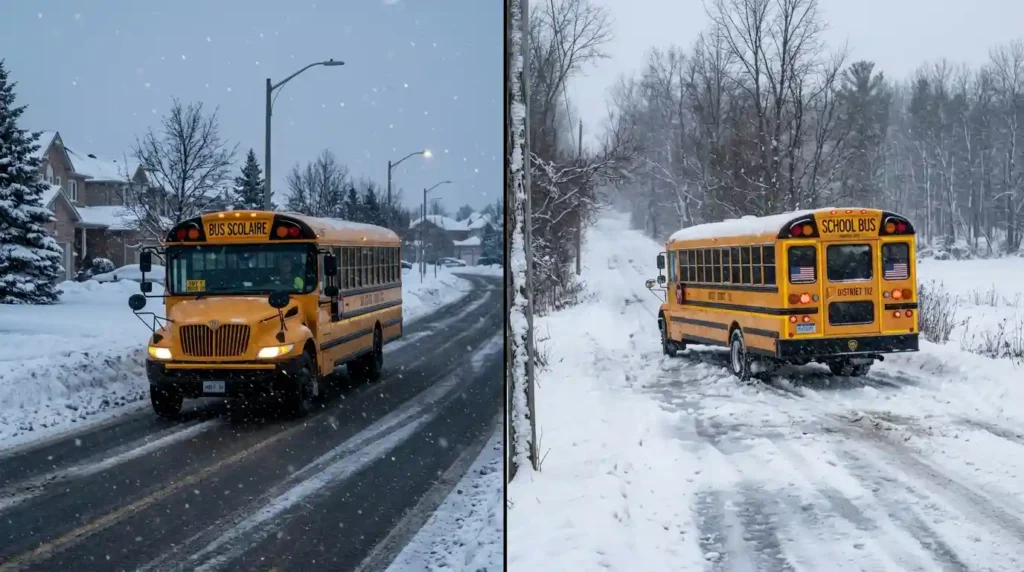
If there is one single factor that most explains the difference in snow day decisions between Canada and the United States, it is transportation infrastructure.
Canadian provinces — especially those in the snow belt — invest heavily in winter road maintenance. Fleet vehicles are often equipped with snow tires as a standard requirement (mandated in provinces like Quebec and British Columbia during winter months). Bus garages in northern Ontario or Saskatchewan maintain fleets specifically designed for extreme winter conditions.
In contrast, American school bus fleets vary enormously by geography. A school district in Minnesota may rival or exceed Canadian preparedness, while a district in Kentucky or Arkansas may have virtually no winter-rated equipment. According to the National School Transportation Association (NSTA), there are no federal mandates for winter-rated school buses, leaving procurement entirely to district budgets and local priorities.
This infrastructure disparity is why the same 10 cm (4 inches) of snowfall might close schools in Memphis, Tennessee, while barely registering as a concern in Thunder Bay, Ontario.
7. How School Boards Communicate Cancellations
Canada: Automated, Multi-Channel Systems
Canadian school boards have largely adopted automated notification platforms (such as SchoolMessenger or Edsby) that push cancellation notices via email, SMS, app notification, and phone calls simultaneously — often by 6:00 AM. Regional radio stations (particularly CBC Radio affiliates) remain a trusted backup channel, especially in rural and remote communities.
United States: District Websites, Social Media, and Local TV
American school districts rely heavily on local television stations, which traditionally run crawl-text notifications across the bottom of early morning news broadcasts. District websites, social media accounts (especially Twitter/X and Facebook), and apps like ParentSquare or Blackboard are now equally prominent. Some larger districts use reverse 911 systems to broadcast automated phone calls to all enrolled families.
8. Virtual Snow Days: A Post-Pandemic Shift
One of the most significant developments in snow day policy — on both sides of the border — has been the normalization of virtual or e-learning snow days. Following the rapid infrastructure buildout during the COVID-19 pandemic, many school boards now have the technical and pedagogical capacity to switch to online instruction rather than cancel school entirely.
In the United States, states like Michigan, Ohio, and Indiana have formally approved virtual snow day policies, allowing districts to log instructional hours even when buildings are closed. In Canada, several Ontario school boards piloted remote learning protocols during winter storm events in the 2022–2024 academic years.
This shift is controversial. Teachers’ unions in both countries have raised concerns about equity (not all students have reliable internet or devices at home) and workload. The debate over whether a virtual snow day is a real snow day is very much ongoing.
For an authoritative overview of school weather policy frameworks, the National Center for Education Statistics (NCES) provides extensive data on school calendar management and instructional time policies across U.S. states:https://nces.ed.gov.
9. Cultural Attitudes Toward Winter in Canada vs the U.S.
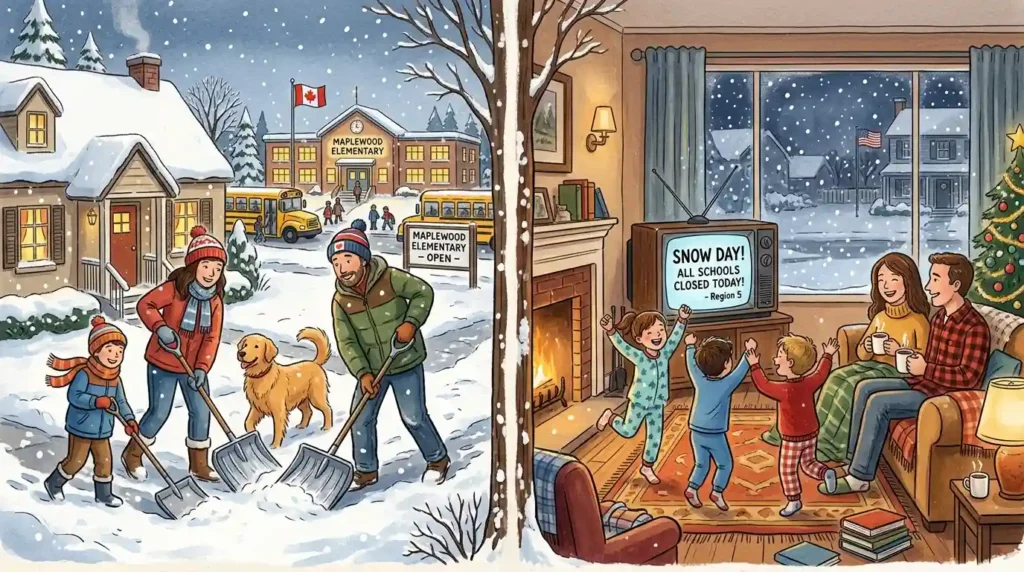
Perhaps the biggest difference between Canadian and American snow day culture is psychological. Canada, by necessity and identity, has cultivated a collective acceptance of winter as a permanent, non-negotiable feature of life. Canadian children are expected to dress appropriately and tolerate cold. The cultural narrative is one of resilience — a snowy commute is a normal commute.
In the United States, particularly in the mid-Atlantic and southern states, snow retains an almost novelty-like quality. Even modest snowfall events generate significant media coverage, grocery store rushes, and social media anticipation. This cultural dynamic subtly influences superintendent decision-making — closing school in a region with low snow tolerance carries less political risk and more parental approval than in regions where snow is routine.
Interestingly, even in traditionally snow-hardy American regions like the Upper Midwest and New England, there is growing evidence that climate change is shifting storm patterns, leading administrators to recalibrate their historical thresholds.
Conclusion
The decision to cancel school due to snow is far more than a weather call — it is an intersection of policy, infrastructure, culture, technology, and risk management. Canada’s approach, shaped by provincial governance structures, transportation consortia, and a cultural familiarity with severe winter, tends to be more structured and threshold-driven. The American approach, decentralized across thousands of independent school districts and mediated by diverse regional climates and infrastructure capacities, is more variable and superintendent-dependent.
Both systems are evolving. Virtual snow days are challenging the traditional binary of “open or closed.” Climate change is reshaping historical storm patterns. And digital tools are empowering both administrators and families to make better-informed decisions faster than ever before.
Understanding these differences isn’t just academically interesting — it matters for parents, school administrators, and policymakers working to balance student safety, instructional continuity, and community resilience every winter season.