Summary
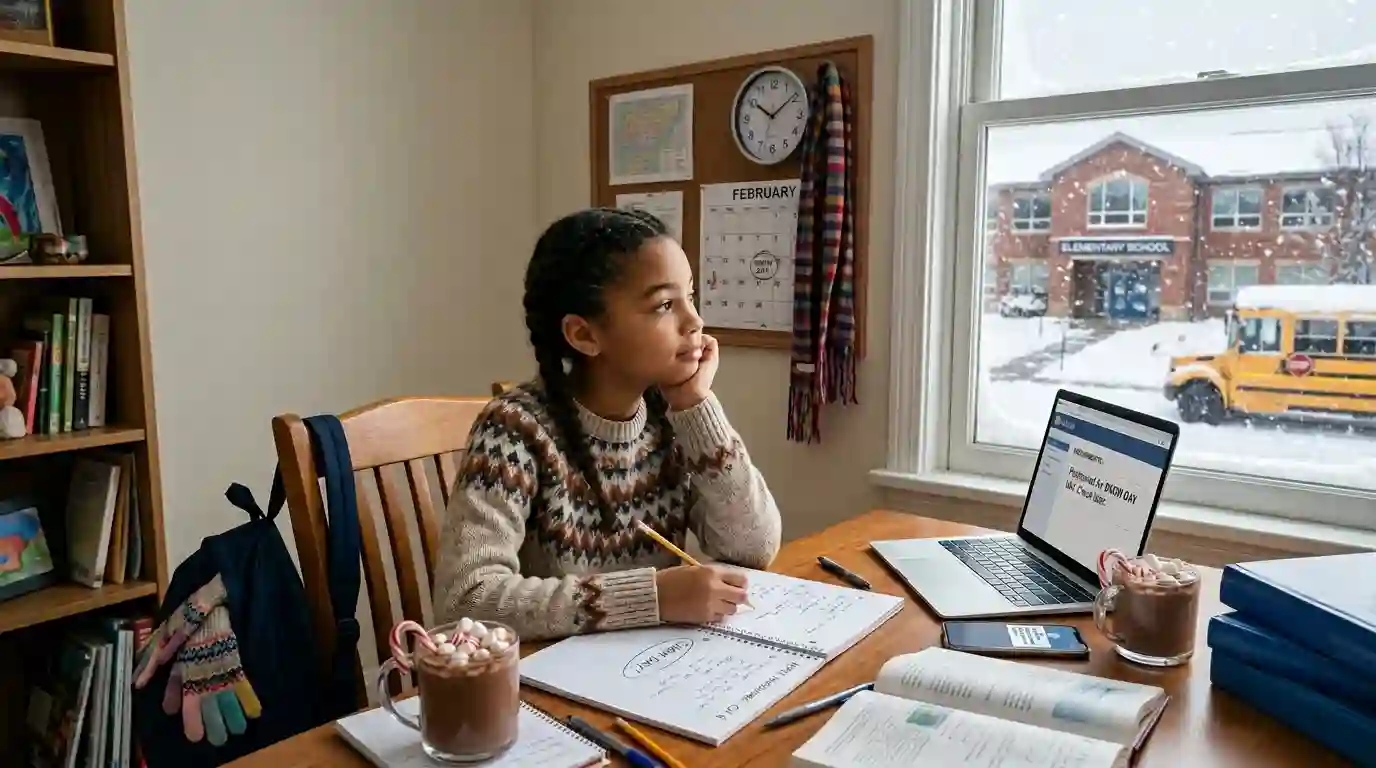
What Happens to Homework When There’s a Snow Day? In most cases, previously assigned homework remains due, but teachers may extend deadlines when school closures disrupt instruction, internet access, or communication. Some schools treat a snow day as a complete academic break, while others use remote learning, e-learning packets, or asynchronous assignments to count the day as instructional time. The exact outcome depends on the school district’s inclement weather policy, the teacher’s expectations, the student’s grade level, and whether the closure is considered a traditional snow day or a virtual learning day. Students should check official school announcements and learning platforms before assuming that homework has been canceled.
Table of Contents
- What Happens to Homework on a Traditional Snow Day?
- Why Snow-Day Homework Policies Vary
- Common Snow-Day Learning Scenarios
- How Teachers Handle Deadlines and Assignments
- What Students Should Do During a Snow Day
- What Parents Should Know
- Technology, Accessibility, and Educational Equity
- Can Schools Require Homework on a Snow Day?
- How Snow Days Affect the Academic Calendar
- Practical Snow-Day Homework Checklist
- Conclusion
- Frequently Asked Questions
What Happens to Homework When There’s a Snow Day?
A snow day does not automatically erase homework, cancel assignments, or remove academic responsibilities. In many schools, homework that was assigned before the closure remains active unless the teacher announces a change.
For example, suppose a teacher assigns a worksheet on Monday and makes it due Wednesday. If the school closes on Tuesday because of heavy snow, the worksheet may still be due Wednesday, especially when students already received all the instructions and materials needed to complete it.
However, teachers often adjust deadlines when the closure affects a lesson that students needed before completing the work. A mathematics assignment based on material that was supposed to be taught during the canceled school day may be postponed. A science lab report may also receive an extension if students need classroom equipment, group results, or additional teacher guidance.
The key distinction is whether the homework depends on missed instruction.
Previously Assigned Homework Usually Remains Active
Homework assigned before the snow day is generally more likely to remain due when:
- Students already received complete instructions.
- The work reviews previously taught material.
- Necessary books and materials are available at home.
- Students can submit the assignment digitally.
- The deadline falls after classes resume.
- The teacher has not announced a postponement.
Students should not assume that an assignment has disappeared simply because the school building is closed. A snow day changes the normal schedule, but it does not necessarily remove work that students were already expected to complete.
New Homework Depends on the Type of Closure
Whether teachers can assign new work depends largely on how the school classifies the day.
During a traditional emergency closure, teachers may not be required to conduct lessons or distribute new assignments. Some districts specifically protect traditional snow days as non-instructional days.
Other districts convert weather closures into remote learning days. Teachers may post readings, recorded lessons, discussion questions, digital quizzes, or independent practice activities. Students may be expected to complete these tasks before the next class or by a stated online deadline.
Teacher Communication Is the Deciding Factor
Official communication should take priority over assumptions, rumors, or informal student group chats. Teachers and school administrators may send updates through:
- A learning management system
- School email
- Parent communication applications
- Text alerts
- The district website
- Classroom announcement pages
- Automated telephone messages
- Digital gradebook notifications
If no update appears, students should follow the most recent instructions they received. When an assignment was already due, it is safer to complete it than to assume it has been canceled.
Why Snow-Day Homework Policies Vary
There is no single homework rule followed by every school. Snow-day procedures are usually determined at the district or school level, and teachers may have some discretion within those rules.
Several factors influence what happens to assignments.
District Inclement Weather Policies
School districts establish procedures for emergency closures, remote instruction, attendance, and make-up days. One district may declare a complete closure with no academic expectations. A neighboring district may require students to log in and complete asynchronous lessons.
Policies can also change from year to year as schools revise their academic calendars, technology plans, and instructional-hour requirements.
Families should review the district handbook or closure announcement rather than relying on what happened during a previous winter.
Student Grade Level
Homework expectations often differ by age.
Elementary students may receive optional reading, spelling practice, educational games, or a short activity packet. Teachers may avoid assigning extensive work because young children often need direct adult support.
Middle school students are more likely to have assignments posted through a digital classroom. High school students may be responsible for checking several course pages, communicating with different teachers, and continuing long-term projects.
College and university students generally have greater responsibility for managing deadlines independently. Unless an instructor announces an extension, online submissions and scheduled readings may remain due even when the physical campus is closed.
Length of the Closure
A single snow day may produce only minor changes. A prolonged winter storm can create a more serious interruption.
During a multi-day closure, schools may begin remote instruction even if the first day was treated as a traditional snow day. Teachers might adjust weekly lesson plans, replace classroom activities with digital alternatives, or reduce the number of assignments.
Long closures are also more likely to affect examination dates, grading periods, project presentations, laboratory work, and required instructional hours.
Access to Technology and Materials
A school cannot assume that every student has reliable internet service, a personal computer, a printer, or a quiet place to work. Severe winter weather may also cause power outages and communication disruptions.
Because of these limitations, some schools make digital snow-day work flexible or provide offline alternatives. Teachers may allow students to complete assignments after returning to school if technical access becomes a problem.
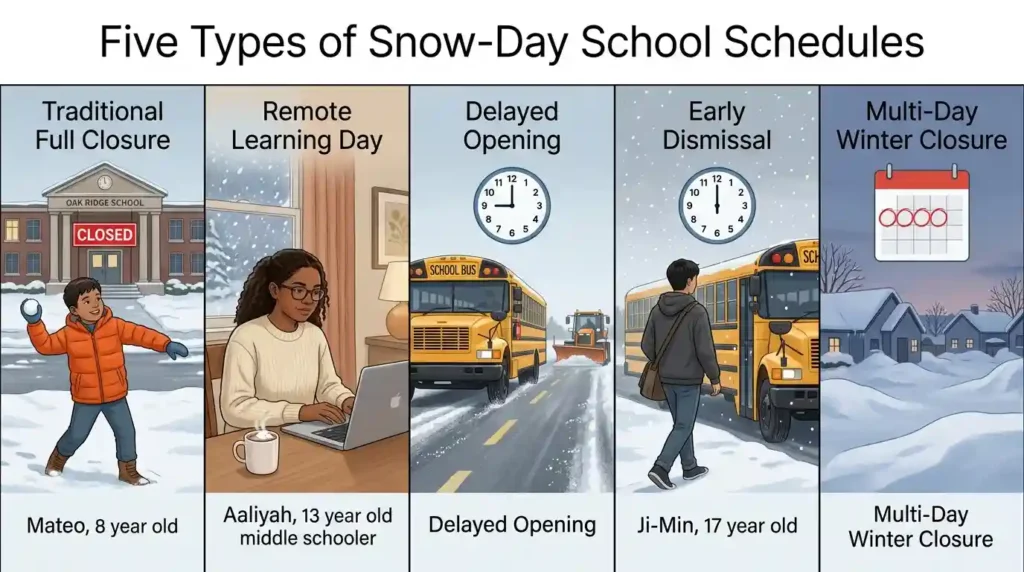
What Happens to Homework When There’s a Snow Day? Common Scenarios
The phrase “snow day” can describe several different situations. Understanding the type of closure helps students predict what will happen to their work.
Scenario 1: A Traditional Full Closure
The school building is closed, transportation is suspended, and the day does not count as an instructional day.
In this situation:
- Live classes are usually canceled.
- Teachers may not assign mandatory new lessons.
- Previously assigned homework may still be due.
- Tests and presentations are normally rescheduled.
- Students may be encouraged to read or review material voluntarily.
A traditional closure is the closest thing to a complete day off, but existing assignments do not necessarily disappear.
Scenario 2: A Remote or E-Learning Day
The building is closed, but instruction continues online.
Students may be required to:
- Check in for attendance.
- Watch recorded lessons.
- Join live video sessions.
- Read assigned chapters.
- Submit digital worksheets.
- Participate in discussion boards.
- Complete quizzes or independent practice.
- Contact teachers during virtual office hours.
In this situation, snow-day homework may function more like ordinary classwork. The assignment may be required for attendance, participation, or course credit.
Scenario 3: A Delayed Opening
A delayed opening usually shortens the school day rather than canceling it.
Homework deadlines often remain unchanged because students still attend classes. Teachers may reduce class activities or move a quiz, but assignments due that day may still need to be submitted.
Students should bring completed work unless the teacher says otherwise.
Scenario 4: An Early Dismissal
When snow begins during the school day, administrators may dismiss students early. Teachers might not have time to explain the evening’s homework or distribute printed materials.
Assignments that were already posted may remain due. New assignments that depend on missed instruction may be delayed or modified.
Scenario 5: A Multi-Day Weather Emergency
Several consecutive closures can force schools to reorganize instruction. Teachers may consolidate lessons, remove lower-priority exercises, extend project deadlines, or introduce remote learning.
Students should check announcements daily because expectations may change as the closure continues.
How Teachers Usually Handle Deadlines and Assignments
Teachers generally try to balance academic continuity with fairness. Their decisions depend on what students can reasonably complete outside the classroom.
Homework Based on Previous Lessons
Assignments reviewing material already taught are the least likely to be postponed. Examples include:
- Reading a chapter
- Completing vocabulary exercises
- Revising an essay
- Solving practice problems
- Studying for a future test
- Continuing a research project
- Finishing an art or writing draft
Because students already have the necessary knowledge, teachers may expect the work to continue as planned.
Homework Based on a Canceled Lesson
Assignments tied to missed instruction are more likely to change. A teacher may need to explain a concept, demonstrate a process, distribute materials, or answer questions before students can work independently.
In these cases, teachers may:
- Move the deadline.
- Reduce the number of questions.
- provide written or recorded instructions.
- Replace the assignment with a simpler activity.
- Review the material when school reopens.
- Make the assignment optional.
- Exclude the task from grading.
Tests and Quizzes
In-person tests are normally postponed when the school building is closed. The new date may be the first day back, but many teachers provide an additional review period.
Online quizzes are less predictable. A quiz may remain available when students were informed about it in advance, although teachers should consider internet outages and device access.
Students should check whether the assessment has a fixed closing time. They should contact the teacher promptly when weather-related technical problems prevent completion.
Projects and Presentations
Long-term projects often retain their original deadlines because students had several days or weeks to complete them. However, teachers may extend the deadline when students need classroom resources, library materials, laboratory data, or face-to-face collaboration.
Presentations scheduled for the closure date are usually moved to the next available class period.
Group Assignments
Snow days can complicate collaborative work. Students may not be able to meet safely or communicate reliably.
Teachers may extend the deadline, adjust the grading criteria, or allow group members to submit individual components. Students should document their progress and communicate any access problems rather than waiting until school reopens.
What Students Should Do During a Snow Day
A snow day can create uncertainty, but a simple process can prevent missed deadlines.
Check Official Announcements First
Students should begin with the school’s official information channels. A social media post from a classmate is not a substitute for a teacher announcement.
Check the learning platform, email inbox, course calendar, district website, and any classroom applications used by the school.
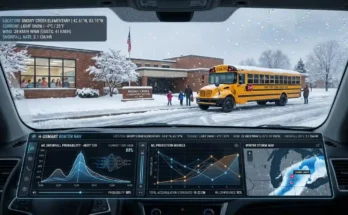
Families monitoring the likelihood of a closure can also consult the Snow day Predictor Tool when planning the following day’s schedule. The tool can support preparation, but official school announcements remain the final authority on whether classes are canceled.
Review Existing Assignments
Students should make a list of:
- Work already assigned
- Original due dates
- Required materials
- Online submission times
- Upcoming tests
- Long-term project milestones
- Questions that require teacher clarification
This prevents a weather closure from turning into an avoidable backlog.
Complete Work That Is Clearly Possible
When an assignment is understandable and the necessary materials are available, completing it is usually the best decision.
Even if the teacher later extends the deadline, the student will have avoided falling behind. Finishing existing work can also make the return to school less stressful.
Ask Specific Questions
When an assignment is unclear, students should send a concise message. A useful question might be:
“Is the essay still due online at 8:00 p.m., or has the deadline changed because of today’s closure?”
Specific questions are easier for teachers to answer than general messages such as “Do we still have homework?”
Save Evidence of Technical Problems
Students experiencing an internet or power outage should record the approximate time and nature of the problem when possible. A screenshot of a failed submission or an error message may help explain why work was late.
The purpose is not to create an excuse. It is to provide accurate information about circumstances outside the student’s control.
Avoid Unsafe Travel for School Materials
Students should not travel through hazardous conditions simply to retrieve a textbook, print a worksheet, or exchange materials with a classmate. Safety takes priority.
The National Weather Service winter weather safety guidance provides practical information about preparing for snow, ice, extreme cold, and dangerous travel conditions.
What Parents Should Know About Snow-Day Homework
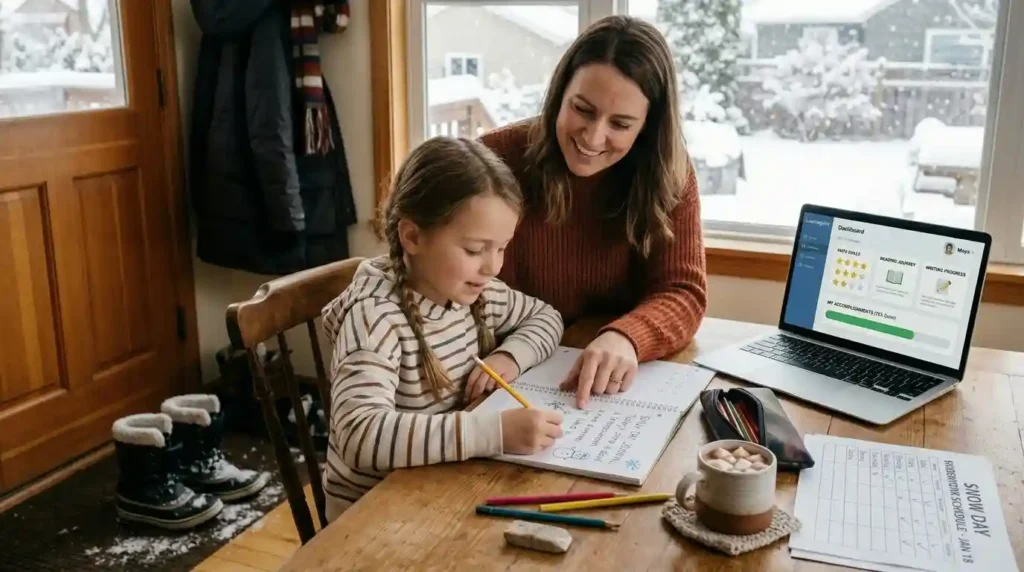
Parents often face two challenges at once: understanding the school’s academic expectations and managing an unexpected change in the household schedule.
Create a Flexible Routine
A snow day does not need to follow the exact structure of a regular school day. A modest routine may include:
- Checking school messages
- Completing urgent assignments
- Reading or reviewing lessons
- Taking a break
- Participating in outdoor activities when conditions are safe
- Preparing materials for the return to school
This approach creates structure without turning the entire day into a rigid home classroom.
Support Without Taking Over
Parents can help children interpret instructions, organize materials, or contact the teacher. They should avoid completing the work for the student.
When adults provide too much assistance, the assignment no longer shows what the student understands. Teachers also lose useful information about where the student needs support.
Consider the Child’s Age and Needs
A first-grade student may need direct supervision to access an online lesson. A high school student should generally be able to manage course pages and deadlines with limited reminders.
Children with attention difficulties, learning differences, or anxiety may need a shorter work period, visual schedule, movement breaks, or additional reassurance.
Balance Academic Work With Rest
Weather closures are disruptive. Some children may be excited, while others feel unsettled by changes in routine. Parents can support academic continuity without expecting hours of uninterrupted study.
A focused period of meaningful work is often more productive than forcing a child to sit at a desk throughout the day.
Plan for Childcare Disruptions
A closure may affect work schedules, transportation, meal routines, and supervision. Families can prepare more effectively by understanding how Snow Days Affect After-School Childcare Plans.
When childcare is uncertain, parents should communicate early with teachers if the child cannot participate in scheduled online activities.
Technology, Accessibility, and Educational Equity
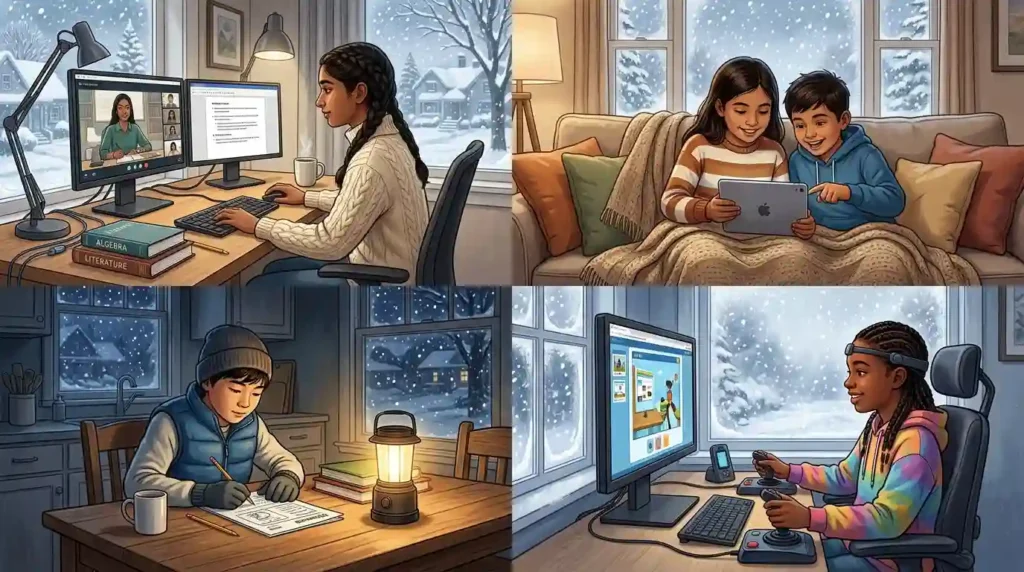
Remote snow-day instruction may appear simple, but it can expose significant differences in students’ home circumstances.
Internet and Device Access
Some households have several children sharing one computer. Others rely on mobile data, experience unstable broadband service, or lose electricity during winter storms.
Teachers should avoid assuming that every student can participate at the same time or submit large files quickly.
Flexible deadlines, downloadable materials, mobile-friendly platforms, and offline alternatives can make remote assignments more accessible.
Students With Disabilities
Students with disabilities may rely on classroom support that is difficult to reproduce at home. This may include:
- Assistive technology
- Speech or language services
- Individualized instruction
- Classroom aides
- Accessible learning materials
- Extended time
- Reduced-distraction environments
- Alternative assignment formats
Snow-day work should remain consistent with applicable accommodations and the student’s educational plan. Families should contact the school when an assignment is inaccessible or requires support that is unavailable at home.
English-Language Learners
Students learning English may need translated instructions, visual explanations, vocabulary support, or additional time. Brief written directions posted without classroom explanation can create confusion.
Teachers can improve access by using clear language, examples, audio instructions, and translated family communications where available.
Home Responsibilities
Older students may be responsible for supervising younger siblings when schools close. Some may also need to help family members, manage household tasks, or continue part-time work.
These responsibilities do not eliminate academic expectations, but they can affect when and how students complete assignments. Asynchronous work is often more equitable than requiring every student to attend a live session at the same time.
Can Schools Require Homework on a Snow Day?
Schools can generally require work when the closure is designated as an instructional or remote learning day. Expectations should be communicated through district policies, school announcements, or teacher instructions.
Traditional snow days are more complicated. Some districts do not count these days as instructional time, which may limit requirements for new mandatory lessons. Nevertheless, teachers may still expect students to complete work that was assigned before the closure.
The distinction often involves three questions:
- Was the day officially classified as a non-instructional closure or a remote learning day?
- Was the assignment given before or after the closure announcement?
- Did students have reasonable access to the instructions, materials, and support needed to complete it?
Policies differ among jurisdictions and institutions. Students and parents should consult the current school handbook, district closure policy, or course syllabus for the most accurate answer.
Are Snow-Day Assignments Graded?
They may be. When remote learning replaces the school day, assignments can count toward participation, attendance, homework, or classwork grades.
Teachers may also grade previously assigned work under the ordinary course policy.
Optional enrichment activities should be clearly labeled so students understand whether completion affects their grade.
Can Late Penalties Apply?
A teacher may apply a late penalty when the assignment remained due and students had adequate notice and access. However, weather-related power failures, internet disruptions, missing materials, and inaccessible platforms can justify flexibility.
Students should communicate problems as soon as reasonably possible. Waiting several days without contacting the teacher can make the situation harder to resolve.
How Snow Days Affect the Academic Calendar
Homework is only one part of the disruption. Closures may also affect the number of instructional days or hours required by the school system.
Make-Up Days
Some districts build extra days into the academic calendar. When closures exceed that allowance, schools may add instructional days later in the year.
Possible make-up options include:
- Using scheduled professional development days
- Shortening a holiday break
- Extending the school year
- Converting future closures into remote learning days
- Adding instructional minutes to other school days
The chosen method depends on district policy and applicable educational requirements.
Changes to Lesson Plans
Teachers usually plan units around a limited number of class periods. A closure can compress the schedule, especially before examinations, grading deadlines, or holiday breaks.
Teachers may remove a lower-priority activity, combine lessons, assign additional reading, or move a project into the next unit. Students may notice a faster pace when school resumes.
Effects on Exams and Major Projects
Standardized testing windows, final examinations, performances, laboratory assessments, and group presentations can be difficult to reschedule.
Schools generally prioritize required assessments and major instructional objectives. Smaller homework assignments may be reduced when students need time to prepare for rescheduled tests.
Practical Snow-Day Homework Checklist
The following checklist can help students and families respond without confusion.
Checklist for Students
- Confirm that school is officially closed or operating remotely.
- Check email, the learning platform, and class announcements.
- Review homework that was assigned before the closure.
- Note the exact submission date and time.
- Complete assignments that do not depend on missed instruction.
- Check for new remote-learning activities.
- Contact the teacher about unclear instructions.
- Save work locally in case internet service fails.
- Keep evidence of unsuccessful online submissions.
- Prepare books and materials for the next school day.
Checklist for Parents
- Confirm the type of closure.
- Check school and district messages.
- Help younger children access their assignments.
- Create a flexible work and break schedule.
- Avoid completing the child’s work.
- Inform teachers about significant technology or childcare problems.
- Prioritize safety during severe weather.
- Monitor changes to reopening plans.
- Help the child organize work before classes resume.
Checklist for Teachers
- Clearly state whether existing deadlines have changed.
- Distinguish required work from optional enrichment.
- Avoid assigning work that depends on unavailable classroom materials.
- Provide instructions in more than one accessible format where possible.
- Allow reasonable flexibility for power and internet outages.
- Consider the age and independence level of students.
- Coordinate major assignments with other teachers when closures continue.
- Explain how snow-day work will be graded.
- Provide a reasonable way for students to ask questions.
- Post a clear plan for the first day back.

Conclusion
So, what happens to homework when there’s a snow day? The most accurate answer is that it depends on the assignment, the school’s closure policy, and the way the day is classified.
Previously assigned homework often remains due when students already have the necessary instructions and materials. Work connected to a canceled lesson is more likely to be postponed or revised. During a remote learning day, students may receive new assignments and may need to participate online. Tests, presentations, laboratory activities, and other in-person tasks are usually rescheduled.
Students should rely on official communication rather than assuming that all work has been canceled. Checking the learning platform, reviewing existing deadlines, and contacting the teacher with specific questions can prevent misunderstandings.
At the same time, schools and teachers should recognize that snowstorms can cause power failures, internet problems, childcare disruptions, and unequal access to learning resources. Clear expectations and reasonable flexibility allow students to continue learning without ignoring the realities of a winter emergency.
A snow day may close the school building, but whether it pauses schoolwork depends on the policy behind the closure.
Frequently Asked Questions
Does a snow day mean there is no homework?
Not necessarily. Homework assigned before the closure may remain due. Students should check the teacher’s latest instructions before assuming that an assignment has been canceled.
Is homework automatically due the day after a snow day?
It may be due the next time the class meets, but the teacher can extend the deadline. Assignments that depend on a missed lesson are more likely to be postponed.
Can teachers assign new homework during a snow day?
Teachers may assign new work when the day is designated as a remote or e-learning day. New mandatory assignments are less common during a traditional non-instructional closure.
Do students have to attend online classes on a snow day?
Students may need to attend when the school has officially converted the closure into a virtual learning day. The school should communicate attendance requirements, login times, and alternatives for students with access problems.
What happens to a test scheduled on a snow day?
An in-person test is usually rescheduled. An online test may remain available, although teachers may extend the testing window because of internet or power disruptions.
What should a student do when the teacher has not posted an update?
The student should follow the most recent assignment instructions, complete any work that is clearly possible, and send a specific question if the deadline is uncertain.
Can a student receive a late penalty because of an internet outage?
Policies vary, but teachers often provide flexibility when a documented power or internet outage prevents submission. The student should communicate the problem as soon as possible and retain evidence of a failed upload when available.
What happens when a student leaves a textbook at school?
The student should notify the teacher rather than travel in unsafe weather. The teacher may provide a digital copy, an alternative assignment, or additional time.
Is snow-day homework different for elementary and high school students?
Yes. Elementary assignments are often shorter and may require parent support. High school students are generally expected to monitor several classes, manage digital deadlines, and continue independent projects.
Are college assignments canceled when the campus closes for snow?
Campus closure does not automatically cancel college assignments. Online submissions, readings, and remote classes may continue unless the instructor or institution announces a change.
Should children spend the entire snow day doing schoolwork?
Usually not. Students should complete required work, but they also need meals, rest, movement, and appropriate breaks. The amount of work should reflect the student’s age and the school’s expectations.
Can optional snow-day activities improve a student’s grade?
That depends on the teacher’s policy. Optional enrichment may be ungraded, offered for extra credit, or used as review. Teachers should clearly explain whether an activity affects the student’s grade.