SUMMARY
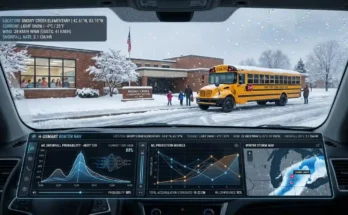
This article, Snow Day Calculator: What It Is & Who Needs It, is a complete, beginner-friendly guide to understanding what a snow day calculator is, how it works, and exactly who benefits from using one. It covers the mechanics of snow day prediction tools, the data inputs they rely on, and why they’ve become a go-to resource for parents, students, teachers, and school administrators across the United States. With SEO-optimized content, LSI keywords, and clear section breakdowns, this article is designed to rank for informational queries related to snow day prediction tools and winter school closure decisions.
TABLE OF CONTENTS
- What Is a Snow Day Calculator?
- A Brief History of Snow Day Prediction
- How Does a Snow Day Calculator Actually Work?
- What Data Goes Into a Snow Day Prediction?
- Who Should Use a Snow Day Calculator?
- Snow Day Calculator vs. Standard Weather Apps – What’s the Difference?
- How Reliable Are Snow Day Prediction Tools?
- Tips for Getting the Most Accurate Snow Day Prediction
- Conclusion
What Is a Snow Day Calculator and Who Should Use It?
Every winter, the same ritual plays out in millions of households across the country. Kids press their faces against cold glass windows, scanning the skies. Parents nervously refresh weather apps. Teachers quietly hope the superintendent makes the call before morning chaos sets in. The question hanging in the air is always the same: Will school be cancelled tomorrow?
Enter the snow day calculator — a specialized digital tool that takes the guesswork out of winter school closure predictions. Whether you’re a parent planning childcare, a student hoping for a free day, or a school administrator preparing communication plans, a snow day calculator delivers something that generic weather forecasts cannot: a probability-based prediction built specifically around school closure decisions.
In this guide, we’ll break down exactly what a snow day calculator is, how it works, who should be using it, and why it has become one of winter’s most searched tools.
What Is a Snow Day Calculator?
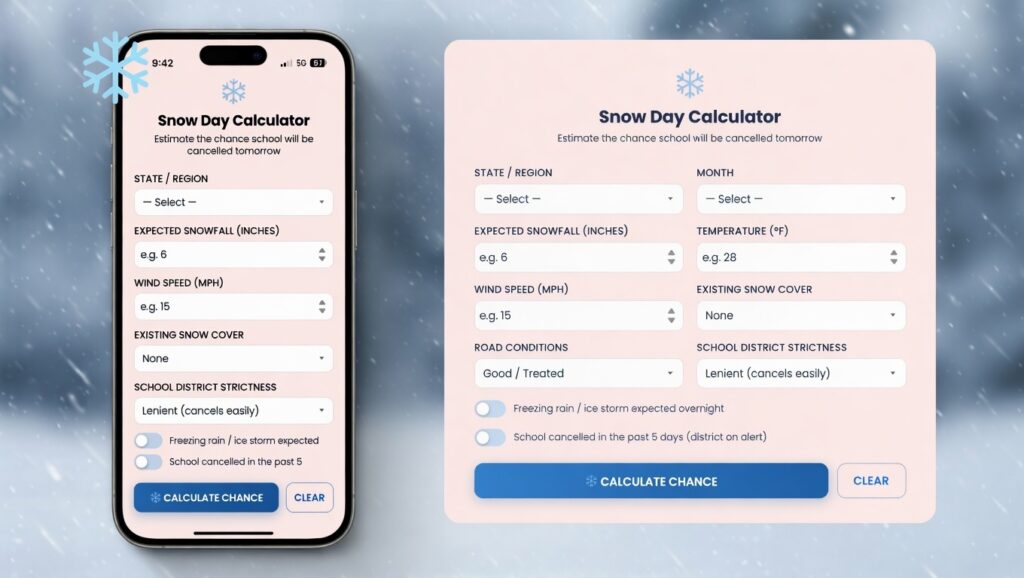
A snow day calculator is an online prediction tool designed to estimate the likelihood that a school or school district will cancel classes due to winter weather conditions. Unlike a standard weather forecast that simply tells you how many inches of snow are expected, a snow day calculator translates raw meteorological data into an actionable probability — usually displayed as a percentage.
For example, a result of “78% chance of a snow day” means there is a high likelihood that schools in your area will close or delay opening tomorrow based on current weather models, historical closure patterns, and local geographic factors.
The tool was originally popularized by the website Snowdaycalculator.com, created in the early 2000s, and has since evolved into a family of tools and apps that millions of users consult every winter season. Today, you can use an advanced Snow Day Calculator to get real-time, location-specific predictions in seconds.
A Brief History of Snow Day Prediction
Before online tools existed, snow day decisions were purely in the hands of local school superintendents, who relied on personal judgment, phone calls from bus drivers, and early-morning news reports from local meteorologists. There was no standardized system — and no way for parents or students to know what was coming until the early hours of the morning.
The first widely-used digital snow day predictor emerged in the early 2000s, when a student created a basic algorithm to calculate the probability of school closings based on snowfall totals and temperature ranges. The concept went viral and spawned a generation of improved, data-driven tools. Today, modern snow day calculators incorporate machine learning, real-time National Weather Service (NWS) feeds, hyperlocal ZIP code data, and historical school closure records to produce predictions with far greater nuance than their early predecessors.
How Does a Snow Day Calculator Actually Work?
At its core, a snow day calculator is a weighted probability algorithm. It collects multiple weather and geographic data points, applies weighted rules to each variable, and outputs a percentage likelihood of school closure.
Here’s a simplified breakdown of the process:
Step 1: Location Input The user enters their ZIP code or city, which allows the tool to pull in localized weather data. This is critical — snowfall predictions vary dramatically even within the same county or metro area.
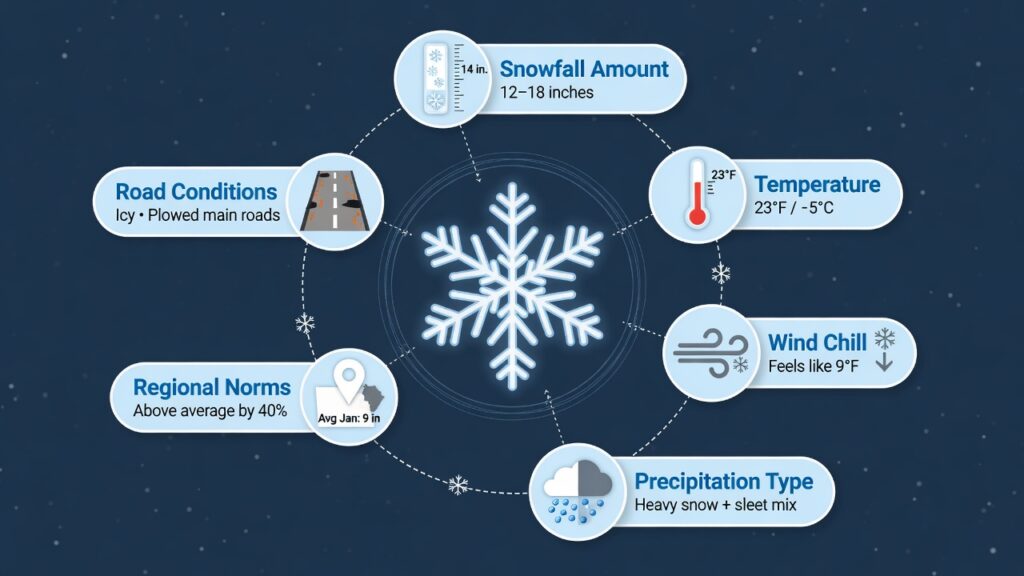
Step 2: Weather Data Retrieval The calculator connects with weather data sources such as the National Weather Service (NWS), NOAA, or private meteorological services to fetch current and forecast conditions. Data points typically include expected snowfall accumulation, precipitation type (snow, sleet, freezing rain), temperature trends, and wind speed.
Step 3: Variable Weighting. Not all weather conditions carry equal weight. A tool might weigh freezing rain more heavily than powdery snow because it creates far more dangerous road conditions. Wind chill factors into bus operation safety. Time of snowfall onset matters — snow that starts at 3 a.m. has very different implications than snow starting at 9 a.m.
Step 4: Regional Adjustment The algorithm accounts for regional norms. A school district in Buffalo, New York, is far less likely to close for 4 inches of snow than a district in Atlanta, Georgia, where the same accumulation would be a crisis. These regional calibrations are baked into the model.
Step 5: Output The final output is a probability percentage — usually colour-coded — that tells users how likely a snow day is. Many tools also include confidence scores and forecaster notes.
What Data Is Used in a Snow Day Prediction?
A high-quality snow day calculator draws on a rich set of meteorological data points and regional variables. Understanding these inputs helps users interpret predictions more intelligently.
Primary Weather Inputs:
- Expected snowfall accumulation (inches)
- Precipitation type (snow, sleet, freezing rain, mixed)
- Air temperature and overnight lows
- Wind speed and wind chill index
- Barometric pressure trends
- Visibility conditions
Secondary Regional Factors:
- Geographic terrain (hills, valleys, elevation)
- Urban vs. rural school district classification
- Historical average snowfall for the region
- State-specific school closure thresholds
- Local road treatment capacity (salt trucks, plows)
- Proximity to bodies of water (lake-effect snow zones)
School-Specific Variables:
- School district size and bus transportation dependency
- Number of students who walk to school
- Previous school closure history in similar weather events
According to the National Weather Service, winter precipitation prediction has become significantly more accurate within the 24-hour forecast window, which is exactly the timeframe most snow day calculators operate within. You can explore their forecast methodology at weather.gov, the official U.S. government weather resource that feeds many of these prediction engines.
Who Should Use a Snow Day Calculator?
The short answer? Almost anyone is affected by winter school closures. But let’s get specific.
5.1 Parents and Guardians
Parents are, by far, the most frequent users of snow day prediction tools — and for good reason. A surprise school cancellation on a Tuesday morning can throw an entire workweek into chaos. Knowing the night before that there’s a 75% chance of school closure gives parents time to:
- Arrange backup childcare with a relative, neighbour, or babysitter
- Notify their employer or reschedule early meetings
- Stock up on food, snacks, and activities for an at-home day
- Coordinate logistics with co-parents or partners
For working parents with non-flexible jobs — healthcare workers, retail employees, tradespeople — early warning is not a convenience, it’s a necessity. A snow day calculator provides that critical advance notice window.
5.2 Students of All Ages
Students — from elementary schoolers to college undergraduates — are the most emotionally invested users of any snow day tool. For younger kids, checking the snow day probability before bed is part of the winter ritual. But beyond excitement, it also helps older students:
- Decide whether to complete assignments due the next day
- Plan study sessions around potential class cancellations
- Avoid making plans that conflict with possible makeup days later
For college students, where campus closure decisions differ from K-12 schools, snow day calculators that include university-specific settings are especially valuable.
5.3 Teachers and School Staff
Teachers are uniquely positioned in the snow day ecosystem — they must plan lessons, but they also need to prepare for last-minute cancellations. Using a snow day predictor helps educators:
- Avoid assigning major tests or presentations the day after a high-probability snow day
- Prepare contingency plans for digital or virtual instruction
- Manage their own commute decisions, especially those who travel long distances
Support staff — custodians, food service workers, bus drivers, and administrative personnel — also benefit from early predictions, as their roles often require on-site presence and advance scheduling.
5.4 School Administrators and Superintendents
While the final closure call rests with district leadership, many administrators monitor snow day calculators as one input in their broader decision-making process. Understanding the public probability helps them:
- Anticipate parent communication volume before it happens
- Prepare automated alerts and school closure announcements
- Align their decision with community expectations
- Avoid being caught off-guard by the weather that tools have already predicted
Though snow day calculators are not official school district tools, they operate on much of the same data that administrators rely on — NWS feeds, road condition reports, and temperature forecasts.
5.5 Working Professionals and Remote Workers
Even adults without school-age children have a stake in snow day predictions. Roads that are bad enough to close schools are often bad enough to affect:
- Office commute safety decisions
- Package delivery and logistics planning
- Event organizers and venue managers
- Retailers are anticipating reduced foot traffic
- Remote workers preparing for power outages or internet disruptions
A snow day calculator’s underlying weather data is robust enough to serve as a general-purpose winter risk indicator for any adult making weather-dependent decisions.

Snow Day Calculator vs. Standard Weather Apps – What’s the Difference?
Many people wonder: Why not just use the Weather Channel app or Google Weather? It’s a fair question, and the answer comes down to the specificity of purpose.
| Feature | Standard Weather App | Snow Day Calculator |
| Snowfall forecast | ✅ Yes | ✅ Yes |
| Temperature & wind | ✅ Yes | ✅ Yes |
| School closure probability | ❌ No | ✅ Yes |
| ZIP-code-level school history | ❌ No | ✅ Yes |
| Regional norm calibration | ❌ No | ✅ Yes |
| Output in % likelihood | ❌ No | ✅ Yes |
Standard weather apps are built to serve everyone — commuters, travelers, farmers, and outdoor enthusiasts. A snow day calculator is purpose-built for one audience and one question: Will school be cancelled? That focus makes it dramatically more useful for parents and students than any general-purpose weather tool.
How Reliable Are Snow Day Prediction Tools?
Snow day calculators are not infallible, but within the 12–24 hour prediction window, they are remarkably accurate for most regions of the United States.
Their reliability depends on:
- Quality of weather data feeds – Tools connected to NOAA and NWS data tend to outperform those using third-party aggregators
- Regional calibration – Tools tuned for specific states or climates perform better locally
- Lead time – Predictions made 12 hours before are more accurate than those made 48 hours before
- Superintendent variability – The final call is always a human decision, and individual administrator habits introduce some unpredictability that no algorithm can fully model
Most reputable snow day calculators are transparent about their confidence ranges and encourage users to treat predictions as probabilistic guidance, not guarantees.
Tips for Getting the Most Accurate Snow Day Prediction
To maximize the accuracy of your prediction, follow these best practices:
- Enter your exact ZIP code — don’t use a city name; hyperlocal data matters.
- Check the night before — the 8–12 hour window produces the most accurate results.
- Update your grade level — K-12 districts have different thresholds than colleges.
- Monitor multiple updates — weather systems shift quickly; check again before bed and in the early morning.
- Cross-reference with local news — major local TV stations often have direct lines to school district communication teams.
- Trust the probability range — anything above 70% is a strong signal; anything below 30% is unlikely to result in a closure.
Conclusion
A snow day calculator is far more than a novelty tool for hopeful children. It is a sophisticated, data-driven prediction engine that serves parents, students, educators, administrators, and working professionals by translating complex winter weather data into a simple, actionable probability.
By combining real-time meteorological inputs with regional school closure history and geographic factors, these tools deliver something no standard weather app can: a direct answer to winter’s most searched question.
Whether you’re arranging last-minute childcare, setting your alarm for a potential delay, or simply enjoying the childhood tradition of hoping for a snow day, the Snow Day Calculator is the smartest first stop of every winter storm season.
Use it wisely, check it early, and when that percentage climbs above 80%, you might just want to leave the alarm off.