Summary
Alaska families know that winter is not an occasional inconvenience; it is a season that shapes transportation, school planning, family routines, and public safety. Snow Day Policies in Alaska are not based on a simple “how many inches fell overnight” rule. Districts look at road conditions, visibility, ice, wind chill, bus routes, building safety, local geography, timing of the storm, and whether students can travel safely. In a state where Anchorage, Fairbanks, Juneau, rural villages, coastal towns, and Interior communities all experience winter differently, the question is not only “How much snow is too much?” but “When does weather make school unsafe or unrealistic?”
Table of Content
- How Snow Day Policies in Alaska Are Decided
- Why Snow Day Policies in Alaska Depend on More Than Snowfall
- What Counts as “Too Much Snow” in Alaska?
- The Main Weather Factors Behind Alaska School Closures
- Delayed Starts, Remote Learning, and Emergency Closure Days
- What Parents Should Check Before Sending Kids to School
- Conclusion
- FAQs
Snow Day Policies in Alaska – When Is Too Much Snow Too Much?
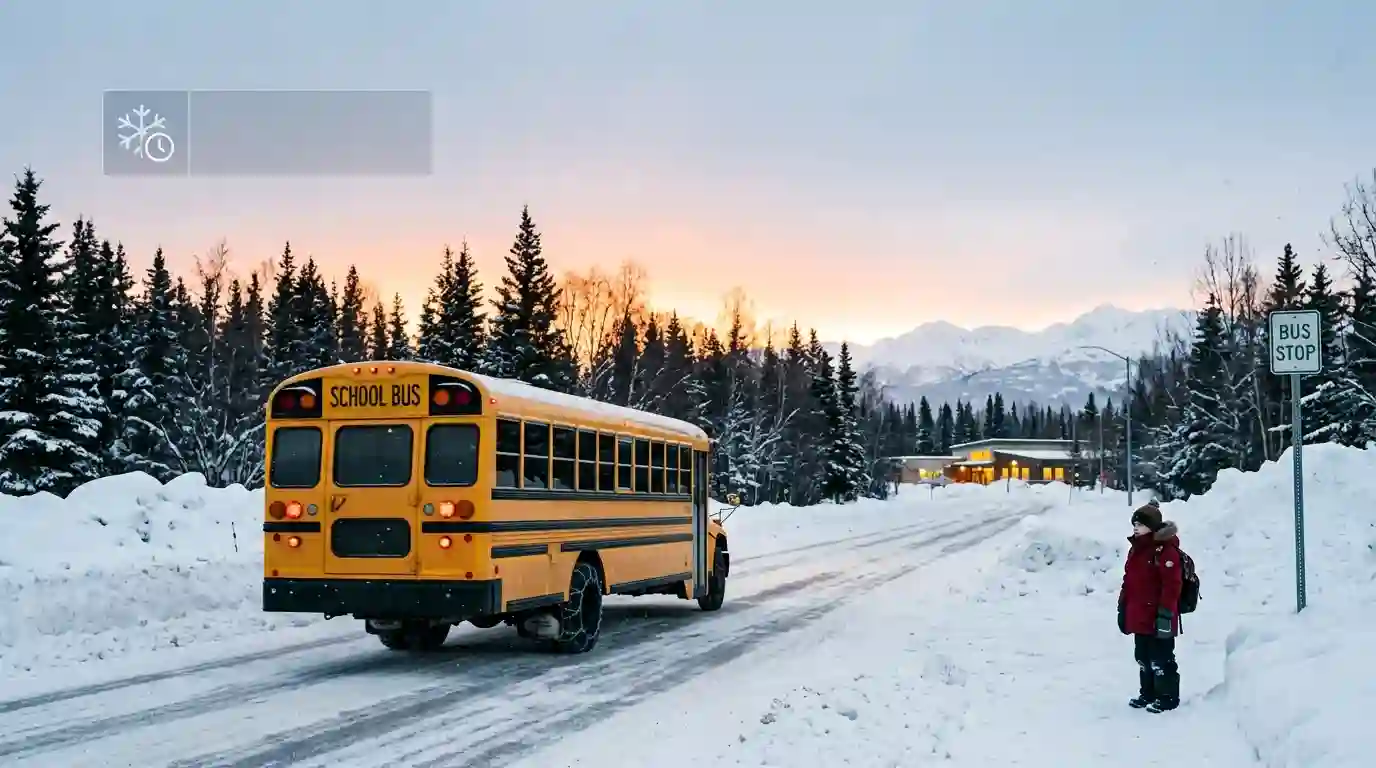
Winter in Alaska is different from winter in most of the United States. In many places, a few inches of snow can close schools, delay buses, and empty office buildings. In Alaska, students may still go to class when snowbanks are already taller than parked cars, temperatures are below zero, and plows are working before sunrise. That does not mean schools ignore dangerous weather. It means the standard for a snow day is shaped by local experience, infrastructure, geography, and safety planning.
Snow day decisions in Alaska are rarely about snow depth alone. A district might stay open after eight inches of light, dry snow if roads are plowed and buses can operate. The same district might close or delay school after less snow if freezing rain creates ice, wind causes whiteout conditions, sidewalks are unsafe, or neighborhood roads remain blocked. For families, the uncertainty can be frustrating. For school leaders, the decision is a balance between student safety, reliable transportation, instructional time, and the reality that many children depend on school for meals, warmth, supervision, and routine.
Alaska’s school closure policies are also highly local. A coastal community may worry more about wet snow, rain-on-snow events, high winds, and power outages. Interior communities may worry about extreme cold, ice fog, and frostbite risk. Urban districts must evaluate hundreds of miles of roads and bus routes. Rural districts may consider snowmachine trails, small airports, limited road networks, and whether staff can reach school buildings.
So, when is too much snow too much? In Alaska, the answer is: when the combined conditions make travel, supervision, or school operations unsafe.
How Snow Day Policies in Alaska Are Decided
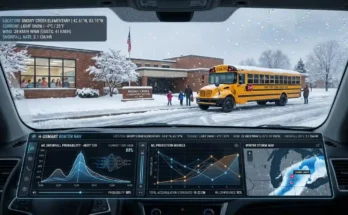
Most Alaska snow day decisions begin before families wake up. District leaders review forecasts, road reports, bus route conditions, building status, and local emergency information. Transportation teams may check roads early in the morning. Superintendents and operations staff may consult with municipal road crews, weather services, bus contractors, principals, maintenance teams, and local public safety officials.
The decision usually falls into one of several categories: school remains open, school opens late, school closes for the day, activities are canceled, or learning shifts to remote instruction where available. A delayed start gives plows more time, allows daylight to improve visibility, and helps buses move after the worst part of a storm. A full closure is more likely when conditions are widespread, road access is poor, buses cannot operate safely, or the storm is expected to worsen during arrival or dismissal.
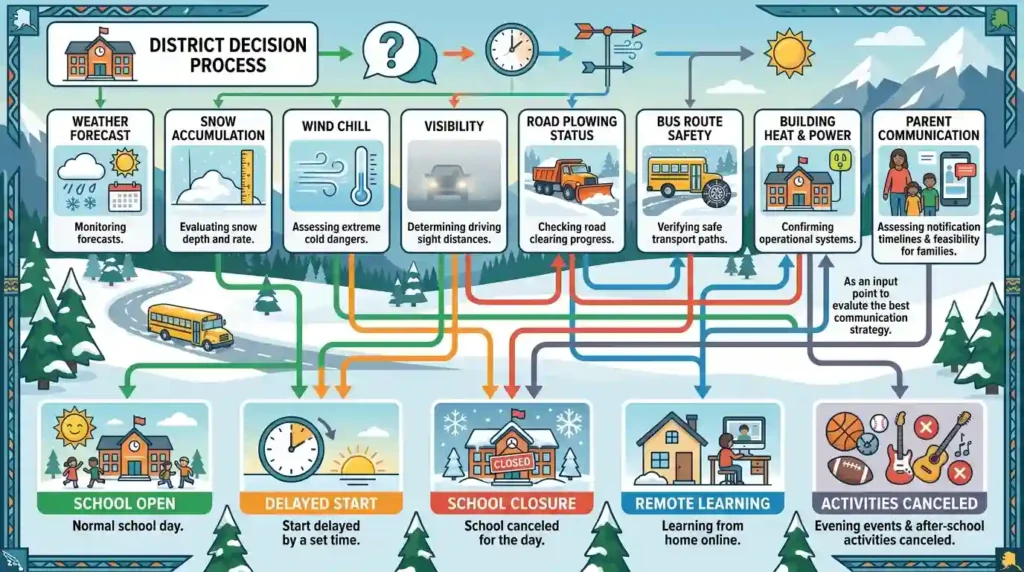
Alaska districts also have to think about communication. Families need enough time to arrange child care, transportation, meals, and work schedules. A decision made too late may leave students already waiting at bus stops in dangerous conditions. A decision made too early may close schools unnecessarily if the storm misses the area or plows clear roads overnight. This is why many districts try to make the call either the night before or very early in the morning.
The most important point is that snow day policies are not designed to reward or punish anyone for winter weather. They are safety policies. A superintendent may decide that schools should remain open because buildings are warm, roads are passable, and buses can run. On another day, the same amount of snow may cause closure because the snow is heavier, roads are icy, wind is blowing, or neighborhoods have not been cleared.
Why Snow Day Policies in Alaska Depend on More Than Snowfall
Snowfall totals matter, but they are only one part of the picture. Five inches of dry powder in Fairbanks may be easier to manage than two inches of freezing rain in Southcentral Alaska. A foot of snow that falls slowly overnight may be plowed before school starts, while a fast-moving morning storm can create chaos during bus pickup.
Alaska school districts often judge winter weather through a risk matrix rather than a single number. They look at whether buses can safely turn around, whether school parking lots are accessible, whether sidewalks are usable, whether staff can report to buildings, whether visibility is poor, and whether students would be exposed to dangerous wind chill while walking or waiting outside.
This is where families sometimes misunderstand the phrase “snow day.” A snow day is not always caused by snow. It may be caused by ice, blowing snow, extreme wind chill, freezing rain, impassable roads, avalanche risk in certain corridors, power outages, or a combination of hazards. In some places, “cold day” may be a more accurate term than “snow day,” especially when the main concern is frostbite or hypothermia rather than accumulation. Families comparing temperature and wind chill can use a tool like the Cold Day Calculator to better understand how harsh conditions may feel before students leave home.
For official weather language, the National Weather Service provides helpful explanations of winter weather warnings, watches and advisories. These alerts do not automatically close schools, but they help districts understand whether conditions are expected to be inconvenient, hazardous, or life-threatening.
What Counts as “Too Much Snow” in Alaska?
There is no universal Alaska-wide snow amount that automatically closes school. A fixed threshold would not make sense in a state this large and diverse. “Too much snow” depends on the type of snow, the timing of the storm, the location, and the ability of local crews to keep roads and school property safe.
Light, dry snow is usually easier to move. Wet, heavy snow can slow plows, damage trees, weigh down power lines, and create slush that freezes into ruts. Snow falling overnight gives road crews more time to work. Snow falling during the morning commute creates more risk for buses, teen drivers, staff, and parents. Snow combined with wind can reduce visibility even if the actual accumulation is not extreme.
In Anchorage, a school closure may depend heavily on whether main roads, neighborhood roads, and bus routes are passable. Residential streets can be a major issue after large storms because buses need wide turning areas and safe pickup zones. In Fairbanks, extreme cold and ice fog may matter as much as snow depth. In Southeast Alaska, rain-on-snow, steep streets, and icy conditions may turn a modest storm into a serious transportation problem. In rural Alaska, snow conditions may affect not only roads but also small-plane travel, village access, fuel delivery, and staff availability.
A useful way to think about it is this: snow becomes “too much” when the school system cannot safely move students from home to school and back again. That includes walkers, bus riders, students with disabilities, young children waiting outside, high school drivers, staff commuters, and families traveling from remote or poorly plowed areas.
The Main Weather Factors Behind Alaska School Closures
Snow Accumulation and Plowing Capacity
Snow depth matters most when it overwhelms local plowing capacity. A storm that drops several inches may be manageable if crews clear priority roads overnight. A much larger storm may delay bus service, block school parking lots, create berms at driveways, and make sidewalks unusable. Districts also consider whether school lots, entrances, fire lanes, and accessible pathways are ready for students and staff.
Parents can improve their own decision-making by watching accumulation hour by hour rather than relying only on a single forecast. For practical tracking, read this guide to Track Snowfall Accumulation in Real Time before a storm arrives.
Ice, Freezing Rain, and Slush
Ice can be more dangerous than deep snow. Freezing rain creates slick roads, unsafe sidewalks, and difficult braking conditions for buses. Slush can freeze into uneven surfaces that make walking and driving hazardous. Ice also increases the risk of falls near school entrances, parking lots, and bus stops. Even if snow totals are low, ice may push a district toward delay or closure.
Visibility and Whiteout Conditions
Blowing snow can create whiteout conditions where drivers cannot see road edges, intersections, pedestrians, or stopped vehicles. Rural roads and open areas are especially vulnerable when wind moves snow across the roadway. For school buses, visibility is critical because drivers must stop frequently, watch for children, and navigate tight neighborhood routes.
Wind Chill and Extreme Cold
Alaska districts do not always close school simply because it is cold. In many communities, winter temperatures far below freezing are normal. However, wind chill changes the safety equation. Students waiting outside without proper gear may face frostbite risk. Very young children, students with medical needs, and families without reliable winter clothing may be especially vulnerable. Districts may also consider whether buses are running on time; a delayed bus during extreme cold can quickly become a safety issue.
Road Conditions and Bus Route Safety
Bus safety is one of the biggest factors in Alaska school closure decisions. A school building may be warm and ready, but if buses cannot safely reach students, the district may delay or close. Decision-makers look at hills, intersections, rural roads, turnaround points, snow berms, and whether emergency vehicles can move through neighborhoods.
Building Operations and Power
A winter storm can affect school buildings even when roads are passable. Heating problems, frozen pipes, roof loads, power outages, blocked exits, and unsafe parking lots may close one school or several schools. Maintenance crews are part of the decision-making process because a building must be safe before students arrive.
Regional Differences: Anchorage, Fairbanks, Juneau, and Rural Alaska
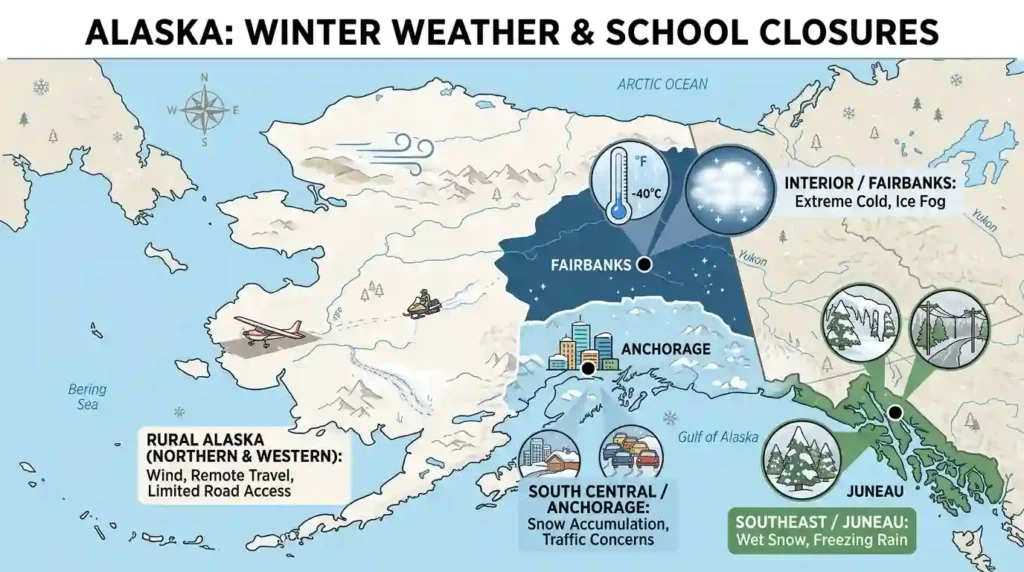
Anchorage and Southcentral Alaska
Anchorage often faces a complicated mix of snow accumulation, commuter traffic, plowing schedules, and neighborhood road conditions. A major storm can create safe main roads but unsafe side streets. Since many students depend on buses, the district must consider whether buses can reach pickup locations and return students home safely. Southcentral Alaska can also experience freeze-thaw cycles, rain-on-snow, and heavy wet snow, all of which complicate transportation.
Fairbanks and Interior Alaska
Fairbanks is known for intense cold. Snow is part of winter life, but the bigger issue may be the combination of temperature, road conditions, and ice fog. Interior Alaska communities are often prepared for cold, but that does not remove the risk of frostbite or dangerous travel. A district may remain open during very cold weather if buildings are safe and roads are manageable, while still advising parents to use personal judgment based on their child’s route and winter gear.
Juneau and Southeast Alaska
Southeast Alaska has a different winter profile. Wet snow, rain, ice, steep roads, and coastal storms can make travel difficult. Heavy, moisture-rich snow can bring down branches or power lines. Conditions can shift quickly from snow to rain to freezing surfaces. Because terrain and road layout matter so much, a smaller snowfall can create bigger hazards than families might expect.
Rural and Remote Alaska
In rural Alaska, snow day policies may look very different from urban district policies. Some communities have limited roads, while others rely on walking routes, snowmachines, boats, or small aircraft for access. Weather may affect staff travel, supply deliveries, internet reliability, and emergency response. A school closure decision in a village may involve local knowledge that cannot be captured by a statewide rule.
Delayed Starts, Remote Learning, and Emergency Closure Days
A delayed start is often the middle ground between staying open and canceling school. It allows more time for snow removal, improves visibility after sunrise, and gives families extra time to travel. Delayed starts may be especially helpful when the worst weather happens overnight but conditions are expected to improve by midmorning.
Remote learning has also changed how some districts think about snow days. In certain situations, a district may close buildings but continue instruction online. This can preserve learning time, but it is not always simple in Alaska. Internet access, device availability, power reliability, age of students, and household conditions all matter. A remote learning day may work well in one community and poorly in another.
Emergency closure days are part of school calendar planning. Districts must meet state instructional requirements, and too many closures may require makeup days, calendar adjustments, or waiver procedures. This is one reason districts do not close schools lightly. Every closure has an educational impact, a family impact, and an operational cost.
Still, safety comes first. If buses cannot run, buildings are unsafe, or weather threatens student health, closing school is the responsible choice.
What Parents Should Check Before Sending Kids to School
Parents should always combine district announcements with their own local judgment. Conditions can vary widely across a school district. One neighborhood may be plowed while another remains blocked. One bus stop may be sheltered while another is exposed to wind. A family living near school may have a different risk level than a family driving across town.
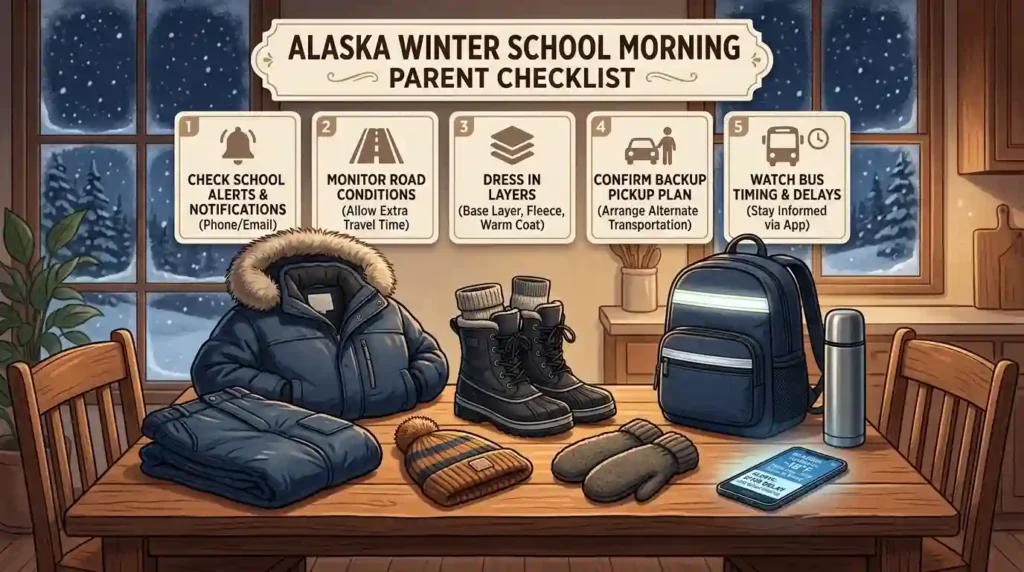
Before sending a child to school during severe winter weather, parents should check the district website, text alerts, email notifications, local news, road condition updates, and the latest weather forecast. They should also consider whether the child has proper winter clothing, how long the child may wait outside, whether the walking route is clear, and whether a backup plan exists if school dismisses early.
Essential winter gear includes insulated boots, gloves or mittens, a hat, a warm coat, snow pants for younger children, reflective clothing or lights during dark mornings, and face protection during extreme cold. Families should also teach children what to do if a bus is late, if they miss a ride, or if they feel too cold while waiting.
Parents should remember that district-wide decisions are based on broad conditions. A school may be open, but a parent may still decide that conditions around their home are unsafe. Most districts allow parents to report weather-related absences, though students are typically still responsible for missed work.
Conclusion
Snow days in Alaska are not simple. They are not decided by one snowfall number, one temperature reading, or one weather alert. They are the result of many safety questions: Can buses run? Are roads passable? Are sidewalks safe? Is visibility acceptable? Can students wait outside without dangerous exposure? Are buildings heated and accessible? Can families receive timely communication?
The real answer to “When is too much snow too much?” is that snow becomes too much when it disrupts the safe movement and care of students. In Alaska, that threshold changes by region, storm type, and local readiness. A community used to deep winter may handle conditions that would close schools elsewhere, but even Alaska has limits when snow, ice, wind, cold, and transportation risks combine.
For parents, the best approach is to stay informed, prepare early, monitor district alerts, track live weather conditions, and use personal judgment when local conditions differ from district-wide announcements. For schools, the goal remains the same every winter: protect students while preserving learning whenever it is safe to do so.
FAQs
1. Do Alaska schools close automatically after a certain amount of snow?
No. Most Alaska districts do not use one automatic snowfall number. They consider road conditions, bus safety, visibility, ice, wind chill, plowing progress, and building operations.
2. Why do schools stay open when it is extremely cold in Alaska?
Cold weather is common in many parts of Alaska, especially Interior communities. Schools may remain open if buildings are warm, buses can run, and roads are safe. However, extreme cold combined with wind, delays, ice fog, or unsafe travel can still lead to closures.
3. What is more likely to close schools: snow or ice?
Ice is often more dangerous than snow. Freezing rain, black ice, and frozen slush can make roads and sidewalks hazardous even when snow totals are low.
4. Who decides whether schools close in Alaska?
The decision is usually made by the superintendent or district leadership after consulting transportation teams, road crews, weather information, maintenance staff, and local safety officials.
5. Are delayed starts common during Alaska winter storms?
Yes, delayed starts can be used when conditions are expected to improve after plows work, daylight increases, or the worst part of a storm passes.
6. Can parents keep children home even if school is open?
Yes, parents should use personal judgment when local conditions are unsafe. Families usually need to notify the school and follow attendance procedures.
7. Do remote learning days replace snow days in Alaska?
Sometimes, but not always. Remote learning depends on district policy, internet access, power reliability, student age, and whether families can realistically participate from home.
8. Why are snow day policies different across Alaska?
Alaska has major regional differences. Anchorage, Fairbanks, Juneau, coastal towns, and rural villages face different combinations of snow, ice, wind, cold, road access, and transportation challenges.
9. What should students wear during extreme Alaska winter weather?
Students should wear insulated boots, gloves or mittens, hats, warm coats, layers, and face protection when needed. Younger children may also need snow pants and backup dry clothing.
10. How can families prepare for possible school closures?
Families should sign up for district alerts, monitor weather updates, plan backup child care, prepare winter clothing the night before, check road conditions, and create a plan for delayed buses or early dismissal.