Summary
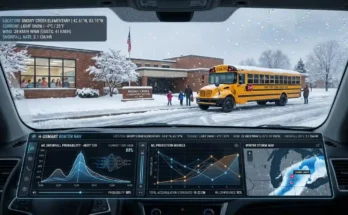
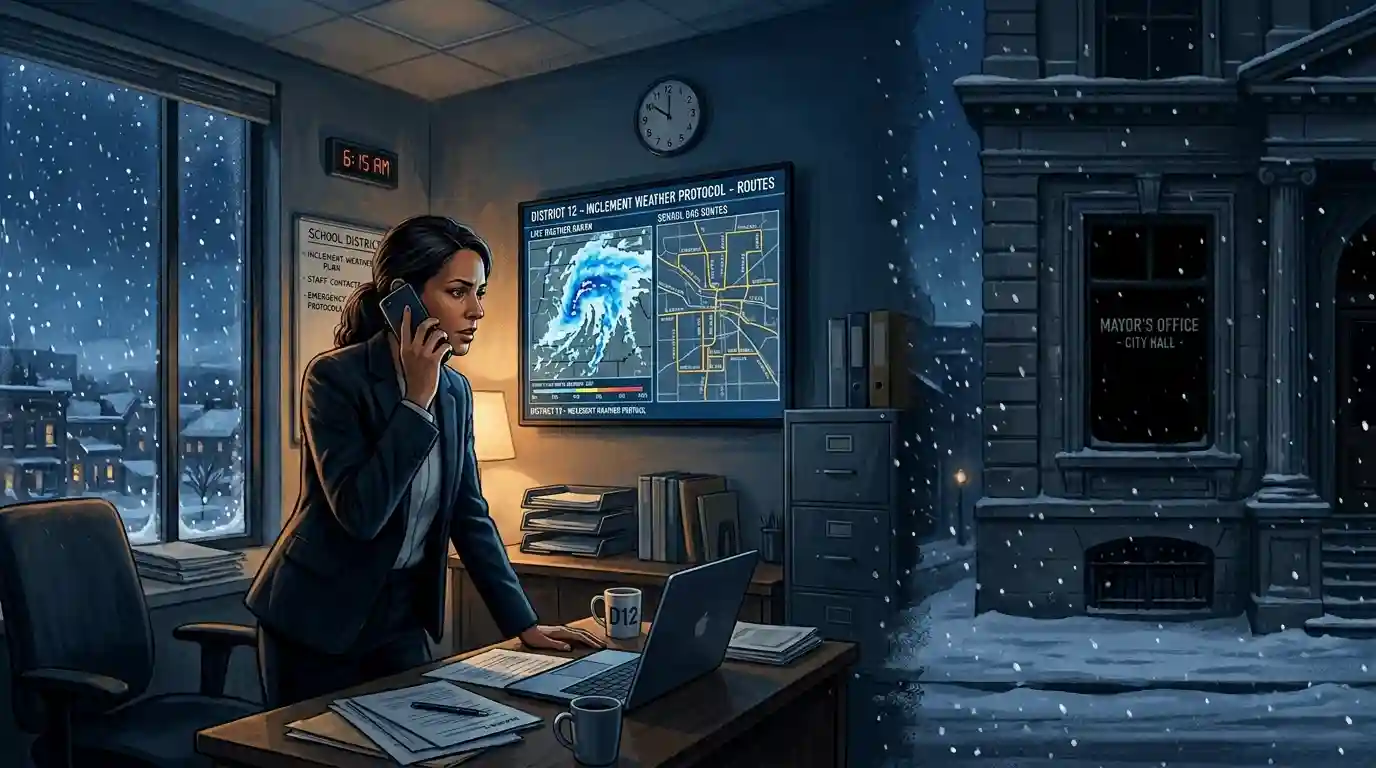
When the forecast turns white and parents start refreshing their phones at 5 a.m., most people assume city hall makes the call. They don’t. Superintendents not mayors decide snow days, and that single fact surprises a lot of parents, students, and even local reporters every winter. School closure authority sits with the district superintendent because they’re the ones legally responsible for student transportation, building safety, and staff logistics — not the mayor’s office, which has no jurisdiction over school operations. This article breaks down exactly why that authority structure exists, how the decision-making process actually works behind the scenes, what factors superintendents weigh before sending out that early-morning robocall, and why this division of power makes more sense than it first appears.
Table of Contents
- Introduction: The Snow Day Confusion
- Why Superintendents Decide Snow Days While Mayors Stay Out of It
- The Legal and Administrative Foundation of School Closure Authority
- How Superintendents Actually Make the Call
- The Role of Transportation Directors and Road Conditions
- Why Mayors Don’t (and Shouldn’t) Control School Closures
- Regional Differences: How Snow Day Decisions Vary by State
- The Communication Chain: From Forecast to Final Announcement
- Common Myths About Who Closes Schools
- Tools That Help Predict Closures Before the Announcement
- Conclusion
- FAQs
Introduction: The Snow Day Confusion
Every winter, the same scene plays out in households across the snow belt. A storm is forecast, group chats light up, and someone inevitably asks, “Did the mayor cancel school yet?” It’s a reasonable question on the surface — mayors run cities, cities have roads, roads get snowy. But the assumption is wrong, and understanding why reveals a lot about how American local governance actually works.
The truth is simpler than people expect: school districts are independent governmental entities, separate from municipal government, and their leadership — the superintendent — holds sole authority over whether schools open, delay, or close. Mayors can declare states of emergency, close municipal offices, or advise residents to stay off roads, but they cannot legally force a school district to cancel classes. This article unpacks the full picture, from legal structure to the meteorological and logistical factors that go into a single 4:30 a.m. phone call.
Why Superintendents Decide Snow Days While Mayors Stay Out of It
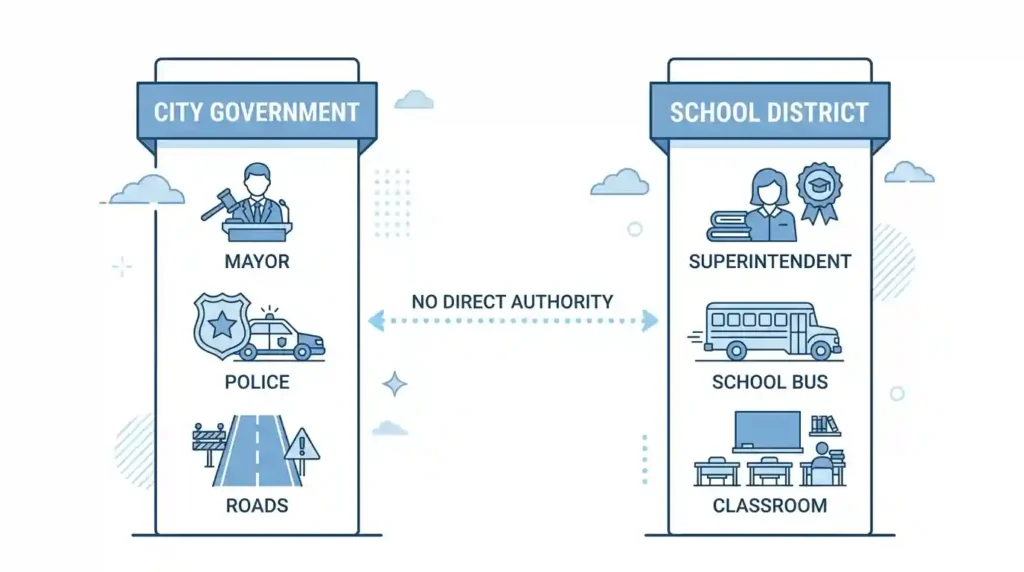
The core reason superintendents not mayors decide snow days comes down to governmental structure. In the United States, public school districts are typically organized as independent special-purpose governments or quasi-independent entities under state education codes. They have their own elected or appointed school boards, their own budgets, their own transportation fleets, and their own chains of command — separate from city or county government.
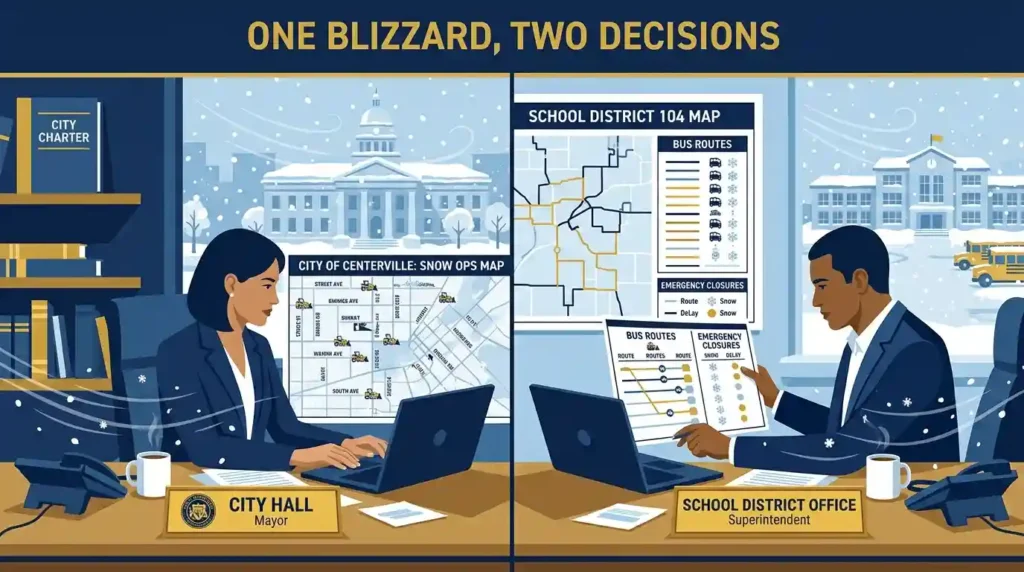
A mayor governs a municipality: police, fire, sanitation, municipal roads, and city offices. A superintendent governs an educational agency: curriculum, staffing, school buildings, bus routes, and student safety. These are two parallel governmental tracks that rarely overlap in jurisdiction, even though they serve overlapping populations.
This separation isn’t accidental. It exists to keep education policy insulated from short-term political pressures and to ensure that decisions about children’s safety are made by people with direct operational knowledge — bus routes, sidewalk conditions near schools, building heating systems — rather than by officials managing a much broader and different set of responsibilities.
Educational Autonomy as a Governance Principle
Most U.S. states grant local school boards and their superintendents broad autonomy over day-to-day operations, including the authority to close schools due to weather, utility failures, or other emergencies. This autonomy is rooted in the idea that those closest to the operational realities — bus garages, school nurses, facilities managers — are best positioned to judge when conditions are unsafe.
The Legal and Administrative Foundation of School Closure Authority
Each state’s education code typically designates the superintendent — or in smaller districts, sometimes a designated administrator — as the final decision-maker on emergency closures. This authority is usually written directly into state statutes governing local education agencies (LEAs).
For example, many state education departments require districts to report closures to the state but do not require state or municipal approval before a closure decision is made. The decision rests entirely with the local education agency, reflecting the principle of local control that’s deeply embedded in American public education policy.
This legal foundation matters because it removes ambiguity. If a mayor attempted to override a superintendent’s closure decision, they would be acting outside their legal authority. Conversely, if a superintendent ignored hazardous road conditions a mayor’s office had flagged, the district — not the city — would bear liability for any resulting harm to students.
Liability and Duty of Care
Superintendents carry a legal “duty of care” toward students. This is a foundational concept in education law: schools are responsible for student safety while children are in their custody, which includes the bus ride to and from school. A municipal mayor has no equivalent duty of care toward a specific district’s students, which is another reason the authority doesn’t — and legally can’t — sit with city hall.
How Superintendents Actually Make the Call
Contrary to popular belief, the decision to close school isn’t made by glancing out a window. It’s a structured, multi-step process that often begins well before sunrise — sometimes the night before, when overnight forecasts are firming up.
Step 1: Monitoring the Forecast
Superintendents and their emergency management teams track forecasts from the National Weather Service, along with private meteorology services some larger districts subscribe to. They’re not just watching snowfall totals — wind chill, ice accumulation, and timing relative to morning bus routes all factor in.
Step 2: Road and Sidewalk Assessments
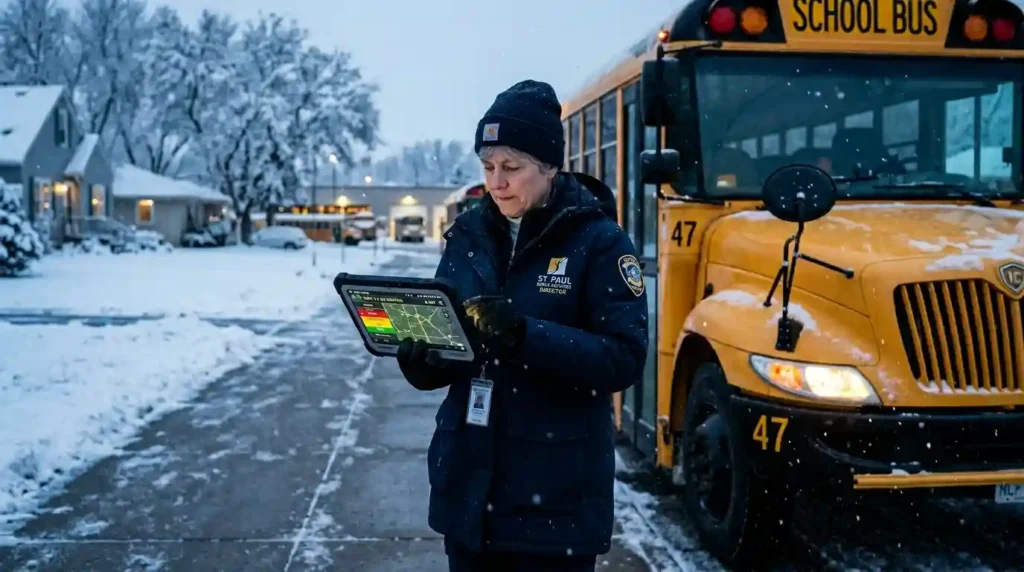
Transportation directors, often starting as early as 4:00 a.m., physically drive sample bus routes to assess road conditions, visibility, and ice buildup, especially on rural roads and hills that don’t get plowed as quickly as main arteries.
Step 3: Consultation with Facilities and Public Works
Superintendents frequently coordinate informally with county or municipal public works departments — not because those departments have authority over the decision, but because road-clearing status directly informs whether buses can run safely.
Step 4: The Final Call
Once data is gathered, the superintendent (sometimes in consultation with the school board or an emergency operations team) makes the final call — full closure, delayed start, early dismissal, or remote learning day. This decision is then pushed out through automated calling systems, district websites, social media, and local news partnerships.
The Role of Transportation Directors and Road Conditions
While the superintendent makes the final decision, transportation directors are arguably the most influential voice in the room. Their on-the-ground assessment of actual road conditions — not just forecasted snowfall — often determines whether a district closes, delays, or operates normally.
Rural districts with long bus routes, gravel roads, and steep grades tend to close more readily than urban districts with shorter routes and better-maintained streets. This is why two neighboring districts can make completely different decisions during the same storm — one might have hilly rural roads prone to ice, while the other serves a compact urban grid that’s easier to plow and salt.
Why Hyperlocal Conditions Matter More Than City-Wide Forecasts
A city-wide forecast might call for “light snow,” but a superintendent overseeing a sprawling rural district knows that even an inch of snow on an unsalted gravel road can be more dangerous than four inches on a well-maintained highway. This is exactly the kind of hyperlocal nuance that a mayor’s office — focused on city-wide municipal services — typically isn’t equipped to evaluate for school bus routes specifically.
Why Mayors Don’t (and Shouldn’t) Control School Closures
It might seem efficient to have a single municipal authority make sweeping decisions during a storm, but there are sound reasons this responsibility stays with superintendents.
Jurisdictional limits: Many school districts span multiple municipalities, counties, or even cross county lines entirely. A mayor governs one city; a superintendent might oversee schools spread across several townships. Giving closure authority to a mayor would create chaos in districts that don’t align neatly with city boundaries.
Operational expertise: Mayors are generalists managing dozens of municipal functions. Superintendents and their transportation teams specialize in exactly the kind of operational detail — bus routes, building heating systems, walking-route sidewalks — that closure decisions require.
Political insulation: Keeping the decision within the education agency helps prevent school closures from becoming politicized municipal decisions, ensuring the call is based on student safety rather than broader city priorities or optics.
According to the National Weather Service, winter storm warnings and advisories are issued based on regional forecasting models, but local agencies — including school districts — are responsible for translating that forecast data into operational decisions specific to their own infrastructure and risk tolerance. This is a key reason the NWS itself doesn’t issue closure mandates; it simply provides the data that superintendents and other local decision-makers use.
The National Weather Service confirms that local NWS forecast offices tailor warnings and advisories to local criteria, and that each office knows the local area and issues warnings, watches, or advisories based on local criteria — meaning even meteorological guidance is calibrated regionally, which is exactly why the operational closure decision has to stay local too, in the hands of the district that owns the buses and buildings in question. National Weather Service
Real district policies bear this out consistently. Frisco ISD’s emergency management documentation notes that decisions regarding closures or delayed openings are made by 5:30 a.m. after hazardous winter weather travel conditions on neighborhood streets and major thoroughfares have been confirmed, and that campus administrators make individualized emergency decisions based on localized NWS warnings, storm cell direction of travel and speed, and weather alerts issued by local jurisdictions — illustrating just how granular and district-specific this process really is. Similarly, Glenview School District 34 states plainly that the Superintendent of Schools determines when and if conditions at one or more of the schools warrant the closing of school buildings.
Regional Differences: How Snow Day Decisions Vary by State
Not every state handles closures identically. Some states require districts to build “snow make-up days” into the academic calendar, while others — particularly after the pandemic normalized remote learning — allow districts to convert snow days into virtual learning days instead of extending the school year.
Northern States vs. Southern States
In northern states like Minnesota, Wisconsin, and Michigan, districts are generally well-equipped for snow — plows, salt trucks, and snow tires are standard — so closures tend to require heavier accumulation or genuinely hazardous ice conditions before a superintendent pulls the trigger. In southern states like Texas, Georgia, or the Carolinas, even an inch of snow or a light ice glaze can shut schools down for days, simply because the infrastructure to clear roads quickly doesn’t exist at the same scale.
Extreme Cold as a Separate Trigger
Snow accumulation isn’t the only weather factor superintendents weigh. Extreme cold — independent of snowfall — is increasingly a standalone reason for closure. As NWS guidance on cold-weather closures explains, snow and ice are common causes for school closures, but extreme cold is another factor that superintendents must consider during the winter season, since dangerous wind chills can be hazardous to children waiting outside for the bus or students traveling by car who may get stranded. Districts often set specific wind-chill thresholds — commonly around -30°F with wind — that automatically trigger closure protocols, similar to an extreme cold warning typically issued when wind-chill reaches -30 degrees Fahrenheit or colder with winds of 10 mph or greater, or when actual temperature drops to -15°F.
This is part of why parents and students trying to anticipate a closure can benefit from checking a Cold day predictor before the official announcement drops — it factors in temperature thresholds and storm timing the same way a superintendent’s team does, just from publicly available data.
The Communication Chain: From Forecast to Final Announcement
Once a superintendent makes the decision, getting that information to thousands of families quickly and reliably is its own logistical operation.
Automated Notification Systems
Most districts use mass notification platforms that simultaneously trigger phone calls, text messages, and emails to every family in the system. As Davenport Community School District outlines, decisions made before the start of the day are typically finalized no later than 5:30 a.m. and communicated through the district messaging system, the district website, social media pages, and major local news outlets.
Coordination with Neighboring Districts
Many superintendents informally coordinate with neighboring districts before finalizing a decision, partly for consistency (especially for families with kids in different districts) and partly to compare road-condition reports across a wider area. Glenview District 34, for instance, notes it works collaboratively with neighboring township districts on closings, seeking consistency to create the least amount of disruption for families with students enrolled across multiple districts.
Local News Partnerships
Television and radio stations remain a major closure-announcement channel, particularly for households that don’t have a child currently enrolled but still want to know whether local schools are closed — a holdover tradition from before automated calling systems existed.

Common Myths About Who Closes Schools
Myth 1: “The Mayor Closes City Schools”
As established, mayors have no legal authority over independent school district operations. They may close municipal buildings, but a public school district operates under its own governance structure.
Myth 2: “It’s Just About Snowfall Totals”
Wind chill, ice accumulation, timing relative to rush hour, and even air quality (some districts, like Sun Prairie, also factor in EPA air quality guidance for outdoor activity) all play into the decision — not just inches of snow.
Myth 3: “Private Schools Follow Public School Closures”
Private and parochial schools often make independent decisions, sometimes staying open when public districts close, or vice versa, since they aren’t bound by the same district transportation infrastructure.
Myth 4: “The Decision Is Made the Night Before”
Most districts wait until the early morning hours — often between 4:30 and 6:00 a.m. — specifically to get the most current road and forecast data, only finalizing the night before when conditions are already unmistakably severe.
Tools That Help Predict Closures Before the Announcement
While only the superintendent makes the official call, families increasingly use predictive tools to estimate the likelihood of a closure before the automated call arrives. These tools typically analyze forecasted snowfall, temperature, wind chill, and historical district closure patterns to generate a probability score.
Interestingly, closure patterns aren’t evenly distributed across the winter months. As explored in the related post February Gets More Snow Days Than December in Most States, late-winter storm systems combined with already-saturated ground and colder average temperatures tend to produce more closures in February than the often-hyped pre-holiday storms of December.
Conclusion
The next time a storm rolls in and the group chats start buzzing with “did the mayor call it yet,” you’ll know the real answer: superintendents not mayors decide snow days, and for good reason. School districts are independent governmental entities with their own legal authority, operational infrastructure, and duty of care toward students — none of which falls under a mayor’s jurisdiction. From pre-dawn road assessments by transportation directors to coordination with the National Weather Service and neighboring districts, the decision-making process is far more rigorous than a simple glance out the window. Understanding this division of authority doesn’t just satisfy curiosity — it explains why closure decisions can differ so dramatically between a city’s municipal offices and the school district serving that same community.
FAQs
Q1: Can a mayor override a superintendent’s decision to keep schools open during a storm?
No. Mayors have no legal jurisdiction over independent school district operations. They can declare a citywide emergency or close municipal buildings, but they cannot legally compel a school district to close.
Q2: Who specifically makes the snow day decision within a school district?
The superintendent holds final authority, typically after consulting transportation directors, facilities staff, and sometimes the school board, along with National Weather Service data.
Q3: Do private schools follow public school district snow day decisions?
Not necessarily. Private and parochial schools often make independent closure decisions since they operate separate transportation and facilities systems.
Q4: What time do superintendents usually announce school closures?
Most districts finalize decisions between 4:30 a.m. and 6:00 a.m., based on overnight forecast updates and early-morning road condition checks, though severe storms may prompt night-before announcements.
Q5: Does extreme cold alone cause school closures, even without snow?
Yes. Many districts have specific wind-chill thresholds — often around -30°F or colder — that trigger automatic closure protocols independent of snowfall.
Q6: Are snow day decisions consistent across neighboring districts?
Often, but not always. Neighboring districts frequently coordinate informally to maintain consistency, but differences in bus routes, road conditions, and rural versus urban geography can lead to different outcomes even within the same storm.