Summary
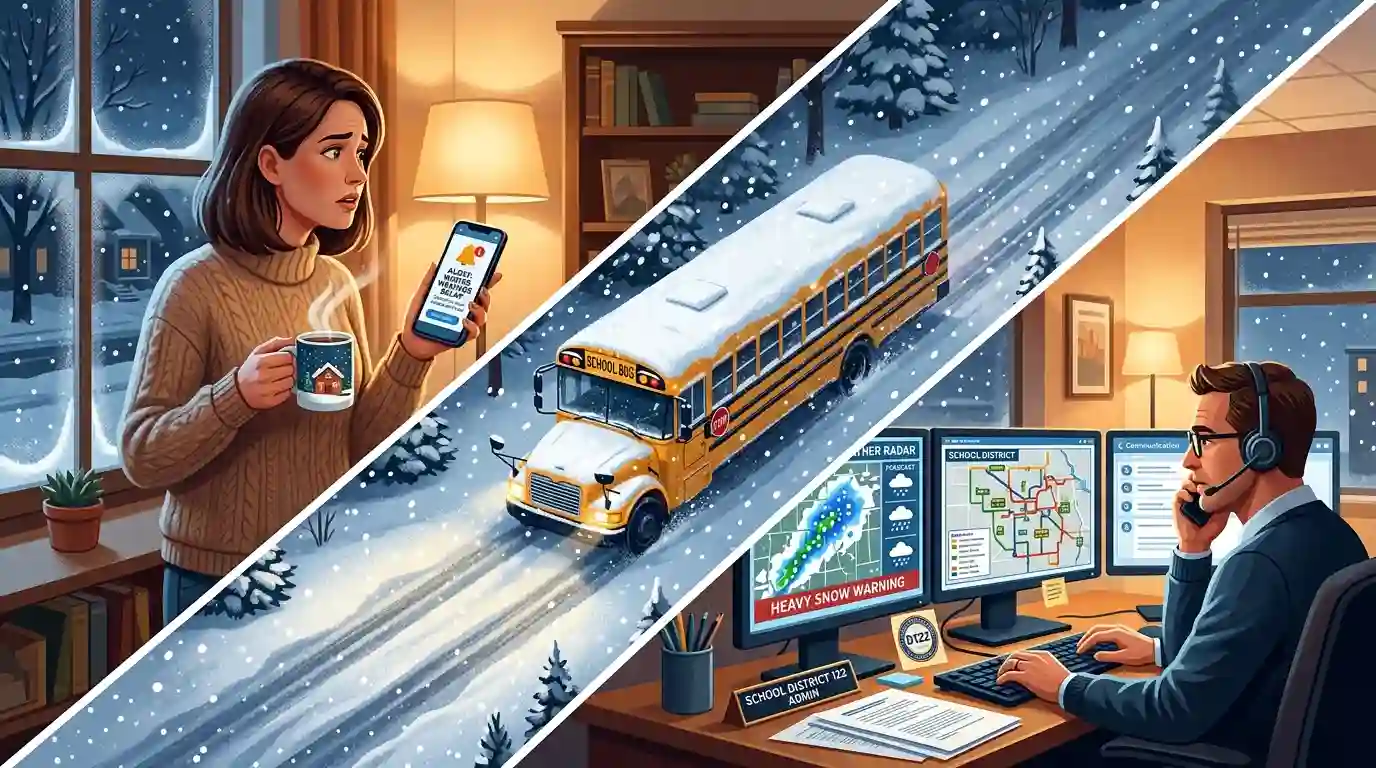
Every winter, the same scene repeats across snowy regions: parents stay up late refreshing district websites while school administrators pore over weather models, road reports, and staffing logs before making a call that will inevitably upset someone. Parents and Schools Disagree on Snow Day Timing more often than most people realize, and the friction isn’t really about whether snow is dangerous. It’s about who bears the consequences of getting the decision wrong. Parents weigh childcare scrambles, missed workdays, and safety from a household-level view, while schools weigh transportation logistics, liability, instructional time, and equity across an entire district. This article unpacks why these two groups so frequently land on opposite sides of the same forecast, what factors actually drive the decision-making process, and how families can plan ahead instead of waiting anxiously for a 5 a.m. announcement.
Table of Contents
- Introduction
- Understanding How Schools Decide on Snow Days
- Why Parents and Schools Disagree on Snow Day Timing
- The Communication Gap Behind the Conflict
- Regional and Cultural Differences in Snow Day Decisions
- How Technology Is Changing the Snow Day Conversation
- Practical Tips for Parents Navigating Snow Day Uncertainty
- Conclusion
- FAQs
Introduction
Snow days sound simple on the surface. It snows, school gets canceled, kids stay home, everyone is happy. In reality, the decision involves a tangle of competing priorities, imperfect information, and institutional caution that most parents never see. When Parents and Schools Disagree on Snow Day Timing, it’s rarely because one side is being unreasonable. It’s because they’re solving different problems with different stakes. A parent juggling a commute and a daycare waitlist experiences a snow day completely differently than a transportation director responsible for the safety of two hundred buses on icy rural roads.
This disagreement has become more visible in recent years as social media amplifies frustration in real time. Parents post screenshots of icy driveways at 6 a.m. demanding to know why school is still in session, while administrators quietly monitor live radar and road crew updates that won’t clear for another hour. Understanding the mechanics behind these decisions, and the structural reasons parents and schools rarely see eye to eye, can reduce a lot of the seasonal stress that builds up every time flakes start falling.
Understanding How Schools Decide on Snow Days
The Role of Superintendents and Transportation Departments
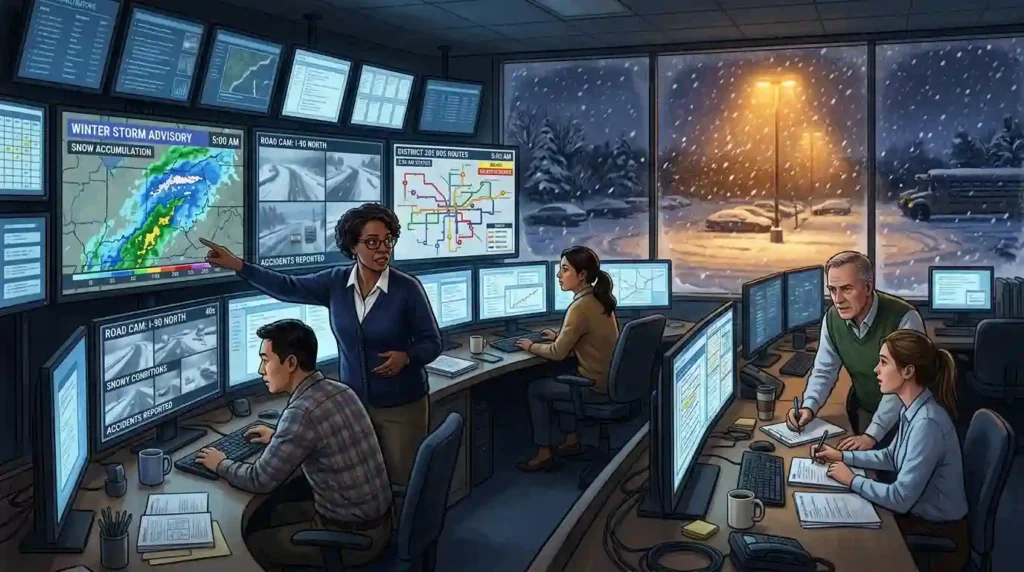
In most U.S. school districts, the final call on a snow day rests with the superintendent, but that decision is rarely made alone. Transportation directors typically drive the actual bus routes before dawn, checking for black ice, unplowed cul-de-sacs, and visibility on rural roads that don’t show up clearly on a typical weather app. Facilities managers assess whether sidewalks and parking lots can be cleared and salted before students arrive. Local law enforcement and county road departments are often consulted directly, since they have real-time information about accidents, closures, and treacherous stretches of highway.
This layered process means that by the time a decision is announced, often between 4:30 and 6 a.m., it reflects input from multiple departments, not a single person glancing out a window. The challenge is that conditions can change quickly between the early-morning assessment and the actual school start time, which is one of the most common sources of frustration for parents who see clear roads by 8 a.m. and wonder why school was canceled hours earlier.
Weather Data, Road Conditions, and Liability Concerns
Schools rely on a combination of National Weather Service forecasts, private meteorological services, and direct road reports. According to the National Weather Service, winter storm warnings are issued when severe winter weather conditions are expected to occur or are occurring, with criteria varying by region. This regional variability is crucial: a forecast that would trigger an automatic closure in Atlanta might be considered a routine weather event in Minneapolis.
Liability also plays a significant, often underdiscussed, role. Districts can face legal exposure if a student or staff member is injured during a commute the district deemed safe enough to require attendance. This legal caution tends to push administrators toward erring on the side of closure when conditions are ambiguous, even if that caution frustrates parents who feel the roads were perfectly fine.
Why Parents and Schools Disagree on Snow Day Timing
The Parent Perspective: Safety, Childcare, and Lost Work Hours
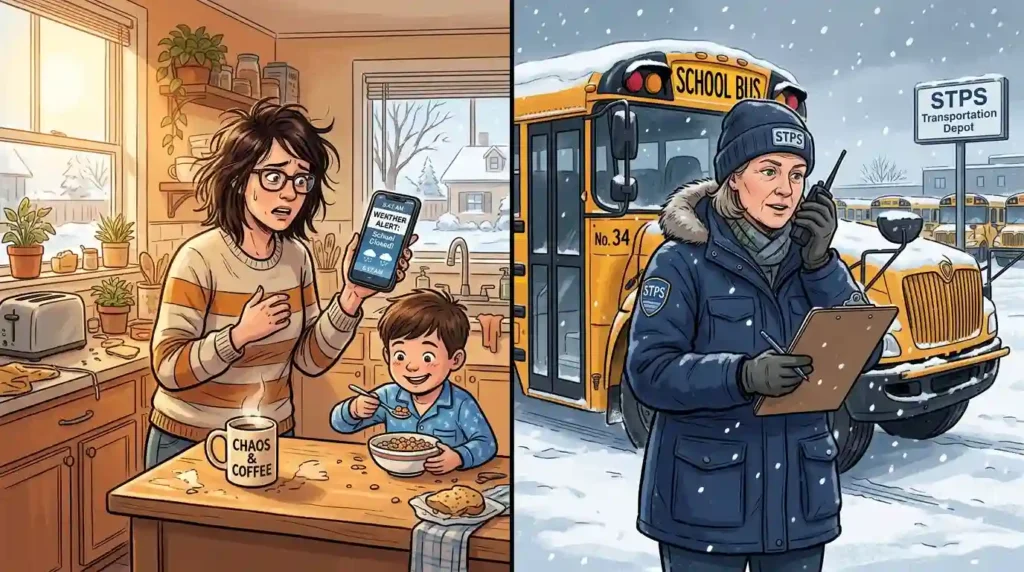
For working parents, a snow day isn’t just a weather event, it’s a logistical emergency. Many households operate on tightly scheduled mornings where both parents work, childcare is prearranged, and there is no backup plan for a sudden day off. When a closure is announced late the night before or, worse, after the morning routine has already started, parents are left scrambling to find emergency childcare, rearrange meetings, or take unpaid time off.
This is where the timing of the decision matters as much as the decision itself. A closure announced at 9 p.m. the night before allows parents to plan. A closure announced at 6 a.m., after some parents have already left for work, creates chaos. Parents understandably feel that schools should weigh the downstream impact on families more heavily, especially in dual-income households or single-parent homes where flexibility is limited.
There’s also a safety dimension that cuts both ways. Some parents feel schools are too cautious, closing for what turns out to be a light dusting. Others feel schools wait too long, sending buses out on roads that are clearly unsafe based on what they can see outside their own window. Because parents are making judgments based on hyper-local, real-time observations, like their own street or driveway, their assessment often diverges sharply from a district-wide decision that has to account for the worst route in the entire system, not the best one.
The School Perspective: Instructional Time and District-Wide Consistency
Schools are bound by state-mandated minimum instructional days, and excessive closures can trigger the need to extend the school year, cut into spring break, or add days in June. This creates institutional pressure to avoid closing unless conditions genuinely warrant it. Administrators are also acutely aware that conditions vary wildly across a district. A neighborhood near the school might have clear roads while a rural route twenty miles away is covered in ice. The decision has to apply to everyone, which means it’s calibrated to the worst-case route, not the average parent’s street.
Equity is another factor parents rarely consider. Families with less reliable transportation, working multiple jobs, or relying on school meal programs are disproportionately affected by closures. For many low-income families, school isn’t just instructional time, it’s a source of breakfast, lunch, and safe daytime supervision. Administrators have to weigh the inconvenience to some families against the genuine hardship a closure can cause for others, which adds a layer of complexity that purely safety-focused parent perspectives often miss.
The Communication Gap Behind the Conflict
Timing of Announcements
One of the most consistent complaints from parents isn’t about the decision itself, but about when it arrives. Districts that announce closures the night before are generally rated more favorably by parents than those that wait until early morning, even when the actual weather conditions are identical. The psychological burden of uncertainty, not knowing whether to set an alarm, pack a lunch, or arrange childcare, creates stress independent of the eventual outcome.
Some districts have adopted a tiered communication approach: an early “weather watch” notice the evening before, followed by a final decision by a set time, often 5:30 or 6 a.m. This doesn’t eliminate the disagreement, but it does reduce the sense of helplessness many parents describe when closures feel arbitrary or last-minute.
Inconsistent Messaging Across Districts
Neighboring districts often make different calls on the same storm, which fuels parent frustration and suspicion that decisions are inconsistent or politically motivated rather than safety-driven. In reality, this inconsistency usually reflects genuine differences in road conditions, terrain, bus fleet capabilities, and even insurance requirements between districts, not arbitrary judgment calls. Still, when a parent sees a neighboring district closed while their own stays open, it reinforces the perception that the system is unpredictable, even when each individual decision was reasonably made.
Regional and Cultural Differences in Snow Day Decisions
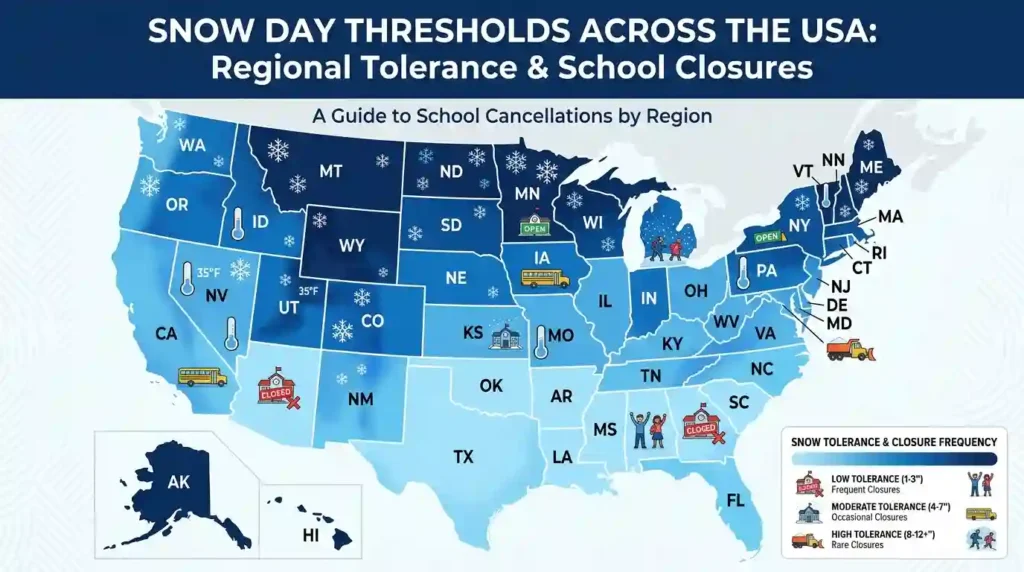
Snow day thresholds vary enormously by region, and this geographic variability is itself a major source of parent-school tension, especially for families who have recently relocated. A half-inch of snow might close schools in coastal North Carolina, where road crews and equipment for snow removal are limited, while the same snowfall would barely register in Vermont or Minnesota, where infrastructure and driver experience are built around winter conditions.
This regional calibration makes sense from a resource perspective, districts in snow-heavy states invest heavily in plows, salt trucks, and driver training, while districts in milder climates simply don’t have the budget or infrastructure to justify that investment for a once-a-year event. But it also means parents who grew up in one climate and now live in another often misjudge what their local district considers “normal,” leading to frustration that feels personal but is actually structural.
How Technology Is Changing the Snow Day Conversation
Predictive tools have started to ease some of the historical uncertainty, even if they can’t fully resolve the underlying disagreement between parents and schools. Apps and websites that aggregate local weather forecasts, historical district closure patterns, and real-time road condition reports give parents a way to anticipate closures before official announcements, rather than waiting anxiously through the evening news.
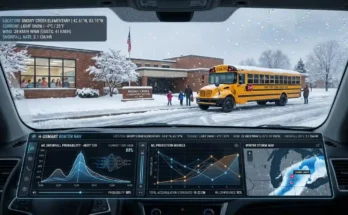
For families who want a head start on planning rather than reacting to a 6 a.m. text alert, tools designed specifically for this purpose can make the waiting game far less stressful. You can Estimate Snow day with Tool to get a probability-based forecast for your specific district, which combines current weather trends with historical closure behavior so you’re not caught off guard. While no tool can override a district’s final decision, having an early estimate allows parents to start contingency planning before the official call comes in, which directly addresses the timing complaint that fuels so much of the parent-school friction.
Practical Tips for Parents Navigating Snow Day Uncertainty
Building a personal system for handling snow day unpredictability reduces stress regardless of what the school district ultimately decides. A few practices consistently help:
Keep a flexible backup childcare contact, whether a neighbor, relative, or local sitter, established before winter weather hits, not during a panicked 6 a.m. scramble. Sign up for every available notification channel your district offers, including text alerts, app push notifications, and local news subscriptions, since districts sometimes use multiple platforms inconsistently. Pack lunches and prepare backpacks the night before during storm watches, so a sudden announcement doesn’t add extra friction to an already disrupted morning. Talk to your employer in advance about remote work flexibility during winter months, since having that conversation proactively is far less stressful than requesting it last-minute.
For a deeper breakdown of how to structure your household routine around unpredictable closures, the Snow Day Survival Guide for Working Parents offers a more detailed framework, including how to negotiate flexible work arrangements and build a rotating childcare network with other families in your school zone.

Conclusion
The recurring tension behind why Parents and Schools Disagree on Snow Day Timing isn’t really a disagreement about whether snow is dangerous. It’s a structural mismatch between household-level decision-making and district-wide responsibility. Parents are reacting to their own street, their own childcare needs, and their own work obligations. Schools are weighing legal liability, the worst route in the district, state-mandated instructional days, and equity across thousands of families with vastly different needs. Neither perspective is wrong, they’re simply optimizing for different variables under the same uncertain forecast.
The good news is that this gap is narrowing as communication practices improve and predictive tools give parents more lead time to plan. Districts that adopt earlier “weather watch” notices, more transparent decision criteria, and consistent multi-channel alerts tend to see less friction from families, even when the actual closure rate doesn’t change much. For parents, the most effective strategy isn’t waiting for districts to change, it’s building personal systems, backup plans, and predictive tools into the winter routine so that whatever the school decides, the household isn’t caught flat-footed.
FAQs
Why do schools sometimes wait until 6 a.m. to announce a snow day?
Districts often wait because road conditions can change significantly overnight, and transportation directors need to physically drive routes in the early morning to assess ice, visibility, and plow progress before making a final call.
Why do neighboring school districts make different snow day decisions during the same storm?
Differences usually come down to road infrastructure, bus fleet capability, terrain, and snow removal resources, which vary even between districts that are geographically close to each other.
Do snow day decisions affect the total number of school days in a year?
Yes, most states require a minimum number of instructional days, so excessive closures can result in extended school years, shortened breaks, or additional days added in June.
Can predictive tools accurately forecast school closures?
Predictive tools use weather data and historical closure patterns to estimate the likelihood of a closure, offering a useful early indicator, though the final decision still rests entirely with the school district.
What can parents do to reduce stress around unpredictable snow day timing?
Establishing backup childcare in advance, enabling all district notification channels, preparing the night before during storm watches, and discussing remote work flexibility with employers ahead of winter all help reduce last-minute scrambling.
Read also, Snow Day Survival Guide for Working Parents Guide.